🏛️ Old Government House Fredericton: The Historic Residence That Helped Shape Canada
🍁 The Rob Brown Realty JournalThursday | Fredericton History
There's a beautiful old house along Woodstock Road in Fredericton that has one of the most unusual résumés of any property in New Brunswick.
It's been a governor's residence.
A place where political decisions helped shape a country.
A school.
A military barracks.
A hospital.
An RCMP headquarters.
And today?
It's a residence again.
Honestly, if houses could write autobiographies, this one would need several volumes. 📚
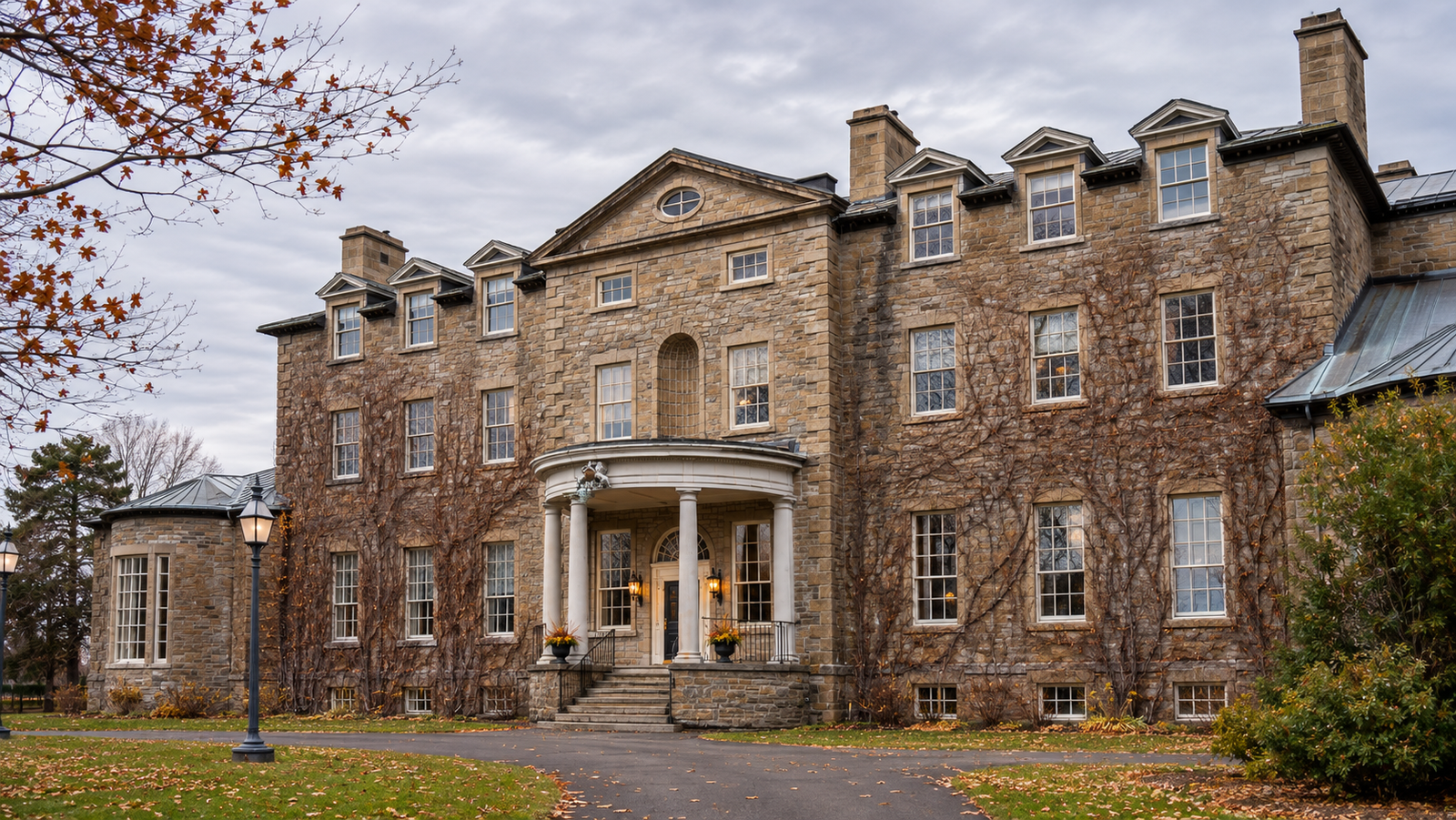
I'm talking about Old Government House, one of Fredericton's most recognizable historic landmarks.
With its stately sandstone exterior, impressive columns and beautiful grounds overlooking the Saint John River, it's easy to admire the architecture.
But the really interesting part?
What happened inside those walls.
Because Old Government House isn't simply a beautiful old building.
It's a place where New Brunswick's history unfolded—and where the meaning of the building itself has changed dramatically over nearly 200 years.
Fredericton was a much smaller community.
New Brunswick was still a British colony.
And Lieutenant-Governor Sir Howard Douglas wanted a residence that reflected the importance of the colonial government.
The previous governor's residence, built in 1787, had been destroyed by fire in 1825.
So a new home was commissioned.
Architect John Elliott Woolford designed an impressive Palladian-style residence, with construction taking place between 1826 and 1828.
And this wasn't your typical family home.
The building was constructed using New Brunswick sandstone.
It featured a symmetrical design, elegant architectural details and a grand entrance.
All situated on approximately 11 acres along the river.
Even by today's standards, that's a pretty remarkable property.
But the design wasn't simply about comfort.
It was about authority.
In the early nineteenth century, government buildings were often designed to communicate power, permanence and stability.
And Old Government House certainly made a statement.
Imagine arriving by carriage in the 1830s, approaching that grand entrance for an official reception.
You'd probably have the same reaction many visitors have today.
"Well, this is quite a place."
The history of this property didn't begin in 1826.
The land along the Wolastoq has a much deeper history connected to the Wolastoqiyik, whose relationship with the river and surrounding territory extends back thousands of years.
The area was also associated with the early Acadian settlement of Sainte-Anne, established long before Fredericton became New Brunswick's capital.
That matters.
Because when we talk about preserving historic places, we sometimes focus so much on the buildings that we forget the histories of the land beneath them.
Old Government House represents an important chapter in New Brunswick's colonial history.
But it's only one chapter.
A property's story doesn't necessarily begin when someone builds a house on it.
And that's worth remembering whenever we look at the historic places around Fredericton.
On April 7, 1866, Old Government House became the setting for a political confrontation that helped change the future of Canada.
At the time, New Brunswick was deeply divided over Confederation.
Should the province join with others to create a new country?
Or should it remain separate?
Not everyone was convinced that Confederation was a good idea.
And the debate was anything but polite background conversation.
Premier Albert J. Smith led a government opposed to Confederation.
Lieutenant-Governor Sir Arthur Hamilton Gordon, meanwhile, supported the movement toward union.
The two men clashed over the province's political direction.
And on that April day in 1866, their confrontation at Government House became a turning point.
The political crisis led to the dissolution of the legislature and a provincial election.
A pro-Confederation government led by Samuel Leonard Tilley emerged.
And New Brunswick went on to become one of the four original provinces of Canada on July 1, 1867.
Think about that for a moment.
A major turning point in the creation of Canada unfolded inside a house right here in Fredericton.
Not in Ottawa.
Not in Toronto.
Not somewhere across the Atlantic.
Right here.
On Woodstock Road.
That's pretty remarkable.
And it makes you wonder how many people drive past the building every day without realizing the significance of what happened there.
For much of the nineteenth century, it was also a centre of Fredericton's social life.
Official dinners.
Receptions.
Balls.
Ceremonies.
Visits from dignitaries.
The kind of events where everyone probably had to dress considerably better than we do for a modern Saturday barbecue.
And I suspect showing up in jeans would not have gone over particularly well. 😄
The building served as both a private residence and a public stage.
Governors and lieutenant-governors lived there.
Important guests were entertained there.
And decisions affecting the province were discussed within its rooms.
That's something we sometimes forget about historic residences.
They weren't simply places where people slept and ate.
They were also places where relationships were built, influence was exercised and public life took shape.
In that sense, Old Government House was much more than a home.
It was one of the most important gathering places in colonial New Brunswick.
By the late nineteenth century, maintaining such a large official residence had become increasingly difficult to justify.
The building was expensive to operate.
Its role had changed.
And by the 1890s, it was no longer being used as the lieutenant-governor's residence.
Now imagine owning a grand sandstone mansion with enormous rooms, formal entertaining spaces and extensive grounds.
Then suddenly realizing you don't have a practical use for it.
That's a challenge.
And it's one that historic buildings continue to face today.
What happens when a building's original purpose disappears?
Do you preserve it exactly as it was?
Find something new for it to do?
Or allow it to deteriorate because maintaining it has become too expensive?
Old Government House would spend much of the next century answering those questions.
Sometimes in ways its original architect probably never imagined.
Just think about that transformation.
Rooms once used for formal receptions and political gatherings were repurposed for education.
The people moving through the building were no longer primarily governors, officials and invited guests.
They were students and staff.
The purpose of the property had changed completely.
And while the architecture remained, the daily life inside the building was very different.
It's an important reminder that historic places don't always have one continuous identity.
Sometimes they take on entirely new roles as community needs change.
Old Government House was used as military barracks.
After the war, it also served as a hospital for returning soldiers.
Consider the contrast.
A building designed for elegant dinners and official ceremonies was now connected to the realities of military service, injury and recovery.
The rooms that once represented colonial prestige were being used for something much more immediate.
Caring for people.
Supporting military operations.
Responding to the needs of a country affected by war.
And given that Remembrance Day was just last week, this part of the building's history feels especially meaningful.
It's another connection between Fredericton's physical landmarks and the experiences of people who lived through major historical events.
Sometimes a building's greatest value isn't in how it was designed, but in how it was needed.
From 1934 until 1988, Old Government House served as headquarters for the RCMP's J Division in New Brunswick.
That's more than five decades.
For generations of Fredericton residents, the building wasn't primarily remembered as a governor's mansion.
It was associated with the RCMP.
Offices.
Administrative work.
Police operations.
And the daily routines of a provincial headquarters.
Imagine walking into one of those grand historic rooms and finding desks, filing cabinets and office equipment.
Not exactly the setting Woolford had in mind when he designed the place.
But once again, the building had found a practical purpose.
And in some ways, that continued use helped keep it part of Fredericton's working landscape.
The building wasn't simply a relic of the past.
It was still being used.
Even if that use looked nothing like its original role.
And the building needed significant attention.
Restoring a historic property of this size is no small undertaking.
Especially one with original architectural details, important heritage features and nearly two centuries of history.
But the decision was made to bring the building back to its original ceremonial role.
A major restoration project took place during the 1990s.
And on July 1, 1999, Old Government House officially reopened.
The date was fitting.
Canada Day.
A building connected to the Confederation story.
And a new chapter in its long history.
The restoration returned many of the principal rooms to their historic appearance.
The drawing room.
The dining room.
The library.
And the lieutenant-governor's original office.
Some original furnishings were also brought back into the building.
Here's a fascinating detail.
In 1897, approximately 400 pieces from the Government House collection were sold at auction.
Over time, roughly 150 pieces have been recovered through purchases, donations and gifts.
Imagine trying to furnish your house after discovering that much of the original furniture had been scattered more than a century earlier.
Now that's a restoration project.
And considerably more complicated than choosing a new sofa. 😉
But here's what I find especially interesting.
It's not simply a private residence.
The building also serves as a ceremonial, cultural and community space.
Its public rooms host official functions and gatherings.
The second floor includes gallery and exhibition spaces featuring New Brunswick art and historical displays.
And the grounds remain a beautiful place for people to enjoy.
The annual New Brunswick Highland Games Festival is one example of how the property continues to be part of community life.
There's something wonderful about that.
A building originally designed to represent colonial authority has evolved into a place that also welcomes the public and celebrates New Brunswick's people, culture and accomplishments.
Its role is still official.
But its relationship with the community has changed.
And perhaps that's one of the most successful parts of its preservation.
"Rob, this is a fascinating history lesson, but what does it have to do with real estate?"
Quite a lot, actually.
Because Old Government House illustrates something we see with older properties all the time.
A building's value isn't always tied to its original purpose.
Think about historic buildings around Fredericton.
Old commercial properties converted into offices.
Former institutional buildings finding new uses.
Older homes being carefully restored for modern living.
And heritage properties that require creative thinking to remain practical.
Sometimes the greatest challenge isn't preserving the walls.
It's finding a purpose that allows those walls to continue standing.
Of course, not every historic building can—or should—be adapted in the same way.
Some changes would damage the very character we're trying to protect.
And restoration can be expensive.
But Old Government House shows what's possible when a community recognizes that a building has value beyond its immediate function.
The best historic preservation doesn't simply protect the past. It gives the past a meaningful place in the present.
We have historic streets.
Older neighbourhoods.
Beautiful public buildings.
And landmarks that connect us to stories much bigger than the city itself.
Old Government House is a perfect example.
You can drive past it on Woodstock Road and admire the architecture.
You can walk the grounds and enjoy the setting.
Or you can learn about the political decisions, wartime experiences and changing public uses that shaped its history.
And suddenly, the building becomes much more interesting.
It's not just sandstone and columns.
It's a witness to almost two centuries of change.
And the land beneath it holds histories that reach back much further.
That's what makes historic places worth preserving.
They help us understand not only what a community looked like, but what it experienced.
Really look at it.
Imagine the carriages arriving in the nineteenth century.
The political debates surrounding Confederation.
The students who attended school there.
The soldiers who passed through its doors.
The RCMP officers who worked inside.
And the visitors who continue to gather there today.
It's an extraordinary collection of stories for one building.
And perhaps the most remarkable part is that it's still being used.
Still welcoming people.
Still connected to the life of the province.
If you've never explored the grounds, they're well worth a visit. And if you'd like to see the interior, check the official Government House schedule for tour opportunities and public events.
I'd also love to hear from you.
Have you ever been inside Old Government House?
Maybe you've attended a reception, visited an exhibition, toured the building or have a family connection to its RCMP years.
Or perhaps there's another historic Fredericton property you think deserves a closer look.
Share your memories.
Because the stories of our buildings don't belong only in archives.
They live in the experiences of the people who have passed through their doors.
And sometimes, the most remarkable homes are the ones that have helped shape history far beyond their own front steps. 🏛️❤️
There's a beautiful old house along Woodstock Road in Fredericton that has one of the most unusual résumés of any property in New Brunswick.
It's been a governor's residence.
A place where political decisions helped shape a country.
A school.
A military barracks.
A hospital.
An RCMP headquarters.
And today?
It's a residence again.
Honestly, if houses could write autobiographies, this one would need several volumes. 📚
I'm talking about Old Government House, one of Fredericton's most recognizable historic landmarks.
With its stately sandstone exterior, impressive columns and beautiful grounds overlooking the Saint John River, it's easy to admire the architecture.
But the really interesting part?
What happened inside those walls.
Because Old Government House isn't simply a beautiful old building.
It's a place where New Brunswick's history unfolded—and where the meaning of the building itself has changed dramatically over nearly 200 years.
🏡 A House Built to Make an Impression
Let's go back to 1826.Fredericton was a much smaller community.
New Brunswick was still a British colony.
And Lieutenant-Governor Sir Howard Douglas wanted a residence that reflected the importance of the colonial government.
The previous governor's residence, built in 1787, had been destroyed by fire in 1825.
So a new home was commissioned.
Architect John Elliott Woolford designed an impressive Palladian-style residence, with construction taking place between 1826 and 1828.
And this wasn't your typical family home.
The building was constructed using New Brunswick sandstone.
It featured a symmetrical design, elegant architectural details and a grand entrance.
All situated on approximately 11 acres along the river.
Even by today's standards, that's a pretty remarkable property.
But the design wasn't simply about comfort.
It was about authority.
In the early nineteenth century, government buildings were often designed to communicate power, permanence and stability.
And Old Government House certainly made a statement.
Imagine arriving by carriage in the 1830s, approaching that grand entrance for an official reception.
You'd probably have the same reaction many visitors have today.
"Well, this is quite a place."
🌿 A History Older Than the House
Before we go any further, there's something important to recognize.The history of this property didn't begin in 1826.
The land along the Wolastoq has a much deeper history connected to the Wolastoqiyik, whose relationship with the river and surrounding territory extends back thousands of years.
The area was also associated with the early Acadian settlement of Sainte-Anne, established long before Fredericton became New Brunswick's capital.
That matters.
Because when we talk about preserving historic places, we sometimes focus so much on the buildings that we forget the histories of the land beneath them.
Old Government House represents an important chapter in New Brunswick's colonial history.
But it's only one chapter.
A property's story doesn't necessarily begin when someone builds a house on it.
And that's worth remembering whenever we look at the historic places around Fredericton.
🇨🇦 The Meeting That Helped Change Canada
Now here's where the story gets particularly interesting.On April 7, 1866, Old Government House became the setting for a political confrontation that helped change the future of Canada.
At the time, New Brunswick was deeply divided over Confederation.
Should the province join with others to create a new country?
Or should it remain separate?
Not everyone was convinced that Confederation was a good idea.
And the debate was anything but polite background conversation.
Premier Albert J. Smith led a government opposed to Confederation.
Lieutenant-Governor Sir Arthur Hamilton Gordon, meanwhile, supported the movement toward union.
The two men clashed over the province's political direction.
And on that April day in 1866, their confrontation at Government House became a turning point.
The political crisis led to the dissolution of the legislature and a provincial election.
A pro-Confederation government led by Samuel Leonard Tilley emerged.
And New Brunswick went on to become one of the four original provinces of Canada on July 1, 1867.
Think about that for a moment.
A major turning point in the creation of Canada unfolded inside a house right here in Fredericton.
Not in Ottawa.
Not in Toronto.
Not somewhere across the Atlantic.
Right here.
On Woodstock Road.
That's pretty remarkable.
And it makes you wonder how many people drive past the building every day without realizing the significance of what happened there.
🥂 The Social Side of Government House
Of course, not every event inside Old Government House involved political confrontation.For much of the nineteenth century, it was also a centre of Fredericton's social life.
Official dinners.
Receptions.
Balls.
Ceremonies.
Visits from dignitaries.
The kind of events where everyone probably had to dress considerably better than we do for a modern Saturday barbecue.
And I suspect showing up in jeans would not have gone over particularly well. 😄
The building served as both a private residence and a public stage.
Governors and lieutenant-governors lived there.
Important guests were entertained there.
And decisions affecting the province were discussed within its rooms.
That's something we sometimes forget about historic residences.
They weren't simply places where people slept and ate.
They were also places where relationships were built, influence was exercised and public life took shape.
In that sense, Old Government House was much more than a home.
It was one of the most important gathering places in colonial New Brunswick.
🔑 Then the House Lost Its Original Purpose
Here's where the story takes an unexpected turn.By the late nineteenth century, maintaining such a large official residence had become increasingly difficult to justify.
The building was expensive to operate.
Its role had changed.
And by the 1890s, it was no longer being used as the lieutenant-governor's residence.
Now imagine owning a grand sandstone mansion with enormous rooms, formal entertaining spaces and extensive grounds.
Then suddenly realizing you don't have a practical use for it.
That's a challenge.
And it's one that historic buildings continue to face today.
What happens when a building's original purpose disappears?
Do you preserve it exactly as it was?
Find something new for it to do?
Or allow it to deteriorate because maintaining it has become too expensive?
Old Government House would spend much of the next century answering those questions.
Sometimes in ways its original architect probably never imagined.
🏫 From Government Residence to School
Between 1896 and 1900, the building served as a school for deaf students.Just think about that transformation.
Rooms once used for formal receptions and political gatherings were repurposed for education.
The people moving through the building were no longer primarily governors, officials and invited guests.
They were students and staff.
The purpose of the property had changed completely.
And while the architecture remained, the daily life inside the building was very different.
It's an important reminder that historic places don't always have one continuous identity.
Sometimes they take on entirely new roles as community needs change.
🎖️ A Building That Served During Wartime
The next major chapter came during the First World War.Old Government House was used as military barracks.
After the war, it also served as a hospital for returning soldiers.
Consider the contrast.
A building designed for elegant dinners and official ceremonies was now connected to the realities of military service, injury and recovery.
The rooms that once represented colonial prestige were being used for something much more immediate.
Caring for people.
Supporting military operations.
Responding to the needs of a country affected by war.
And given that Remembrance Day was just last week, this part of the building's history feels especially meaningful.
It's another connection between Fredericton's physical landmarks and the experiences of people who lived through major historical events.
Sometimes a building's greatest value isn't in how it was designed, but in how it was needed.
👮 The Mounties Move In
Now for one of the building's longest and perhaps most surprising chapters.
From 1934 until 1988, Old Government House served as headquarters for the RCMP's J Division in New Brunswick.
That's more than five decades.
For generations of Fredericton residents, the building wasn't primarily remembered as a governor's mansion.
It was associated with the RCMP.
Offices.
Administrative work.
Police operations.
And the daily routines of a provincial headquarters.
Imagine walking into one of those grand historic rooms and finding desks, filing cabinets and office equipment.
Not exactly the setting Woolford had in mind when he designed the place.
But once again, the building had found a practical purpose.
And in some ways, that continued use helped keep it part of Fredericton's working landscape.
The building wasn't simply a relic of the past.
It was still being used.
Even if that use looked nothing like its original role.
🛠️ The Great Restoration
By the time the RCMP moved out in 1988, Old Government House had experienced decades of changing uses.And the building needed significant attention.
Restoring a historic property of this size is no small undertaking.
Especially one with original architectural details, important heritage features and nearly two centuries of history.
But the decision was made to bring the building back to its original ceremonial role.
A major restoration project took place during the 1990s.
And on July 1, 1999, Old Government House officially reopened.
The date was fitting.
Canada Day.
A building connected to the Confederation story.
And a new chapter in its long history.
The restoration returned many of the principal rooms to their historic appearance.
The drawing room.
The dining room.
The library.
And the lieutenant-governor's original office.
Some original furnishings were also brought back into the building.
Here's a fascinating detail.
In 1897, approximately 400 pieces from the Government House collection were sold at auction.
Over time, roughly 150 pieces have been recovered through purchases, donations and gifts.
Imagine trying to furnish your house after discovering that much of the original furniture had been scattered more than a century earlier.
Now that's a restoration project.
And considerably more complicated than choosing a new sofa. 😉
🖼️ A Historic House That Still Welcomes People
Today, Old Government House is once again the official residence and workplace of New Brunswick's lieutenant-governor.But here's what I find especially interesting.
It's not simply a private residence.
The building also serves as a ceremonial, cultural and community space.
Its public rooms host official functions and gatherings.
The second floor includes gallery and exhibition spaces featuring New Brunswick art and historical displays.
And the grounds remain a beautiful place for people to enjoy.
The annual New Brunswick Highland Games Festival is one example of how the property continues to be part of community life.
There's something wonderful about that.
A building originally designed to represent colonial authority has evolved into a place that also welcomes the public and celebrates New Brunswick's people, culture and accomplishments.
Its role is still official.
But its relationship with the community has changed.
And perhaps that's one of the most successful parts of its preservation.
🏡 What Old Government House Teaches Us About Real Estate
Now, I know what you're thinking."Rob, this is a fascinating history lesson, but what does it have to do with real estate?"
Quite a lot, actually.
Because Old Government House illustrates something we see with older properties all the time.
A building's value isn't always tied to its original purpose.
Think about historic buildings around Fredericton.
Old commercial properties converted into offices.
Former institutional buildings finding new uses.
Older homes being carefully restored for modern living.
And heritage properties that require creative thinking to remain practical.
Sometimes the greatest challenge isn't preserving the walls.
It's finding a purpose that allows those walls to continue standing.
Of course, not every historic building can—or should—be adapted in the same way.
Some changes would damage the very character we're trying to protect.
And restoration can be expensive.
But Old Government House shows what's possible when a community recognizes that a building has value beyond its immediate function.
The best historic preservation doesn't simply protect the past. It gives the past a meaningful place in the present.
❤️ Living Fredericton: More Than a Beautiful Building
I think one of the things that makes Fredericton special is the way history remains visible in everyday life.We have historic streets.
Older neighbourhoods.
Beautiful public buildings.
And landmarks that connect us to stories much bigger than the city itself.
Old Government House is a perfect example.
You can drive past it on Woodstock Road and admire the architecture.
You can walk the grounds and enjoy the setting.
Or you can learn about the political decisions, wartime experiences and changing public uses that shaped its history.
And suddenly, the building becomes much more interesting.
It's not just sandstone and columns.
It's a witness to almost two centuries of change.
And the land beneath it holds histories that reach back much further.
That's what makes historic places worth preserving.
They help us understand not only what a community looked like, but what it experienced.
🌿 Bringing It Home...
The next time you're travelling along Woodstock Road, take a moment to look at Old Government House.Really look at it.
Imagine the carriages arriving in the nineteenth century.
The political debates surrounding Confederation.
The students who attended school there.
The soldiers who passed through its doors.
The RCMP officers who worked inside.
And the visitors who continue to gather there today.
It's an extraordinary collection of stories for one building.
And perhaps the most remarkable part is that it's still being used.
Still welcoming people.
Still connected to the life of the province.
If you've never explored the grounds, they're well worth a visit. And if you'd like to see the interior, check the official Government House schedule for tour opportunities and public events.
I'd also love to hear from you.
Have you ever been inside Old Government House?
Maybe you've attended a reception, visited an exhibition, toured the building or have a family connection to its RCMP years.
Or perhaps there's another historic Fredericton property you think deserves a closer look.
Share your memories.
Because the stories of our buildings don't belong only in archives.
They live in the experiences of the people who have passed through their doors.
And sometimes, the most remarkable homes are the ones that have helped shape history far beyond their own front steps. 🏛️❤️