🌺 Remembrance Day in Fredericton: The Streets, Cenotaphs and Public Places That Preserve Our History
🍁 The Rob Brown Realty JournalWednesday | Living Fredericton — Remembrance Day Edition
There's something different about Fredericton on November 11.
The trees have mostly lost their leaves.
The November air has a familiar chill.
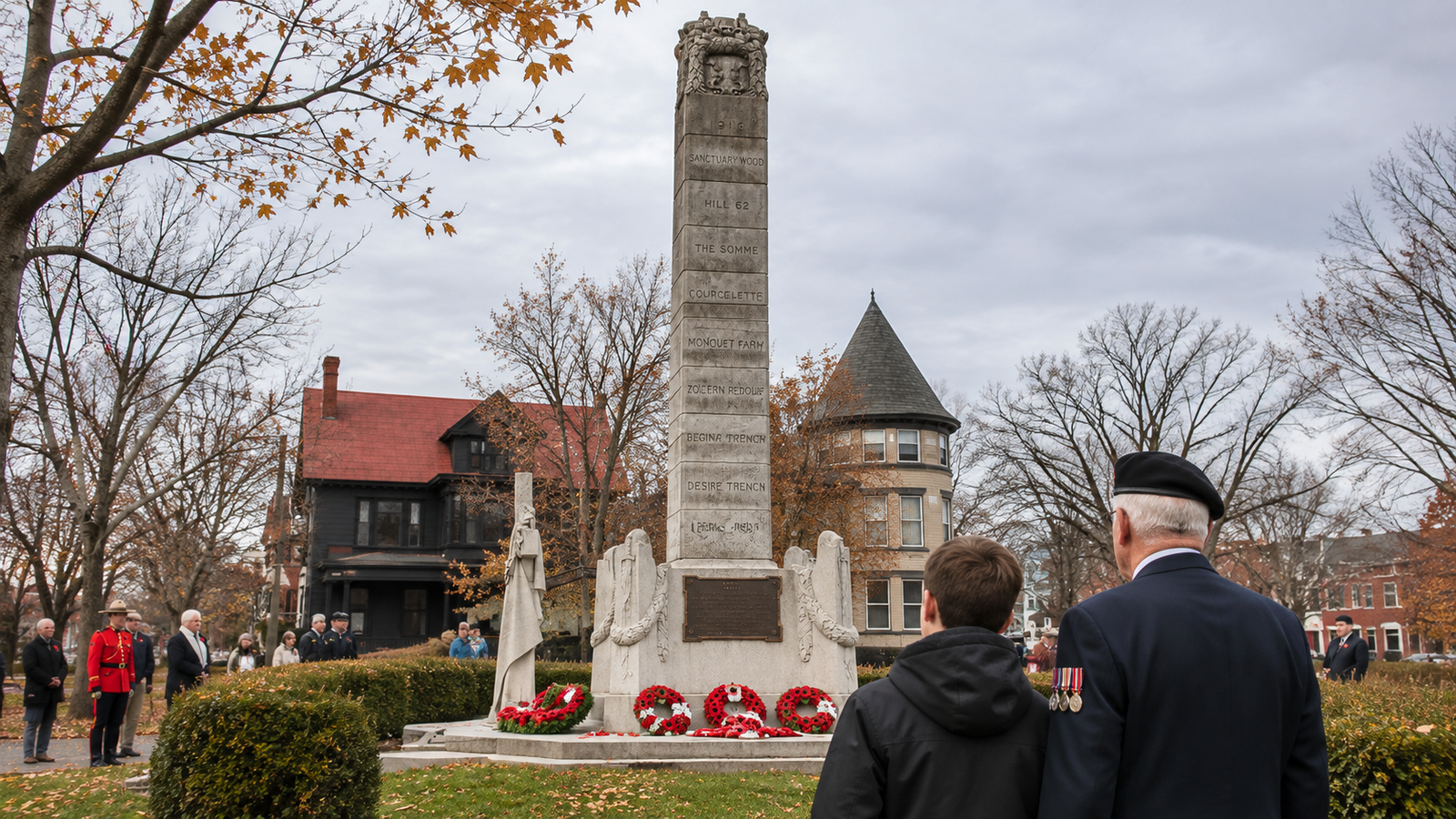
And at the intersection of Queen, Church and King Streets, people gather around a monument that has stood for more than a century.
Some are veterans.
Some are serving military members.
Some are parents with children.
Others have come because a name, a memory or a family story connects them to this place.
And for a few moments, the ordinary rhythm of the city gives way to something more important.
Remembering.
But here's something worth thinking about.
How many of us know the history behind the memorials we pass?
How many know that soldiers once left Fredericton on snowshoes, beginning an extraordinary winter journey during the War of 1812?
Or that New Brunswick soldiers fought through the mud of the Somme, the snow at Vimy Ridge and the brutal Italian campaign of the Second World War?
These aren't simply stories from faraway battlefields.
They're part of Fredericton's story.
And today, I'd like to share a few of them.
🪖 1813: The Soldiers Who Marched Out of Fredericton
Long before the First World War, Fredericton was already a military town.And one of the most remarkable chapters in its history began on February 16, 1813.
The War of 1812 was underway, and British forces urgently needed reinforcements in Upper Canada.
There was one enormous problem.
Winter.
The St. Lawrence River was frozen, making the usual water route impractical.
So the 104th Regiment of Foot, based in Fredericton, was ordered to make the journey overland.
Imagine the scene.
Hundreds of soldiers preparing to leave Fredericton in the middle of February.
No heated vehicles.
No paved highways.
No modern winter clothing.
Just snowshoes, toboggans, supplies and a very long journey ahead.
Approximately 550 men set out in companies, travelling through deep snow and bitter cold.
Their destination?
Kingston, Upper Canada.
More than 1,100 kilometres away.
The journey took roughly eight weeks.
The soldiers faced hunger, exhaustion and harsh winter conditions before reaching their destination and continuing into military service.
It's an extraordinary story of endurance.
And here's the part I find especially interesting.
That journey began right here in Fredericton.
Today, the Garrison District and memorial markers near Officers' Square help preserve the story of the 104th Regiment.
It's easy to walk through that part of downtown and see beautiful historic buildings.
But imagine standing there in February 1813, watching those soldiers begin their march.
Suddenly, the streets feel a little different.
🌺 1914–1918: Fredericton and the Great War
A century after the War of 1812, another conflict would profoundly affect Fredericton.When the First World War began in 1914, men from communities across New Brunswick volunteered for military service.
They were farmers.
Tradesmen.
Students.
Clerks.
Sons.
Brothers.
Husbands.
And many would never return home.
One of the province's best-known fighting units was the 26th Battalion, Canadian Expeditionary Force, often called the Fighting New Brunswick 26th.
Formed in 1914, the battalion arrived in France in September 1915.
Over the following years, its soldiers fought in some of the most difficult battles of the war.
The Somme.
Vimy Ridge.
Passchendaele.
Amiens.
The fighting that brought the war toward its conclusion in 1918.
These names can seem distant today.
But for New Brunswick families, they represented places where loved ones fought, were wounded or died.
🎖️ The Somme: A Name Carved Into Stone
In 1916, the Battle of the Somme became one of the defining tragedies of the First World War.
New Brunswick's 26th Battalion fought during the Somme campaign, including the fighting around Courcelette.
Conditions were horrific.
Mud.
Artillery fire.
Trenches.
Exhaustion.
And the constant uncertainty of what the next day might bring.
For families back in Fredericton, news travelled through letters, newspapers and official messages.
Imagine waiting weeks for a letter.
Imagine seeing the name of a battle in the newspaper and knowing someone you loved was there.
And imagine receiving news that changed your family forever.
Those experiences help explain why, after the war, communities across Canada felt such a strong need to build permanent memorials.
They wanted somewhere to remember.
Somewhere the names would remain.
🇨🇦 Vimy Ridge: New Brunswickers in the Snow
On April 9, 1917, Canadian forces began their assault on Vimy Ridge in France.
The 26th Battalion was part of the opening attack.
Its soldiers advanced across approximately 800 metres of no man's land in driving snow toward a German defensive position known as the Black Line.
Think about that for a moment.
Young New Brunswickers, far from home, moving across exposed ground under wartime conditions that are almost impossible for us to imagine today.
The 26th Battalion achieved its initial objective, though the wider battle came at a heavy human cost.
Vimy Ridge has become an important part of Canada's national remembrance.
But it's also part of New Brunswick's history.
And through the people who served, it belongs to communities like Fredericton.
How could a community properly remember those who had died?
In 1921, efforts began to establish a permanent war memorial.
A committee gathered the names of local soldiers who had lost their lives.
Even that task proved difficult.
Families had moved.
Records had to be checked.
And the committee wanted to ensure that those who had died would be properly recognized.
The result was the New Brunswick Provincial Cenotaph.
On November 11, 1923, five years after the Armistice, Fredericton dedicated the monument.
Its memorial tablet carried 109 names of Fredericton men who had died in the First World War.
One hundred and nine.
Not simply a number.
One hundred and nine lives.
One hundred and nine families and circles of friends affected by loss.
The monument rises approximately 25 feet and bears the names of battles connected to the city's wartime losses.
Look closely and you'll see names such as the Somme, Courcelette and Passchendaele.
These aren't decorative inscriptions.
They're reminders of where Fredericton's history intersected with some of the most devastating events of the twentieth century.
And there's another detail worth noticing.
The cenotaph includes the symbolism of an empty tomb.
A place to honour those who died far from home, including those whose families could not visit their graves.
For grieving families, the monument provided a place where remembrance could happen here, in the city they called home.
More than a hundred years later, it continues to serve that purpose.
On September 10, 1939, Canada declared war on Germany.
Once again, New Brunswickers answered the call.
Among the units with strong connections to the Fredericton region was the Carleton and York Regiment.
The regiment drew heavily from southwestern New Brunswick, including York County.
It mobilized in 1939 and travelled overseas.
For years, its soldiers trained in Britain before joining the Allied invasion of Sicily in July 1943.
They then fought on the Italian mainland.
And the Italian campaign was anything but easy.
🇮🇹 The Long Road Through Italy
The Carleton and York Regiment took part in the difficult fighting that pushed Allied forces north through Italy.
Its soldiers faced mountainous terrain, heavily defended positions, destroyed bridges and fierce resistance.
They served during campaigns associated with places such as Ortona, the Liri Valley and the Gothic Line.
These were not quick or easy victories.
The fighting continued through 1944 and into 1945.
Eventually, the regiment moved to Northwest Europe for the final stages of the war.
For families in Fredericton and surrounding communities, the conflict meant years of uncertainty.
Letters from overseas.
News reports about distant battles.
Waiting.
Hoping.
And, for some, receiving the news that a loved one would not be coming home.
The Fredericton Region Museum has helped preserve these stories, including through its exhibition work on New Brunswick's contribution to the liberation of Italy.
And there's a particularly meaningful local connection.
The Carleton and York Regiment's Colours were placed in the New Brunswick Legislative Assembly in Fredericton in 1955.
They remain an important physical connection to the regiment's history.
Another example of how remembrance lives within our public buildings.
Not just on November 11.
But throughout the year.
Consider a short walk through downtown.
📍 Officers' Square and the Garrison District
These historic grounds connect Fredericton to its military beginnings and the soldiers stationed here long before Confederation.
Markers also recall the extraordinary winter march of the 104th Regiment in 1813.
📍 Fredericton Region Museum
Housed in the former Officers' Quarters, the museum preserves stories and artifacts that help connect the city's military past to the people who lived it.
📍 New Brunswick Legislative Assembly
The historic regimental Colours of the Carleton and York Regiment offer another connection to New Brunswickers who served during the Second World War.
📍 New Brunswick Provincial Cenotaph
At Queen, Church and King Streets, the monument honours those lost in the First World War and, through later additions, the Second World War and Korean War.
It's possible to pass these places while going about an ordinary day without giving them much thought.
But they're more than landmarks.
They're pieces of our shared memory.
And that raises an important question.
What happens when we stop noticing them?
The establishment of Camp Gagetown in the 1950s created an enduring military presence near Oromocto.
Today, 5th Canadian Division Support Base Gagetown remains a significant part of the region.
For many households in Fredericton, Lincoln, Oromocto and surrounding communities, military service is a living experience.
A parent leaving for training.
A family preparing for a posting.
A spouse managing life at home during a deployment.
A veteran adjusting to civilian life.
A family carrying memories of someone who served.
And while Remembrance Day asks us to honour those who died in service, it also encourages us to recognize the sacrifices made by military families and those who returned carrying the effects of war.
History doesn't always feel distant when it's part of your family's everyday life.
They look up at the tall stone monument.
They see the wreaths.
The uniforms.
The poppies.
And then they ask:
"Why are all those names there?"
It's such a simple question.
But what an important opportunity.
We can explain that the names represent real people.
People who once walked streets like ours.
Who went to school.
Who worked.
Who had families and friends.
Who had plans for their futures.
And whose lives were changed or ended by war.
We can explain that remembrance is about honouring their service and sacrifice.
And about understanding why peace matters.
Not every child has a relative who served.
Not every family has wartime letters or photographs.
But every child can stand before a memorial and learn.
That's one of the most valuable things a public place can offer: a connection between generations.
New buildings appear.
Streets evolve.
Neighbourhoods develop.
And public spaces take on new purposes.
That's a natural part of a living city.
But history deserves a place in that conversation.
Because when we preserve a memorial, a historic building or a meaningful public space, we're doing more than protecting stone and architecture.
We're protecting a connection.
A connection between the people who came before us and those who will follow.
The cenotaph isn't valuable because of the land it occupies.
Officers' Square isn't important only because it's a beautiful gathering place.
The former Officers' Quarters isn't meaningful simply because it's an old building.
These places matter because of the stories they help us remember.
And some stories are too important to leave entirely to books and archives.
They deserve a place in the everyday life of our community.
And those are all important parts of what makes this city special.
But there's another layer.
The people who shaped it.
The soldiers who left Fredericton in the winter of 1813.
The New Brunswickers who fought at the Somme and Vimy Ridge.
The members of the Carleton and York Regiment who served through the Italian campaign.
The families who waited at home.
The veterans who returned.
And those who never did.
Their stories are woven into the history of this place.
And in many cases, the evidence is still right in front of us.
Carved into stone.
Preserved in museums.
Displayed in public buildings.
And remembered through ceremonies that continue from one generation to the next.
Perhaps we can take a moment to learn something.
Read one of the names on the cenotaph.
Visit the Fredericton Region Museum.
Share a family story.
Ask an older relative about their memories.
Or take a younger person to a memorial and explain why it's there.
Because remembrance isn't only about knowing that something happened.
It's about understanding that it happened to people.
People who lived in communities like ours.
People whose families once walked these same streets.
And people whose stories deserve to be carried forward.
If your family has a connection to Fredericton's military history, or there's a memorial or Remembrance Day tradition that holds special meaning for you, I'd be honoured to hear about it.
Those personal stories are an important part of our community's history, too.
And perhaps the next time we're walking through downtown Fredericton, we'll look at those familiar places a little differently.
Not simply as landmarks.
But as reminders.
The streets we walk today carry the memories of those who walked them before us.
And it's up to us to make sure those memories are never lost.
In 1916, the Battle of the Somme became one of the defining tragedies of the First World War.
New Brunswick's 26th Battalion fought during the Somme campaign, including the fighting around Courcelette.
Conditions were horrific.
Mud.
Artillery fire.
Trenches.
Exhaustion.
And the constant uncertainty of what the next day might bring.
For families back in Fredericton, news travelled through letters, newspapers and official messages.
Imagine waiting weeks for a letter.
Imagine seeing the name of a battle in the newspaper and knowing someone you loved was there.
And imagine receiving news that changed your family forever.
Those experiences help explain why, after the war, communities across Canada felt such a strong need to build permanent memorials.
They wanted somewhere to remember.
Somewhere the names would remain.
🇨🇦 Vimy Ridge: New Brunswickers in the Snow
On April 9, 1917, Canadian forces began their assault on Vimy Ridge in France.
The 26th Battalion was part of the opening attack.
Its soldiers advanced across approximately 800 metres of no man's land in driving snow toward a German defensive position known as the Black Line.
Think about that for a moment.
Young New Brunswickers, far from home, moving across exposed ground under wartime conditions that are almost impossible for us to imagine today.
The 26th Battalion achieved its initial objective, though the wider battle came at a heavy human cost.
Vimy Ridge has become an important part of Canada's national remembrance.
But it's also part of New Brunswick's history.
And through the people who served, it belongs to communities like Fredericton.
🪨 1923: Why Fredericton Built Its Cenotaph
After the First World War ended, Fredericton faced a difficult question.How could a community properly remember those who had died?
In 1921, efforts began to establish a permanent war memorial.
A committee gathered the names of local soldiers who had lost their lives.
Even that task proved difficult.
Families had moved.
Records had to be checked.
And the committee wanted to ensure that those who had died would be properly recognized.
The result was the New Brunswick Provincial Cenotaph.
On November 11, 1923, five years after the Armistice, Fredericton dedicated the monument.
Its memorial tablet carried 109 names of Fredericton men who had died in the First World War.
One hundred and nine.
Not simply a number.
One hundred and nine lives.
One hundred and nine families and circles of friends affected by loss.
The monument rises approximately 25 feet and bears the names of battles connected to the city's wartime losses.
Look closely and you'll see names such as the Somme, Courcelette and Passchendaele.
These aren't decorative inscriptions.
They're reminders of where Fredericton's history intersected with some of the most devastating events of the twentieth century.
And there's another detail worth noticing.
The cenotaph includes the symbolism of an empty tomb.
A place to honour those who died far from home, including those whose families could not visit their graves.
For grieving families, the monument provided a place where remembrance could happen here, in the city they called home.
More than a hundred years later, it continues to serve that purpose.
🎖️ 1939–1945: Fredericton Families Face Another War
Just over twenty years after the First World War ended, Canada entered another global conflict.On September 10, 1939, Canada declared war on Germany.
Once again, New Brunswickers answered the call.
Among the units with strong connections to the Fredericton region was the Carleton and York Regiment.
The regiment drew heavily from southwestern New Brunswick, including York County.
It mobilized in 1939 and travelled overseas.
For years, its soldiers trained in Britain before joining the Allied invasion of Sicily in July 1943.
They then fought on the Italian mainland.
And the Italian campaign was anything but easy.
🇮🇹 The Long Road Through Italy
The Carleton and York Regiment took part in the difficult fighting that pushed Allied forces north through Italy.
Its soldiers faced mountainous terrain, heavily defended positions, destroyed bridges and fierce resistance.
They served during campaigns associated with places such as Ortona, the Liri Valley and the Gothic Line.
These were not quick or easy victories.
The fighting continued through 1944 and into 1945.
Eventually, the regiment moved to Northwest Europe for the final stages of the war.
For families in Fredericton and surrounding communities, the conflict meant years of uncertainty.
Letters from overseas.
News reports about distant battles.
Waiting.
Hoping.
And, for some, receiving the news that a loved one would not be coming home.
The Fredericton Region Museum has helped preserve these stories, including through its exhibition work on New Brunswick's contribution to the liberation of Italy.
And there's a particularly meaningful local connection.
The Carleton and York Regiment's Colours were placed in the New Brunswick Legislative Assembly in Fredericton in 1955.
They remain an important physical connection to the regiment's history.
Another example of how remembrance lives within our public buildings.
Not just on November 11.
But throughout the year.
🏛️ The History We Walk Past
One of the remarkable things about Fredericton is how much of its military history remains visible.Consider a short walk through downtown.
📍 Officers' Square and the Garrison District
These historic grounds connect Fredericton to its military beginnings and the soldiers stationed here long before Confederation.
Markers also recall the extraordinary winter march of the 104th Regiment in 1813.
📍 Fredericton Region Museum
Housed in the former Officers' Quarters, the museum preserves stories and artifacts that help connect the city's military past to the people who lived it.
📍 New Brunswick Legislative Assembly
The historic regimental Colours of the Carleton and York Regiment offer another connection to New Brunswickers who served during the Second World War.
📍 New Brunswick Provincial Cenotaph
At Queen, Church and King Streets, the monument honours those lost in the First World War and, through later additions, the Second World War and Korean War.
It's possible to pass these places while going about an ordinary day without giving them much thought.
But they're more than landmarks.
They're pieces of our shared memory.
And that raises an important question.
What happens when we stop noticing them?
🇨🇦 From Wartime History to Military Families Today
Fredericton's military connections didn't end in 1945.The establishment of Camp Gagetown in the 1950s created an enduring military presence near Oromocto.
Today, 5th Canadian Division Support Base Gagetown remains a significant part of the region.
For many households in Fredericton, Lincoln, Oromocto and surrounding communities, military service is a living experience.
A parent leaving for training.
A family preparing for a posting.
A spouse managing life at home during a deployment.
A veteran adjusting to civilian life.
A family carrying memories of someone who served.
And while Remembrance Day asks us to honour those who died in service, it also encourages us to recognize the sacrifices made by military families and those who returned carrying the effects of war.
History doesn't always feel distant when it's part of your family's everyday life.
👨👩👧👦 How Do We Teach the Next Generation?
Imagine standing at Fredericton's cenotaph with a child.They look up at the tall stone monument.
They see the wreaths.
The uniforms.
The poppies.
And then they ask:
"Why are all those names there?"
It's such a simple question.
But what an important opportunity.
We can explain that the names represent real people.
People who once walked streets like ours.
Who went to school.
Who worked.
Who had families and friends.
Who had plans for their futures.
And whose lives were changed or ended by war.
We can explain that remembrance is about honouring their service and sacrifice.
And about understanding why peace matters.
Not every child has a relative who served.
Not every family has wartime letters or photographs.
But every child can stand before a memorial and learn.
That's one of the most valuable things a public place can offer: a connection between generations.
🌳 Why Preserving These Places Matters
Fredericton continues to grow and change.New buildings appear.
Streets evolve.
Neighbourhoods develop.
And public spaces take on new purposes.
That's a natural part of a living city.
But history deserves a place in that conversation.
Because when we preserve a memorial, a historic building or a meaningful public space, we're doing more than protecting stone and architecture.
We're protecting a connection.
A connection between the people who came before us and those who will follow.
The cenotaph isn't valuable because of the land it occupies.
Officers' Square isn't important only because it's a beautiful gathering place.
The former Officers' Quarters isn't meaningful simply because it's an old building.
These places matter because of the stories they help us remember.
And some stories are too important to leave entirely to books and archives.
They deserve a place in the everyday life of our community.
❤️ Living Fredericton: The Names Behind the History
When we talk about Fredericton's character, we often mention its beautiful riverfront, historic architecture, parks and neighbourhoods.And those are all important parts of what makes this city special.
But there's another layer.
The people who shaped it.
The soldiers who left Fredericton in the winter of 1813.
The New Brunswickers who fought at the Somme and Vimy Ridge.
The members of the Carleton and York Regiment who served through the Italian campaign.
The families who waited at home.
The veterans who returned.
And those who never did.
Their stories are woven into the history of this place.
And in many cases, the evidence is still right in front of us.
Carved into stone.
Preserved in museums.
Displayed in public buildings.
And remembered through ceremonies that continue from one generation to the next.
🌺 What We Carry Forward
Today, as Fredericton pauses for Remembrance Day, perhaps we can do more than observe two minutes of silence.Perhaps we can take a moment to learn something.
Read one of the names on the cenotaph.
Visit the Fredericton Region Museum.
Share a family story.
Ask an older relative about their memories.
Or take a younger person to a memorial and explain why it's there.
Because remembrance isn't only about knowing that something happened.
It's about understanding that it happened to people.
People who lived in communities like ours.
People whose families once walked these same streets.
And people whose stories deserve to be carried forward.
If your family has a connection to Fredericton's military history, or there's a memorial or Remembrance Day tradition that holds special meaning for you, I'd be honoured to hear about it.
Those personal stories are an important part of our community's history, too.
And perhaps the next time we're walking through downtown Fredericton, we'll look at those familiar places a little differently.
Not simply as landmarks.
But as reminders.
The streets we walk today carry the memories of those who walked them before us.
And it's up to us to make sure those memories are never lost.
Lest we forget. 🌺