🏙️ Why Fredericton Needs More Free Gathering Spaces
🍁 The Rob Brown Realty JournalThursday | Fredericton Neighbourhoods
There's a particular kind of afternoon in Fredericton when you just want to get out of the house.
Maybe you've been working from home all day.
Maybe the weather has turned cold and grey.
Maybe you've had enough screen time to last until Christmas.
You don't necessarily want to shop.
You aren't particularly hungry.
And you don't need another coffee.
You just want somewhere to go.
Somewhere warm.
Somewhere welcoming.
Somewhere you might run into someone you know—or simply enjoy being around other people.
And here's where things get interesting.
Where exactly do you go?
Because in a growing city like Fredericton, we have plenty of places to spend money.
But do we have enough places where spending money isn't the price of admission?
It's a question that gets to the heart of what makes a city feel like a community.
And there's actually a name for the kind of place we're talking about.
The concept is wonderfully simple.
🏡 Your first place: Home.
💼 Your second place: Work—or school, for many people.
☕ Your third place: The informal gathering spot where people connect outside those responsibilities.
Think cafés, libraries, community centres, parks, public squares and neighbourhood gathering spaces.
Places where you can relax.
See familiar faces.
Have a conversation.
Or simply feel part of something larger than your own daily routine.
Third places help turn strangers into acquaintances and acquaintances into neighbours.
They're where everyday community life happens without anyone having to organize a formal event.
And the best ones share an important quality.
You don't need a special invitation to belong.
But here's the complication.
Not every place that looks like a third place is equally accessible.
Fredericton has some wonderful independent cafés, restaurants, pubs and other gathering places.
They contribute enormously to the character of our city.
They create jobs.
They provide welcoming spaces.
And they give us reasons to leave the house and connect.
But businesses also have bills to pay.
Rent.
Utilities.
Wages.
Supplies.
Insurance.
They're not public waiting rooms, and it isn't reasonable to expect a small business to provide unlimited seating without customers supporting it.
Still, there's another side to the conversation.
Imagine you're a student watching every dollar.
A senior on a fixed income.
A parent trying to entertain two children.
Or someone between jobs who simply wants a change of scenery.
A coffee here.
A snack there.
Parking, perhaps.
And suddenly, a casual afternoon out becomes an expense you hadn't planned for.
It's not that any one purchase is necessarily unreasonable.
It's that when nearly every opportunity to gather comes with a transaction, social connection starts to have a price tag.
And that should concern us.
Because belonging shouldn't be reserved for people with discretionary income.
Fredericton has gathering spaces that show what accessible community life can look like.
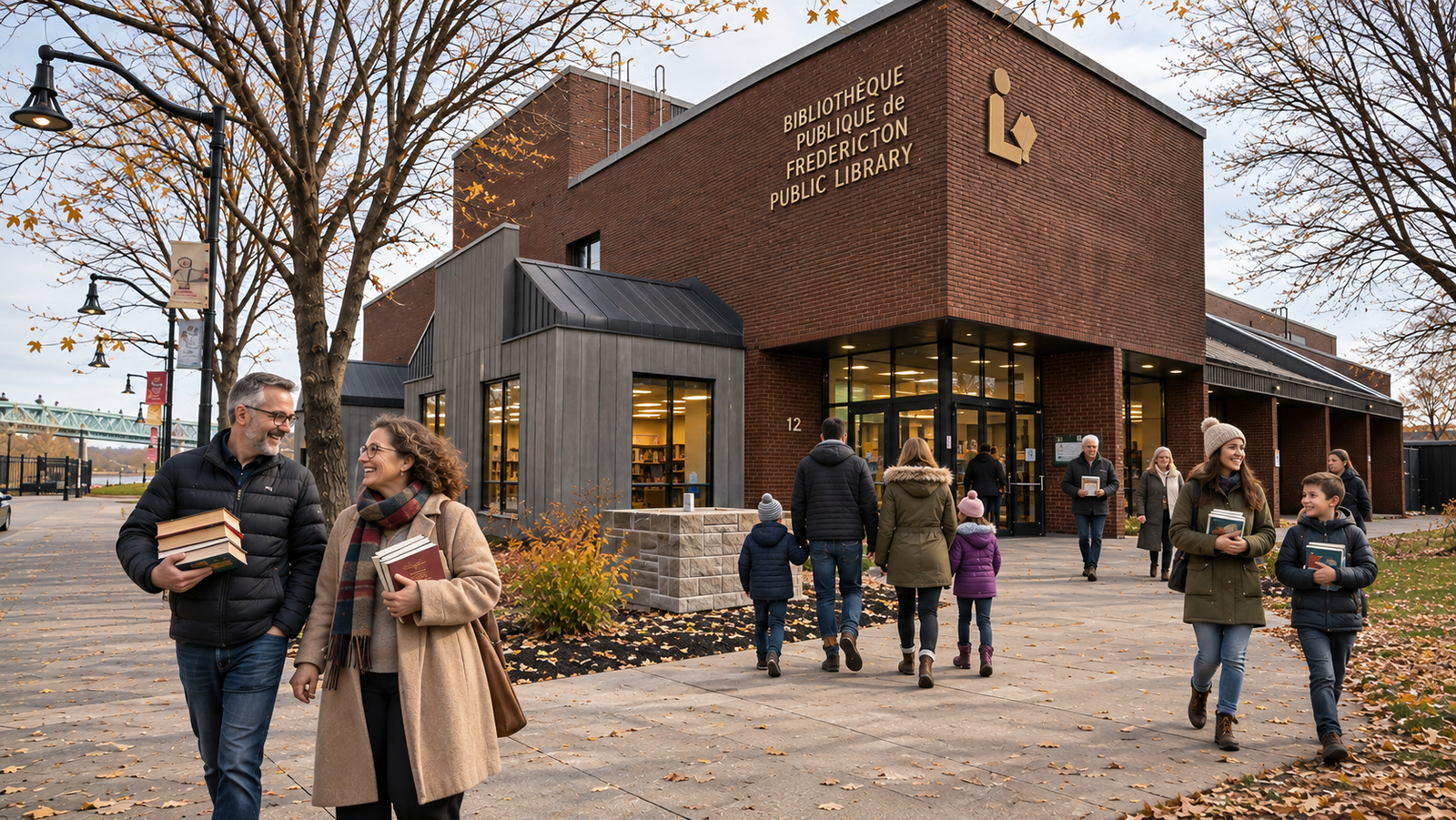
📖 Fredericton Public Library
The Fredericton Public Library on Carleton Street is more than a place to borrow books.
It's somewhere people can read, study, access information, attend programming or simply spend time in a shared public setting.
You don't have to order a latte to sit down.
And you don't have to justify why you're there.
That matters.
🌲 O'Dell Park
O'Dell Park offers something equally valuable in a completely different setting.
Room to walk.
Room to think.
Room to meet a friend without spending a dollar.
Its trails, wooded areas and open spaces provide a welcome escape from busy schedules.
And sometimes, the most meaningful conversation of the week happens while walking side by side rather than sitting across a table.
🌉 The Bill Thorpe Walking Bridge
The walking bridge is one of Fredericton's great everyday meeting places.
People cross it for exercise, transportation, fresh air and river views.
You see cyclists, walkers, families and people who simply want a few minutes outside.
There's no admission fee.
No reservation.
No expectation that you'll purchase anything.
Just a shared public space connecting both sides of the Saint John River.
There's a particular kind of afternoon in Fredericton when you just want to get out of the house.
Maybe you've been working from home all day.
Maybe the weather has turned cold and grey.
Maybe you've had enough screen time to last until Christmas.
You don't necessarily want to shop.
You aren't particularly hungry.
And you don't need another coffee.
You just want somewhere to go.
Somewhere warm.
Somewhere welcoming.
Somewhere you might run into someone you know—or simply enjoy being around other people.
And here's where things get interesting.
Where exactly do you go?
Because in a growing city like Fredericton, we have plenty of places to spend money.
But do we have enough places where spending money isn't the price of admission?
It's a question that gets to the heart of what makes a city feel like a community.
And there's actually a name for the kind of place we're talking about.
🪑 The Place Between Home and Work
Sociologist Ray Oldenburg popularized the idea of the "third place" in his 1989 book The Great Good Place.The concept is wonderfully simple.
🏡 Your first place: Home.
💼 Your second place: Work—or school, for many people.
☕ Your third place: The informal gathering spot where people connect outside those responsibilities.
Think cafés, libraries, community centres, parks, public squares and neighbourhood gathering spaces.
Places where you can relax.
See familiar faces.
Have a conversation.
Or simply feel part of something larger than your own daily routine.
Third places help turn strangers into acquaintances and acquaintances into neighbours.
They're where everyday community life happens without anyone having to organize a formal event.
And the best ones share an important quality.
You don't need a special invitation to belong.
But here's the complication.
Not every place that looks like a third place is equally accessible.
☕ When a Coffee Costs More Than Coffee
Let's be clear about something.Fredericton has some wonderful independent cafés, restaurants, pubs and other gathering places.
They contribute enormously to the character of our city.
They create jobs.
They provide welcoming spaces.
And they give us reasons to leave the house and connect.
But businesses also have bills to pay.
Rent.
Utilities.
Wages.
Supplies.
Insurance.
They're not public waiting rooms, and it isn't reasonable to expect a small business to provide unlimited seating without customers supporting it.
Still, there's another side to the conversation.
Imagine you're a student watching every dollar.
A senior on a fixed income.
A parent trying to entertain two children.
Or someone between jobs who simply wants a change of scenery.
A coffee here.
A snack there.
Parking, perhaps.
And suddenly, a casual afternoon out becomes an expense you hadn't planned for.
It's not that any one purchase is necessarily unreasonable.
It's that when nearly every opportunity to gather comes with a transaction, social connection starts to have a price tag.
And that should concern us.
Because belonging shouldn't be reserved for people with discretionary income.
📚 Fredericton Already Has Some Good Answers
Fortunately, we're not starting from zero.Fredericton has gathering spaces that show what accessible community life can look like.
📖 Fredericton Public Library
The Fredericton Public Library on Carleton Street is more than a place to borrow books.
It's somewhere people can read, study, access information, attend programming or simply spend time in a shared public setting.
You don't have to order a latte to sit down.
And you don't have to justify why you're there.
That matters.
🌲 O'Dell Park
O'Dell Park offers something equally valuable in a completely different setting.
Room to walk.
Room to think.
Room to meet a friend without spending a dollar.
Its trails, wooded areas and open spaces provide a welcome escape from busy schedules.
And sometimes, the most meaningful conversation of the week happens while walking side by side rather than sitting across a table.
🌉 The Bill Thorpe Walking Bridge
The walking bridge is one of Fredericton's great everyday meeting places.
People cross it for exercise, transportation, fresh air and river views.
You see cyclists, walkers, families and people who simply want a few minutes outside.
There's no admission fee.
No reservation.
No expectation that you'll purchase anything.
Just a shared public space connecting both sides of the Saint John River.
🌿 Officers' Square and the Downtown Green
Our downtown public spaces offer another version of the same idea.
A bench.
A patch of grass.
A place to sit and watch the city go by.
In warmer months, these spaces can feel like Fredericton's shared living room.
And that's worth protecting.
But these examples also raise another question.
What happens when November arrives?
Outdoor public spaces are wonderful.
Until it's dark at five o'clock.
The wind picks up.
The sidewalks turn icy.
And the idea of sitting on a park bench becomes significantly less appealing.
Fredericton has an impressive trail network and beautiful green spaces.
But a trail isn't necessarily a substitute for somewhere warm to sit on a Tuesday evening in February.
We need both.
And the colder months expose a weakness that can be easy to overlook in summer.
A city can have excellent outdoor gathering spaces and still struggle to provide accessible indoor places to spend time.
Libraries and community facilities help fill that gap.
But their hours, locations, programming and available space don't necessarily meet everyone's needs.
A parent with young children may need something different from a teenager.
A senior may want somewhere comfortable to socialize.
A remote worker may be looking for casual human interaction.
And someone who doesn't have money to spend may simply need somewhere they can exist without feeling unwelcome.
Those are different needs.
But they share a common theme.
People need places where they can belong without being required to buy something.
Where do people naturally run into one another?
Maybe it's a local café.
A playground.
A community hall.
A library.
A walking trail.
Or a small park where the same people seem to appear every afternoon.
These places do something that sidewalks and houses alone cannot.
They create opportunities for connection.
And connection matters.
It's how people learn their neighbours' names.
How newcomers begin to feel at home.
How community groups find volunteers.
And how someone having a difficult week might end up in a conversation they didn't know they needed.
Now imagine a neighbourhood without any of those places.
Plenty of houses.
Plenty of driveways.
Maybe even attractive streets and landscaping.
But nowhere obvious to gather.
People drive home.
Pull into their garages.
Close the doors.
And repeat.
There's nothing inherently wrong with wanting privacy.
But a neighbourhood designed only for private life can make public life surprisingly difficult.
That's an important consideration as Fredericton continues to grow.
Fredericton needs places for people to live, and conversations about housing supply, affordability and development are not going away.
But there's another question worth asking when we look at new neighbourhoods.
Where will the people who live there actually meet one another?
Will there be sidewalks connecting homes to parks and services?
Will children have somewhere to gather?
Will older residents have comfortable, accessible places to spend time?
Will someone without a car be able to reach a library, community centre or public gathering space?
And will there be opportunities to connect that don't require spending money?
These aren't decorative extras.
They're part of how a neighbourhood functions.
A beautiful subdivision with no convenient gathering places may offer lovely homes but fewer opportunities for spontaneous community life.
Meanwhile, an older neighbourhood with a modest park, a library branch or a well-used community hall may offer something that's harder to capture in a listing description.
A built-in sense of connection.
As a REALTOR®, I think that's worth paying attention to.
Because people aren't simply buying a house.
They're choosing the everyday life that surrounds it.
Our downtown public spaces offer another version of the same idea.
A bench.
A patch of grass.
A place to sit and watch the city go by.
In warmer months, these spaces can feel like Fredericton's shared living room.
And that's worth protecting.
But these examples also raise another question.
What happens when November arrives?
❄️ The Winter Problem Nobody Can Ignore
Here's where the third-place conversation becomes especially relevant in New Brunswick.Outdoor public spaces are wonderful.
Until it's dark at five o'clock.
The wind picks up.
The sidewalks turn icy.
And the idea of sitting on a park bench becomes significantly less appealing.
Fredericton has an impressive trail network and beautiful green spaces.
But a trail isn't necessarily a substitute for somewhere warm to sit on a Tuesday evening in February.
We need both.
And the colder months expose a weakness that can be easy to overlook in summer.
A city can have excellent outdoor gathering spaces and still struggle to provide accessible indoor places to spend time.
Libraries and community facilities help fill that gap.
But their hours, locations, programming and available space don't necessarily meet everyone's needs.
A parent with young children may need something different from a teenager.
A senior may want somewhere comfortable to socialize.
A remote worker may be looking for casual human interaction.
And someone who doesn't have money to spend may simply need somewhere they can exist without feeling unwelcome.
Those are different needs.
But they share a common theme.
People need places where they can belong without being required to buy something.
🏘️ What Happens When Neighbourhoods Lose Their Gathering Places?
Think about the neighbourhoods you know best.Where do people naturally run into one another?
Maybe it's a local café.
A playground.
A community hall.
A library.
A walking trail.
Or a small park where the same people seem to appear every afternoon.
These places do something that sidewalks and houses alone cannot.
They create opportunities for connection.
And connection matters.
It's how people learn their neighbours' names.
How newcomers begin to feel at home.
How community groups find volunteers.
And how someone having a difficult week might end up in a conversation they didn't know they needed.
Now imagine a neighbourhood without any of those places.
Plenty of houses.
Plenty of driveways.
Maybe even attractive streets and landscaping.
But nowhere obvious to gather.
People drive home.
Pull into their garages.
Close the doors.
And repeat.
There's nothing inherently wrong with wanting privacy.
But a neighbourhood designed only for private life can make public life surprisingly difficult.
That's an important consideration as Fredericton continues to grow.
🏗️ Are We Building Homes—or Building Community?
New housing is essential.Fredericton needs places for people to live, and conversations about housing supply, affordability and development are not going away.
But there's another question worth asking when we look at new neighbourhoods.
Where will the people who live there actually meet one another?
Will there be sidewalks connecting homes to parks and services?
Will children have somewhere to gather?
Will older residents have comfortable, accessible places to spend time?
Will someone without a car be able to reach a library, community centre or public gathering space?
And will there be opportunities to connect that don't require spending money?
These aren't decorative extras.
They're part of how a neighbourhood functions.
A beautiful subdivision with no convenient gathering places may offer lovely homes but fewer opportunities for spontaneous community life.
Meanwhile, an older neighbourhood with a modest park, a library branch or a well-used community hall may offer something that's harder to capture in a listing description.
A built-in sense of connection.
As a REALTOR®, I think that's worth paying attention to.
Because people aren't simply buying a house.
They're choosing the everyday life that surrounds it.
💡 What Could Fredericton Do Differently?
Here's the encouraging part.Creating better third places doesn't always require a massive new building or an expensive redevelopment project.
Sometimes the most useful improvements are relatively modest.
🪑 Make existing public spaces more comfortable.
Good seating, accessible washrooms, clear pathways, lighting and places to shelter from the weather can make a big difference.
A public space isn't particularly welcoming if there's nowhere comfortable to stay.
📚 Make better use of the spaces we already have.
Libraries, recreation facilities and community buildings may offer opportunities for informal gatherings, drop-in activities and intergenerational programming.
The challenge is balancing accessibility with staffing, operating costs and the needs of existing programs.
🏘️ Plan gathering spaces alongside new housing.
Rather than treating community amenities as something to think about later, we could make them part of the conversation from the beginning.
🤝 Support low-cost community programming.
Walking groups, board-game afternoons, community conversations, neighbourhood events and casual drop-ins can create connection without requiring everyone to buy a ticket.
❄️ Think about winter from the start.
This one deserves particular attention.
A gathering space that works beautifully in July but becomes unusable in November only solves part of the problem.
We live in New Brunswick.
Winter shouldn't be an afterthought in how we design community life.
None of these ideas is free to operate.
Public spaces need maintenance.
Buildings need staff.
Programs need funding.
And taxpayers deserve to know how those resources are being used.
But that doesn't mean the conversation should stop.
It means we need to ask what kinds of shared spaces offer the greatest value to the people who use them.
❤️ Living Fredericton: The Value of Simply Being Somewhere
There's something quietly powerful about a place where you can spend time without being asked to spend money.A place where a teenager can meet friends.
Where a newcomer can become familiar with the city.
Where a senior can enjoy a conversation.
Where a parent can take a break.
Or where someone can sit alone without feeling isolated.
Those moments don't necessarily generate revenue.
They don't always show up in economic-development announcements.
And they're difficult to measure.
But they contribute to the feeling that makes people say:
"I like living here."
Fredericton has many of the ingredients of a connected, welcoming city.
The challenge is making sure those opportunities remain accessible as our city changes.
Because a vibrant downtown isn't just one with busy cash registers.
And a successful neighbourhood isn't simply one with attractive houses.
A genuinely welcoming city makes room for people who aren't there to buy anything.
🌿 So, Where Do We Go From Here?
The next time you're out in Fredericton, notice where people naturally gather.Notice the places where someone can sit comfortably without making a purchase.
Notice which spaces feel welcoming to children, seniors, students and people with different abilities.
And notice what's missing.
Because sometimes the most important question about a city isn't what new business is opening.
It's where people can go when they don't want to spend anything at all.
I'd love to hear your perspective.
Where is Fredericton's best free or low-cost gathering place?
And perhaps more importantly:
What kind of gathering space do you wish Fredericton had—but doesn't?
A comfortable indoor space for winter evenings?
More neighbourhood community rooms?
Better public seating?
Somewhere for teenagers to hang out?
Or something entirely different?
If you're exploring Fredericton's neighbourhoods and thinking about where you want to put down roots, I'd be happy to help you consider the community beyond the front door.
Because the best places to live aren't always the places with the most amenities for sale.
They're the places where people have room to belong.
We enjoy exploring the places, people and ideas shaping Fredericton's future.