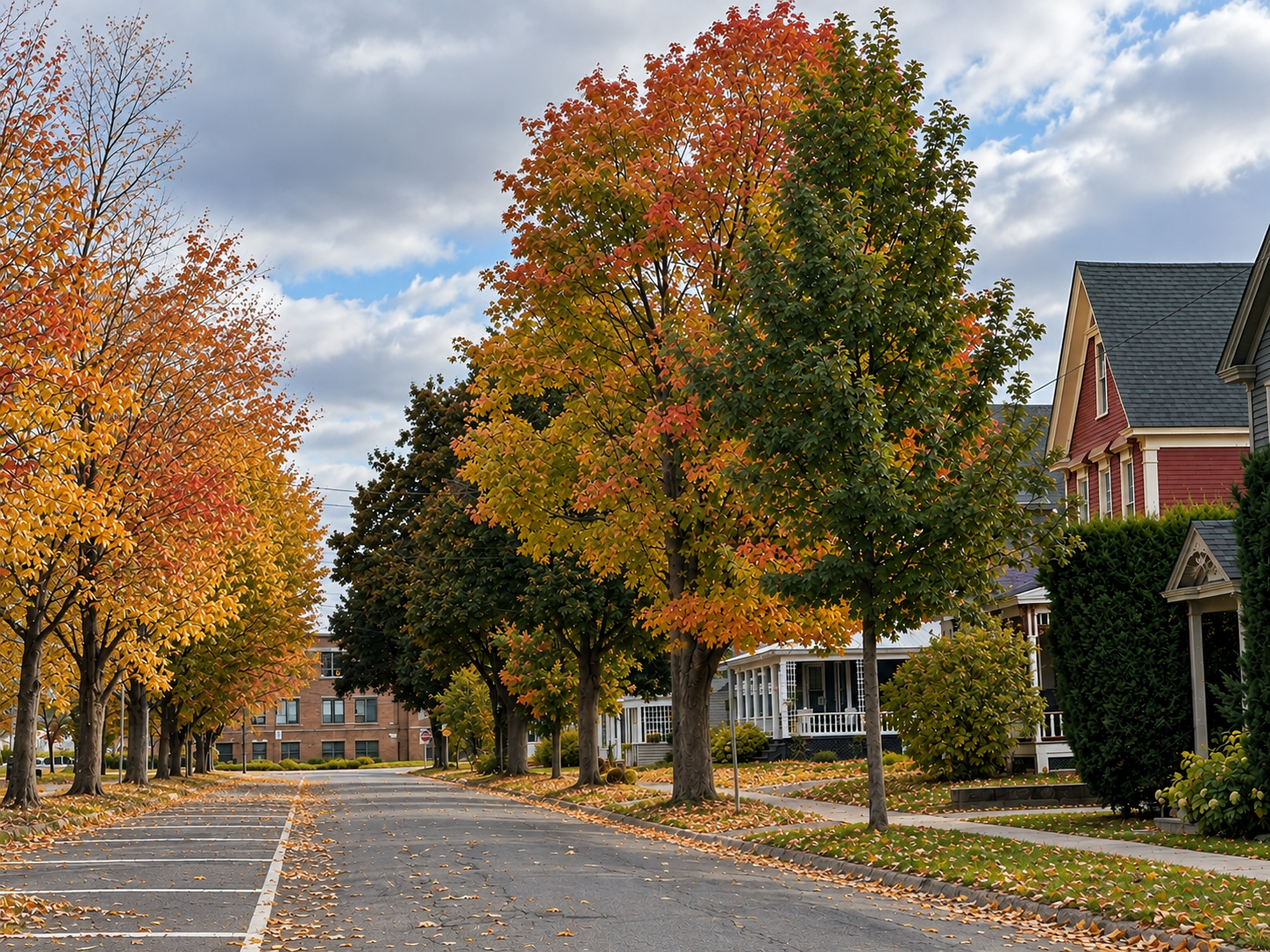
🏡 The Historic Homes Around Wilmot Park and Fredericton's Changing Boundaries
🍁 The Rob Brown Realty JournalThursday | Fredericton Neighbourhoods
Imagine buying a house on O'Dell Avenue in 1897.
Today, we'd describe the location as established. Central. Across from Wilmot Park. Minutes from downtown.
In 1897?
You were moving to the edge of Fredericton.
That's one of the fascinating things about the houses surrounding Wilmot Park. They don't simply tell us what Fredericton used to look like.
They tell us where Fredericton used to end.
And that makes a walk around the park a surprisingly good lesson in how an address can completely change meaning without moving an inch.
🌳 First, There Was the Park
Wilmot Park's story actually begins decades before many of the houses surrounding it.The land was part of the O'Dell estate when it was set aside as a public “pleasure ground” in 1860. Prince Albert Edward—the future King Edward VII—officially opened it during his royal visit that August. But for decades afterward, the grounds remained relatively undeveloped.
Then came Edward Henry Wilmot.
Wilmot purchased the property in 1894, improved it, and in 1895 gave it to Fredericton to be held for public use, along with an endowment for its maintenance.
The City describes that moment as something more consequential than the opening of a park:
It helped catalyze development in western Fredericton.
That's where our real estate story begins.
🗺️ Fredericton Had an Edge
It's difficult to picture now.Walk east from Wilmot Park and you're quickly surrounded by some of Fredericton's most recognizable older residential streets.
Walk west and you're heading toward O'Dell Park, Woodstock Road and neighbourhoods that generations of Frederictonians simply consider part of the city.
But in the mid-1890s, residential development west of Smythe Street was still extremely limited.
Wilmot Park changed the equation.
Suddenly, living beside this newly developed public space was desirable.
And Fredericton began pushing west.
A new street appeared beside the park.
Its name was wonderfully literal:
Park Street.
We know it today as O'Dell Avenue.
🏠 And Then the Houses Arrived
This is where the story becomes visible.At 226 O'Dell Avenue, a two-and-a-half-storey Queen Anne Revival-inspired home was completed in 1896.
The Canadian Register of Historic Places describes it as one of the first houses constructed on the new Park Street and directly connects its construction to the rapid development that followed Wilmot Park's opening.
Nearby, 206 O'Dell Avenue followed in 1897. Its heritage record makes essentially the same point: Wilmot Park triggered a building boom around the new western edge of Fredericton.
Then there is 216 O'Dell Avenue, also completed in 1897.
By that point, something remarkable had happened.
Most of the lots made available along the new street in 1895 had already been sold and built upon.
Two years.
That's not gradual expansion.
That's demand.
🤔 So What Were Buyers Actually Buying?
This is where the history starts sounding surprisingly modern.They weren't just buying houses.
They were buying location.
More specifically, they were buying proximity to a major public amenity.
Park Street was considered desirable because it was beside Wilmot Park.
Sound familiar?
We still do this.
We pay attention to trails.
Parks.
Schools.
Walkability.
Water.
Downtown access.
Mature trees.
Recreation.
A house is one part of the purchase.
What's outside the front door is another.
The language of real estate has changed considerably since 1897.
That part hasn't.
🧱 Except One House Got There First
There is a wonderful wrinkle in the story at 234–236 O'Dell Avenue.Its Classical Revival main portion was constructed in 1891.
That's four years before Park Street itself was created.
The house literally predates the street it now sits on.
Think about that for a moment.
Today, an address feels permanent.
We assume the street came first.
Then the lot.
Then the house.
Not necessarily.
Cities are layers.
Roads get created.
Names change.
Lots are subdivided.
Buildings are moved.
Boundaries expand.
What looks completely inevitable today may once have been somebody's field.
🌆 Was This Fredericton's Version of Suburbia?
Not in the modern sense.No cul-de-sacs.
No attached garages.
No commuter subdivision.
But the underlying idea isn't entirely different.
Frederictonians were moving beyond the established residential footprint into a newly desirable area at the edge of town.
The opening of Wilmot Park helped redefine the western boundary of the town plat, and the houses that followed offered residents new housing choices beyond the city's traditional limits.
So perhaps these houses were doing something we recognize very well today.
Following Fredericton's growth outward.
The difference is that yesterday's edge eventually became today's core.
📍 What Does “Central” Actually Mean?
This might be the most interesting question the neighbourhood raises.We talk about location as though it's permanent.
Central.
Suburban.
Outlying.
Established.
Up-and-coming.
But those words have expiration dates.
An address doesn't move.
The city moves around it.
A house on the edge of Fredericton in 1897 can become a highly established central-city home generations later.
And something we're calling the outskirts today?
Frederictonians 75 years from now may find that description hilarious.
🌳 The Park Changed Too
Wilmot Park wasn't frozen in 1895 either.Its early Victorian landscape was built around pastoral space, tree-lined corridors and communal gathering.
A pond arrived in the early 1900s. A former Government House gatehouse was moved into the park in 1918 to house its caretaker. The pond later evolved into a wading pool, and eventually the modern splash pad.
Today there are tennis and basketball courts, lawn bowling, paths, the bandstand, the Stepping Stone Seniors Centre and places to simply sit beneath mature trees.
Different generations have asked different things of the same piece of land.
That's part of why the park has endured.
It evolved without completely losing its original purpose:
A public place for people.
🏡 And The Houses Kept Evolving Too
This is another part of old neighbourhoods we sometimes romanticize away.Historic homes weren't necessarily preserved untouched for 130 years.
They changed because people's lives changed.
An especially good example is again 234–236 O'Dell Avenue.
When the original house was constructed in 1891, there was also a barn at the rear of the property.
In 1923, that barn was physically attached to the house and converted into living space.
That's adaptive reuse on the scale of a single home.
People needed something different.
So the property changed.
The neighbourhood we now think of as historic was itself constantly evolving.
❤️ The Fredericton Conversation
And that brings us to a question Fredericton is still wrestling with.When does a neighbourhood become “established”?
After 20 years?
50?
100?
And once it gets there, how much change should we allow?
The houses around Wilmot Park were themselves part of a major expansion that redefined Fredericton's boundaries.
At the time, they represented change.
Today, some of those same homes represent heritage.
That's quite a transformation.
It also complicates the way we talk about growth.
Because the neighbourhoods we're trying to preserve today often exist because an earlier generation allowed the city to evolve.
🍂 Take the Long Way Around...
Next time you're at Wilmot Park, don't just walk through it.Walk around it.
Look across at the houses.
Notice their porches.
Their rooflines.
Their additions.
The distance between them.
And imagine the same view in the 1890s, when building a house here meant participating in the expansion of Fredericton.
A century later, those addresses haven't moved.
But their meaning has.
And we'd love to know:
Which Fredericton neighbourhood do you think will feel completely different 50 years from now?
Will today's outskirts become tomorrow's established core?
And when that happens, what will we wish we'd preserved along the way?
Because perhaps the most interesting thing about an old house isn't simply when it was built.
It's everything the city built around it afterward.