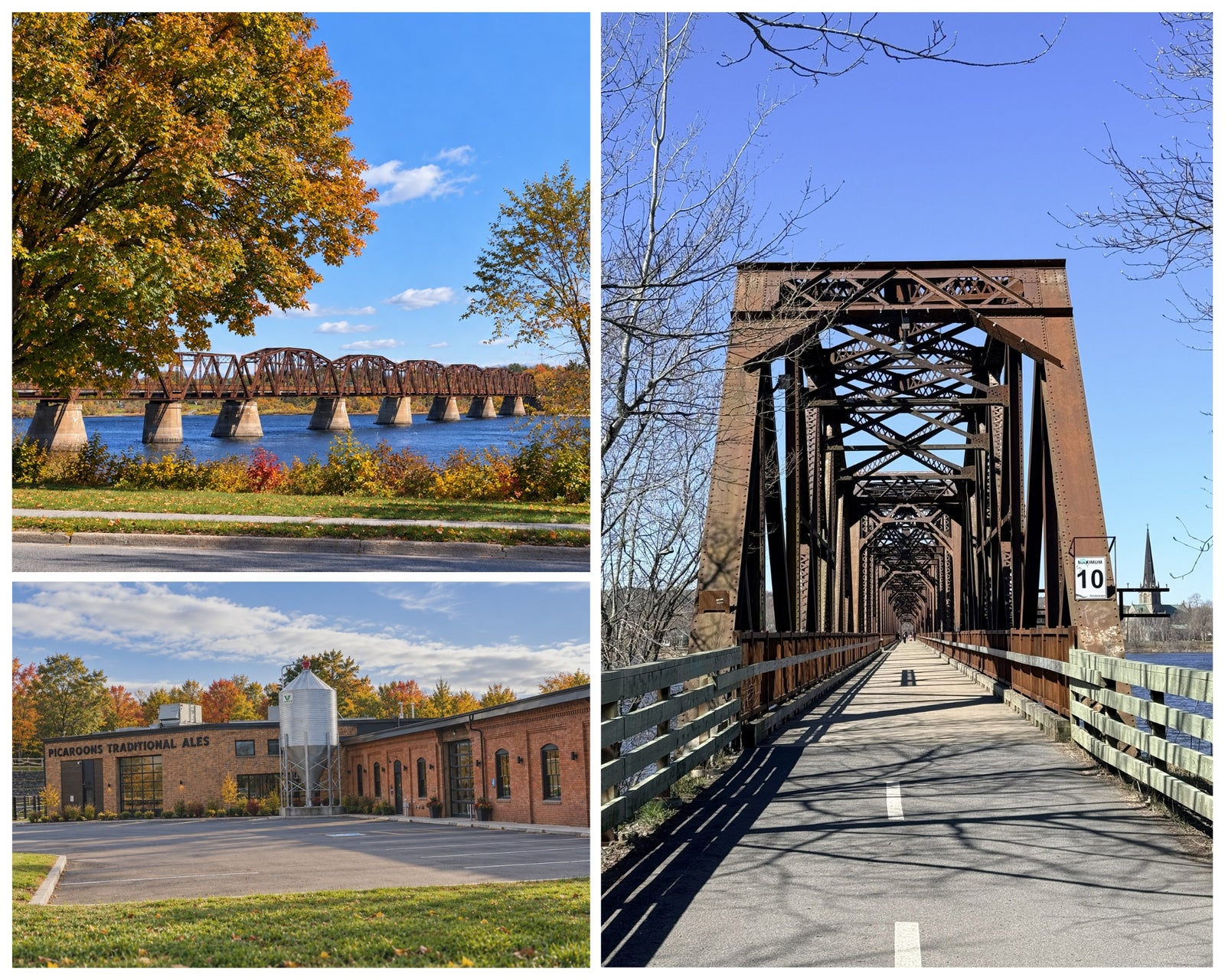
🚂 From Rails to Ales
🍁 The Rob Brown Realty JournalWednesday | Fredericton History
If you walk from downtown Fredericton across the Bill Thorpe Walking Bridge and stop for a beer at Picaroons, you're following a route that tells more than a century of the city's history.
Today, it feels completely natural.
Cyclists roll across the bridge. Runners follow the trail. Families stop halfway for the view. On the north side, people spill into the Roundhouse for coffee, food or a pint.
But this landscape wasn't designed for recreation.
It was built for trains.
The bridge carried locomotives across the Saint John River. The trails were rail corridors. The brick Roundhouse serviced locomotives in the Gibson Railway Yard.
And that's what makes this corner of Fredericton so interesting.
We didn't erase the old infrastructure.
We found something new for it to do.
🚂 Before the Walking Bridge, There Was the Railway
To understand this story, we need to go back to Gibson.The community on the north side of the river was deeply connected to industrialist Alexander “Boss” Gibson, whose business interests included lumber, manufacturing and railways.
Rail transportation was crucial to that industrial world.
Gibson was involved with the Northern & Western Railway, incorporated in 1882. The line ran from Gibson toward Chatham along the Miramichi and connected with other New Brunswick railways. Gibson and future New Brunswick lieutenant-governor Jabez B. Snowball were members of the company's original board.
There was one obvious problem.
The river.
Fredericton sat on one side.
Gibson's growing railway network sat on the other.
So in the late 1880s, steel began stretching across the Saint John River.
The Fredericton Railway Bridge opened in the late 1880s, finally creating a railway connection across the river between Fredericton and Gibson.
Imagine standing on the riverbank then.
No Westmorland Street Bridge.
No cyclists.
No runners.
No trail signs.
Instead, there was an enormous new piece of industrial infrastructure carrying trains across the river.
The bridge wasn't scenery.
It was transportation.
🧱 And On the Other Side: The Roundhouse
At almost exactly the same moment, another remarkable structure appeared in the Gibson Railway Yard.In 1885, Saint John contractor B. Mooney & Sons built the Gibson Roundhouse for the Northern & Western Railway.
And here's where the history becomes particularly local.
The bricks used to build it came from Boss Gibson's own brickyard.
Approximately half a million of them.
Think about that the next time you're sitting inside the Roundhouse with a pint.
Those walls weren't designed as atmosphere.
They weren't an architect's attempt at industrial chic.
They are industrial.
The building existed because steam locomotives needed somewhere to be housed and serviced.
For decades, this was working railway infrastructure.
The Roundhouse subsequently served the Canada Eastern Railway and Canadian National Railway, remaining in railway use for more than half a century before new facilities replaced it in 1937.
Today, the former Gibson Roundhouse is formally recognized as a historic place.
But its survival was hardly guaranteed.
🌊 Then the River Reminded Everyone Who Was in Charge
Fredericton has always had a complicated relationship with the river.Beautiful?
Absolutely.
Predictable?
Not particularly.
A major freshet damaged the original railway bridge in the 1930s. The structure was rebuilt and reopened in 1938.
That's an important distinction when we look at the bridge today.
The crossing itself dates to Fredericton's nineteenth-century railway era, but the structure generations of Frederictonians recognize was substantially shaped by that 1930s reconstruction.
And trains continued crossing it for decades.
The railway landscape on the north side also continued changing.
Eventually, however, the role of rail in Fredericton diminished.
And that created a question cities across North America have had to answer:
What do you do with infrastructure after the reason it was built disappears?
🚲 Tear It Down—or Use It Differently?
This may be the most interesting chapter in the story.Old railway corridors can become barriers.
Old bridges can become liabilities.
Industrial buildings can sit empty until deterioration makes demolition seem inevitable.
Fredericton took another path.
When railway lines around the city were abandoned, local trail advocates pushed an idea that probably seems obvious today:
What if the old railway network became a people network?
Residents including trail advocate Patty Trail began promoting the conversion of abandoned rail corridors into walking and cycling routes. When the railway lines south of Fredericton were abandoned in the mid-1990s, the old railway bridge suddenly offered something enormously valuable—a ready-made connection between trail systems on opposite sides of the river. The refurbished bridge opened to pedestrians and cyclists in 1997.
The bridge was eventually named for Bill Thorpe, whose advocacy for trails and active transportation helped drive Fredericton's trail movement.
Today, it is part of the Trans Canada Trail network.
At approximately 581 metres long, it carries more than 600,000 crossings annually, according to Housing, Infrastructure and Communities Canada. During Summer, roughly 3,000 people can cross it in a day.
That's a remarkable second life.
A bridge designed to move trains became one of Fredericton's most heavily used recreational and active-transportation corridors.
🍺 And Then Someone Put a Brewery in the Roundhouse
This is where the story gets particularly Fredericton.Because preserving the bridge was only one half of the equation.
At the north end sat that enormous brick relic of the railway age.
The former Gibson Roundhouse.
Instead of treating it simply as something old to admire from the outside, it was adapted again.
After extensive renovation, Picaroons moved its brewery operation into the former Roundhouse, with the expanded public Roundhouse taproom and café opening in 2016.
Which created one of those combinations that seems obvious only after somebody does it.
Old railway architecture.
A working brewery.
A trail.
A pedestrian bridge.
The river.
Carleton Park.
Food.
Coffee.
Community space.
Suddenly, an obsolete industrial site wasn't obsolete at all.
🍻 Picaroons Roundhouse
Picaroons itself has been brewing since 1995, making it part of New Brunswick's craft-beer story long before craft breweries became as common as they are today.But the Roundhouse gave the brewery something different.
A place.
Not simply somewhere beer is manufactured.
Somewhere people actually gather.
Today, the building at 912 Union Street houses Picaroons Brewing Company along with 540 NORTH, Grain & Grind Coffee Co., and the Roundhouse Brewtique, which carries New Brunswick-made beer, cider, spirits and wine. Picaroons explicitly describes the Roundhouse as its community space—somewhere intended for people to celebrate, connect and spend time together.
That's an unusually appropriate use for this particular building.
Because roundhouses were inherently communal pieces of infrastructure.
Everything revolved around movement.
Trains arrived.
Workers maintained them.
Locomotives departed.
People and goods moved through the railway network.
More than 140 years later, people are still arriving.
They're just arriving on bicycles.
Or with dogs.
Or pushing strollers.
Or meeting friends for a beer.
The traffic changed.
The building didn't have to disappear with it.
🧱 Half a Million Bricks—and Still Working
This may be our favourite detail.Those approximately 500,000 locally made bricks have now survived several completely different versions of Fredericton.
They witnessed the railway age.
Industrial Gibson.
Canada Eastern.
Canadian National.
The decline of passenger and freight rail in the city.
Decades of other uses.
And eventually the rise of Fredericton's trail and craft-brewing culture.
The building is still doing what good buildings do.
Being useful.
That distinction matters.
Because heritage preservation doesn't always have to mean freezing something at one moment in history.
Sometimes the best way to preserve an old building is to give people a reason to keep walking through its doors.
🤔 Is This What Good Heritage Preservation Looks Like?
That's the bigger conversation.Fredericton has no shortage of old buildings.
And every time one faces redevelopment, renovation or demolition, familiar questions appear.
What should be preserved?
Who pays for it?
Can an old structure realistically accommodate a modern use?
How much alteration is too much?
And when does preservation become economically unrealistic?
There aren't simple answers.
But the Roundhouse demonstrates one possibility:
Don't just preserve the building. Give it another job.
The same philosophy applies to the railway bridge.
Neither structure performs its original function anymore.
Yet arguably both are more woven into everyday Fredericton life now than they have been in decades.
That's adaptive reuse at its best.
Not nostalgia.
Continuity.
🌉 One Walk. Three Frederictons.
Try this sometime.Start downtown.
Walk toward the river.
Cross the Bill Thorpe Walking Bridge.
Look at the steel structure around you.
Remember that locomotives once travelled where you're walking.
Then reach the north side.
Follow the former railway landscape toward that massive brick building.
Go inside the Roundhouse.
And suddenly you're standing in three different Frederictons at once.
The industrial city.
The trail city.
And the modern city of breweries, coffee shops, restaurants and community spaces.
They aren't competing with each other.
One grew out of the other.
❤️ The Fredericton Conversation
Which raises a question worth asking as Fredericton continues to grow.What else should we be reusing?
When an old building or piece of infrastructure has outlived its original purpose, should our first instinct be to replace it?
Or should we ask:
What else could this become?
The Roundhouse became a brewery and gathering place.
Rail beds became trails.
A railway bridge became one of the city's most recognizable pedestrian connections.
What other Fredericton building would you love to see given a second life?
And where should we draw the line between preserving history and allowing a city to change?
That's a conversation we'd genuinely like to hear.
🚂 The Next Time You Cross...
It's easy to walk across the Bill Thorpe Bridge without thinking about any of this.And that's actually part of the success of the place.
It doesn't feel like a museum.
Neither does the Roundhouse.
They're simply part of Fredericton.
But the next time you cross the river and stop at Picaroons, look around.
Steel built for locomotives.
Trails built on rail beds.
Half a million bricks made in Boss Gibson's brickyard.
A nineteenth-century railway building filled with twenty-first-century Frederictonians.
From rails to trails.
From locomotives to local ales.
Some of Fredericton's best new places aren't new at all.
We just found better reasons to keep using them.