✨ Starlite Village Hanwell: The Fredericton-Area Neighbourhood With a Story to Tell
🍁 The Rob Brown Realty JournalThursday | Fredericton Neighbourhoods
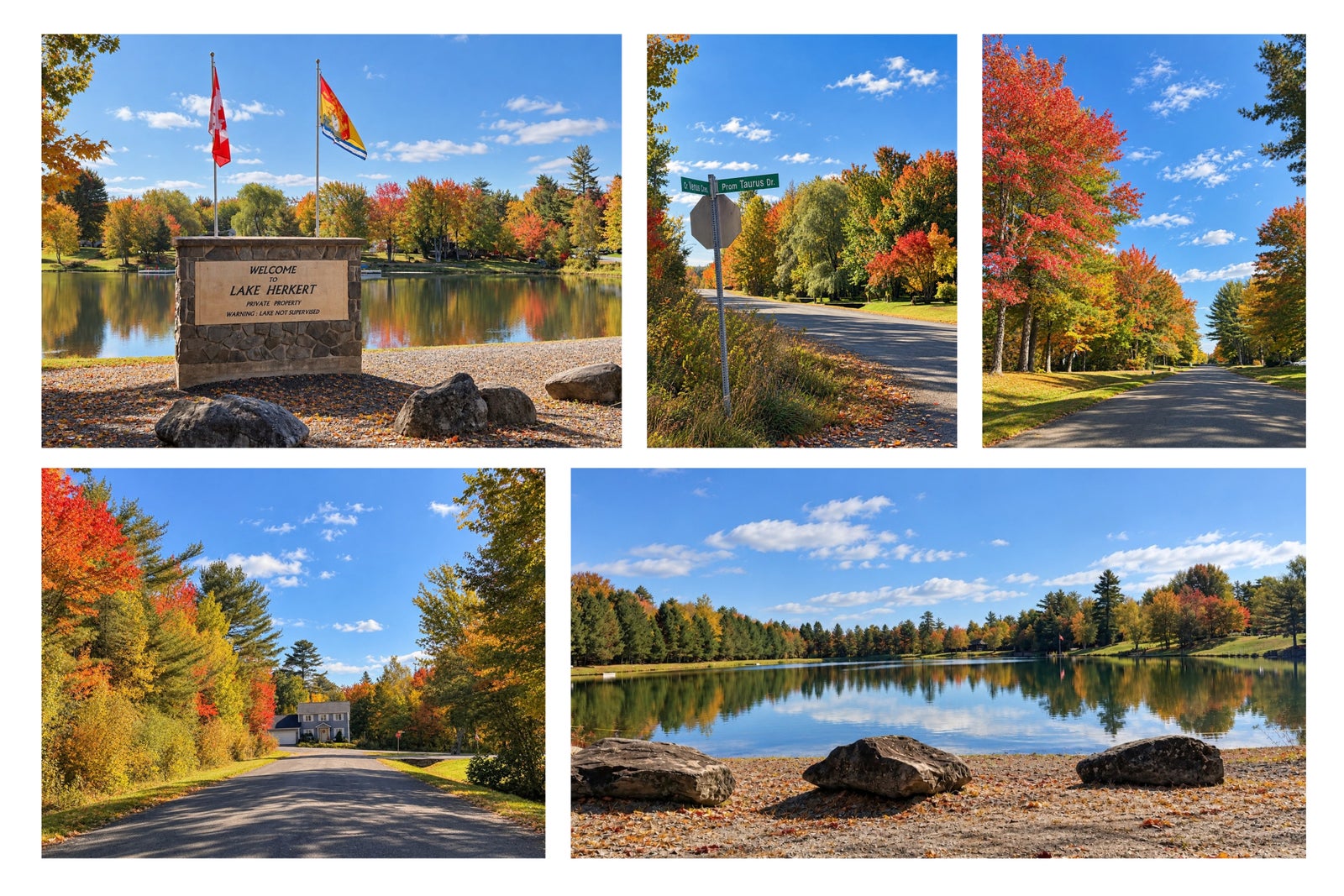
Space-themed streets, a lake tucked into the neighbourhood, large wooded lots and a community that grew alongside modern Hanwell — Starlite Village is more interesting than its familiar entrance from Hanwell Road might suggest.
If you grew up around Fredericton, you've probably heard someone say they live in Starlite.
Not Hanwell.
Not out the Hanwell Road.
Starlite.
That distinction says something.
Fredericton and the surrounding communities have plenty of subdivisions, but relatively few develop identities strong enough that their names survive for generations.
Starlite Village has.
Turn off the Hanwell Road and even the street names tell you this isn't an anonymous subdivision: Milky Way Drive, Jupiter Crescent, Mercury Lane, Neptune Crescent, Leo Lane, Libra Lane, Carina Lane, Aries Lane — even Lynx Lane.
Somewhere along the way, somebody committed to the theme.
But the names are only the beginning.
Hanwell began as a largely rural and agricultural community. The area's name dates to Thomas Baillie, who brought Irish immigrants to settle here in 1825. By the latter part of the 20th century, however, residential subdivisions were beginning to change the landscape substantially.
Hanwell's current Community Wildfire Resiliency Plan specifically identifies significant residential development beginning in the 1970s. Today, the Rural Community officially recognizes Starlite Village alongside established neighbourhoods including Brookdale, Deerwood Acres, Somerset Park, Birchwood Estates, Eaglewood, Eagle Ridge and Cobblestone Estates.
That transformation created something Fredericton-area buyers still recognize today:
country-sized lots without feeling completely disconnected from the city.
Starlite became one of the neighbourhoods that helped define that idea.
Jupiter.
Mercury.
Neptune.
Aries.
Leo.
Libra.
Carina.
It's easy to dismiss subdivision street names as trivia.
But neighbourhood identity is often built from little things.
A child growing up on Jupiter Crescent remembers that name.
Someone giving directions to Milky Way Drive remembers it.
And when several generations continue referring to the entire area as Starlite, the original development name becomes something more permanent.
It becomes geography.
That's actually one of the interesting differences between an established subdivision and a new one.
A developer can build streets and houses.
It takes decades for those streets to accumulate memories.
Lake Herkert sits within the neighbourhood landscape, along with ponds, wetlands and wooded areas that give Starlite considerably more natural character than its subdivision label might suggest.
And that environment isn't just something mentioned in real-estate descriptions.
It has generated genuine local attachment.
During a 2022 Hanwell Council meeting, a Starlite Village resident objected to the draining and filling of a neighbourhood pond. In her presentation, she described the pond as habitat for frogs, other amphibians, birds, aquatic plants and insects, and said the network of ponds, wetlands and Lake Herkert was part of what made Starlite Village special.
That's worth paying attention to.
People don't normally show up at council meetings to defend something they don't feel connected to.
The debate also raises a question that reaches well beyond Starlite:
When people buy into a neighbourhood partly because of its natural environment, how much responsibility does the community have to protect that environment as development continues?
That's a very Hanwell conversation in 2026.
Hanwell's own community newsletters document recreation at Lake Herkert. In 2012, for example, the Hanwell newsletter featured residents participating in the annual New Year's Day Polar Bear Dip there.
Hanwell municipal records from 2022 also refer to maintenance around Herkert Lake, including trails and the installation of “Children Playing” signs.
That history helps explain why the lake matters.
A neighbourhood with a natural gathering place tends to develop differently from one where every recreational space has to be constructed later.
And it gives Starlite something increasingly difficult to add to a new subdivision:
a natural feature around which community traditions have already formed.
This isn't a subdivision where every house looks as though it arrived in the same year.
Older homes have been renovated.
Landscaping has matured.
Trees that were once small have become part of the canopy.
Garages, decks and outdoor spaces have evolved.
And many properties retain the larger, more wooded lots associated with Hanwell living.
Recent listings illustrate that pattern. Properties within Starlite Village frequently combine generous, wooded lots with relatively easy access to Fredericton — including homes on Lynx Lane and Milky Way Drive that have recently come to market on large private lots.
That's a combination that continues to attract people to communities outside the city boundary:
🌲 privacy
🏡 more land
🚗 reasonable access to Fredericton
🌿 established natural surroundings
But Starlite no longer exists in the same Hanwell it did when many of its homes were new.
And that may be the biggest change of all.
That changed dramatically in September 2022.
Hanwell Park Academy opened as a Kindergarten-to-Grade 8 school designed for 650 students, with 37 classrooms, two gyms, music and performing-arts spaces, a library commons, project rooms and outdoor learning areas on approximately 34 acres.
The new school wasn't a small addition.
It was evidence of how much Hanwell had changed.
In its first year, just over 500 students walked through the doors.
For established neighbourhoods like Starlite, that altered the equation.
What had once been primarily a rural-suburban neighbourhood outside Fredericton was now part of a community with its own K–8 school, municipal government, recreation infrastructure and expanding local identity.
That's a significant evolution.
The houses came first.
Much of the broader community infrastructure followed later.
Hanwell incorporated as a Rural Community in 2014, after years as a local service district. Since then, municipal recreation and community facilities have become a much larger part of Hanwell life.
Today, Hanwell Recreation Park includes trails used for walking, skiing and snowshoeing, while the municipality even loans residents snowshoes and cross-country skis free of charge.
Hanwell's 2025–2029 Strategic Plan emphasizes trails, forests, outdoor recreation and the community's natural setting as important assets while acknowledging continued growth.
That's almost the reverse of how we usually think about neighbourhood planning.
Normally we imagine:
build the community → then build the houses.
Hanwell has spent decades doing some of it the other way around:
houses → neighbourhoods → municipality → school → recreation → stronger community identity.
Starlite has lived through nearly that entire transformation.
The qualities people value in established Hanwell neighbourhoods are often exactly the things most vulnerable to future change.
Large lots can be attractive for redevelopment.
Wooded properties can lose trees.
Wetlands can conflict with infrastructure.
More residents mean more traffic.
More services can mean more development.
And growing communities eventually face pressure to provide things that weren't considered when the original subdivision was laid out.
Hanwell's own 2026 wildfire planning document estimates the community's population at roughly 7,000 following the 2023 local-governance changes, although revised official census figures are still pending.
Hanwell isn't the quiet collection of rural subdivisions it once was.
It's becoming a much more complete community.
The question is whether that can happen without losing the landscape that attracted many residents in the first place.
Is it the houses?
The acre-sized lots?
The mature trees?
Lake Herkert?
The privacy?
The school nearby?
Or simply the fact that people have been calling this place home long enough that Starlite Village means something without needing to explain it?
Probably some combination of all of them.
But here's the question I'd like to hear longtime Hanwell residents answer:
Is Starlite better today because Hanwell has grown around it — or was part of its appeal the quieter, less-developed Hanwell that existed before?
And another:
As Hanwell continues growing, what is the one thing about established neighbourhoods like Starlite that shouldn't be sacrificed?
The large lots?
Trees?
Wetlands?
Quiet streets?
Access to nature?
Those answers may tell us a lot about what residents want the next Hanwell to look like.
It isn't Fredericton's newest neighbourhood.
It isn't Hanwell's newest subdivision.
And that's precisely the point.
Its trees have had time to grow.
Its houses have changed owners and been renovated.
Families have grown up there.
People have jumped into Lake Herkert on New Year's Day.
Residents have argued about protecting wetlands.
And while all of that was happening, Hanwell transformed around it.
Sometimes the most interesting neighbourhoods aren't the ones being built.
They're the ones that have been around long enough to become something their original developers couldn't entirely plan.
Starlite Village started as a subdivision.
Somewhere along the way, it became a place.
If you're considering a move to Hanwell, understanding those differences between its established neighbourhoods can be just as important as comparing the individual houses within them. We're always happy to help!
Space-themed streets, a lake tucked into the neighbourhood, large wooded lots and a community that grew alongside modern Hanwell — Starlite Village is more interesting than its familiar entrance from Hanwell Road might suggest.
If you grew up around Fredericton, you've probably heard someone say they live in Starlite.
Not Hanwell.
Not out the Hanwell Road.
Starlite.
That distinction says something.
Fredericton and the surrounding communities have plenty of subdivisions, but relatively few develop identities strong enough that their names survive for generations.
Starlite Village has.
Turn off the Hanwell Road and even the street names tell you this isn't an anonymous subdivision: Milky Way Drive, Jupiter Crescent, Mercury Lane, Neptune Crescent, Leo Lane, Libra Lane, Carina Lane, Aries Lane — even Lynx Lane.
Somewhere along the way, somebody committed to the theme.
But the names are only the beginning.
🌲 Starlite Is Part of a Much Bigger Hanwell Story
To understand Starlite, it helps to understand what happened to Hanwell.Hanwell began as a largely rural and agricultural community. The area's name dates to Thomas Baillie, who brought Irish immigrants to settle here in 1825. By the latter part of the 20th century, however, residential subdivisions were beginning to change the landscape substantially.
Hanwell's current Community Wildfire Resiliency Plan specifically identifies significant residential development beginning in the 1970s. Today, the Rural Community officially recognizes Starlite Village alongside established neighbourhoods including Brookdale, Deerwood Acres, Somerset Park, Birchwood Estates, Eaglewood, Eagle Ridge and Cobblestone Estates.
That transformation created something Fredericton-area buyers still recognize today:
country-sized lots without feeling completely disconnected from the city.
Starlite became one of the neighbourhoods that helped define that idea.
🌌 Yes, Those Street Names Really Are Part of the Character
Milky Way.Jupiter.
Mercury.
Neptune.
Aries.
Leo.
Libra.
Carina.
It's easy to dismiss subdivision street names as trivia.
But neighbourhood identity is often built from little things.
A child growing up on Jupiter Crescent remembers that name.
Someone giving directions to Milky Way Drive remembers it.
And when several generations continue referring to the entire area as Starlite, the original development name becomes something more permanent.
It becomes geography.
That's actually one of the interesting differences between an established subdivision and a new one.
A developer can build streets and houses.
It takes decades for those streets to accumulate memories.
💧 Then There's Lake Herkert
This is where Starlite becomes more unusual.Lake Herkert sits within the neighbourhood landscape, along with ponds, wetlands and wooded areas that give Starlite considerably more natural character than its subdivision label might suggest.
And that environment isn't just something mentioned in real-estate descriptions.
It has generated genuine local attachment.
During a 2022 Hanwell Council meeting, a Starlite Village resident objected to the draining and filling of a neighbourhood pond. In her presentation, she described the pond as habitat for frogs, other amphibians, birds, aquatic plants and insects, and said the network of ponds, wetlands and Lake Herkert was part of what made Starlite Village special.
That's worth paying attention to.
People don't normally show up at council meetings to defend something they don't feel connected to.
The debate also raises a question that reaches well beyond Starlite:
When people buy into a neighbourhood partly because of its natural environment, how much responsibility does the community have to protect that environment as development continues?
That's a very Hanwell conversation in 2026.
🏊 Lake Herkert Has Been Part of Community Life for Years
The lake isn't simply scenery behind someone's backyard.Hanwell's own community newsletters document recreation at Lake Herkert. In 2012, for example, the Hanwell newsletter featured residents participating in the annual New Year's Day Polar Bear Dip there.
Hanwell municipal records from 2022 also refer to maintenance around Herkert Lake, including trails and the installation of “Children Playing” signs.
That history helps explain why the lake matters.
A neighbourhood with a natural gathering place tends to develop differently from one where every recreational space has to be constructed later.
And it gives Starlite something increasingly difficult to add to a new subdivision:
a natural feature around which community traditions have already formed.
🏡 The Houses Have Matured Along With the Neighbourhood
Spend some time driving through Starlite and another thing becomes apparent.This isn't a subdivision where every house looks as though it arrived in the same year.
Older homes have been renovated.
Landscaping has matured.
Trees that were once small have become part of the canopy.
Garages, decks and outdoor spaces have evolved.
And many properties retain the larger, more wooded lots associated with Hanwell living.
Recent listings illustrate that pattern. Properties within Starlite Village frequently combine generous, wooded lots with relatively easy access to Fredericton — including homes on Lynx Lane and Milky Way Drive that have recently come to market on large private lots.
That's a combination that continues to attract people to communities outside the city boundary:
🌲 privacy
🏡 more land
🚗 reasonable access to Fredericton
🌿 established natural surroundings
But Starlite no longer exists in the same Hanwell it did when many of its homes were new.
And that may be the biggest change of all.
🎒 Hanwell Finally Got Its Own School
For decades, one of the realities of living in Hanwell was that children travelled outside the community for much of their schooling.That changed dramatically in September 2022.
Hanwell Park Academy opened as a Kindergarten-to-Grade 8 school designed for 650 students, with 37 classrooms, two gyms, music and performing-arts spaces, a library commons, project rooms and outdoor learning areas on approximately 34 acres.
The new school wasn't a small addition.
It was evidence of how much Hanwell had changed.
In its first year, just over 500 students walked through the doors.
For established neighbourhoods like Starlite, that altered the equation.
What had once been primarily a rural-suburban neighbourhood outside Fredericton was now part of a community with its own K–8 school, municipal government, recreation infrastructure and expanding local identity.
That's a significant evolution.
🥾 Hanwell Has Been Building the Community Around the Houses
This might be the most interesting chapter in Starlite's story.The houses came first.
Much of the broader community infrastructure followed later.
Hanwell incorporated as a Rural Community in 2014, after years as a local service district. Since then, municipal recreation and community facilities have become a much larger part of Hanwell life.
Today, Hanwell Recreation Park includes trails used for walking, skiing and snowshoeing, while the municipality even loans residents snowshoes and cross-country skis free of charge.
Hanwell's 2025–2029 Strategic Plan emphasizes trails, forests, outdoor recreation and the community's natural setting as important assets while acknowledging continued growth.
That's almost the reverse of how we usually think about neighbourhood planning.
Normally we imagine:
build the community → then build the houses.
Hanwell has spent decades doing some of it the other way around:
houses → neighbourhoods → municipality → school → recreation → stronger community identity.
Starlite has lived through nearly that entire transformation.
🌳 But Maturity Creates a New Challenge
Here's where the story gets more complicated.The qualities people value in established Hanwell neighbourhoods are often exactly the things most vulnerable to future change.
Large lots can be attractive for redevelopment.
Wooded properties can lose trees.
Wetlands can conflict with infrastructure.
More residents mean more traffic.
More services can mean more development.
And growing communities eventually face pressure to provide things that weren't considered when the original subdivision was laid out.
Hanwell's own 2026 wildfire planning document estimates the community's population at roughly 7,000 following the 2023 local-governance changes, although revised official census figures are still pending.
Hanwell isn't the quiet collection of rural subdivisions it once was.
It's becoming a much more complete community.
The question is whether that can happen without losing the landscape that attracted many residents in the first place.
❤️ The Hanwell Conversation
Starlite raises an interesting question about what makes a neighbourhood valuable.Is it the houses?
The acre-sized lots?
The mature trees?
Lake Herkert?
The privacy?
The school nearby?
Or simply the fact that people have been calling this place home long enough that Starlite Village means something without needing to explain it?
Probably some combination of all of them.
But here's the question I'd like to hear longtime Hanwell residents answer:
Is Starlite better today because Hanwell has grown around it — or was part of its appeal the quieter, less-developed Hanwell that existed before?
And another:
As Hanwell continues growing, what is the one thing about established neighbourhoods like Starlite that shouldn't be sacrificed?
The large lots?
Trees?
Wetlands?
Quiet streets?
Access to nature?
Those answers may tell us a lot about what residents want the next Hanwell to look like.
✨ More Than a Subdivision Name
Maybe that's why Starlite Village deserves a closer look.It isn't Fredericton's newest neighbourhood.
It isn't Hanwell's newest subdivision.
And that's precisely the point.
Its trees have had time to grow.
Its houses have changed owners and been renovated.
Families have grown up there.
People have jumped into Lake Herkert on New Year's Day.
Residents have argued about protecting wetlands.
And while all of that was happening, Hanwell transformed around it.
Sometimes the most interesting neighbourhoods aren't the ones being built.
They're the ones that have been around long enough to become something their original developers couldn't entirely plan.
Starlite Village started as a subdivision.
Somewhere along the way, it became a place.
If you're considering a move to Hanwell, understanding those differences between its established neighbourhoods can be just as important as comparing the individual houses within them. We're always happy to help!