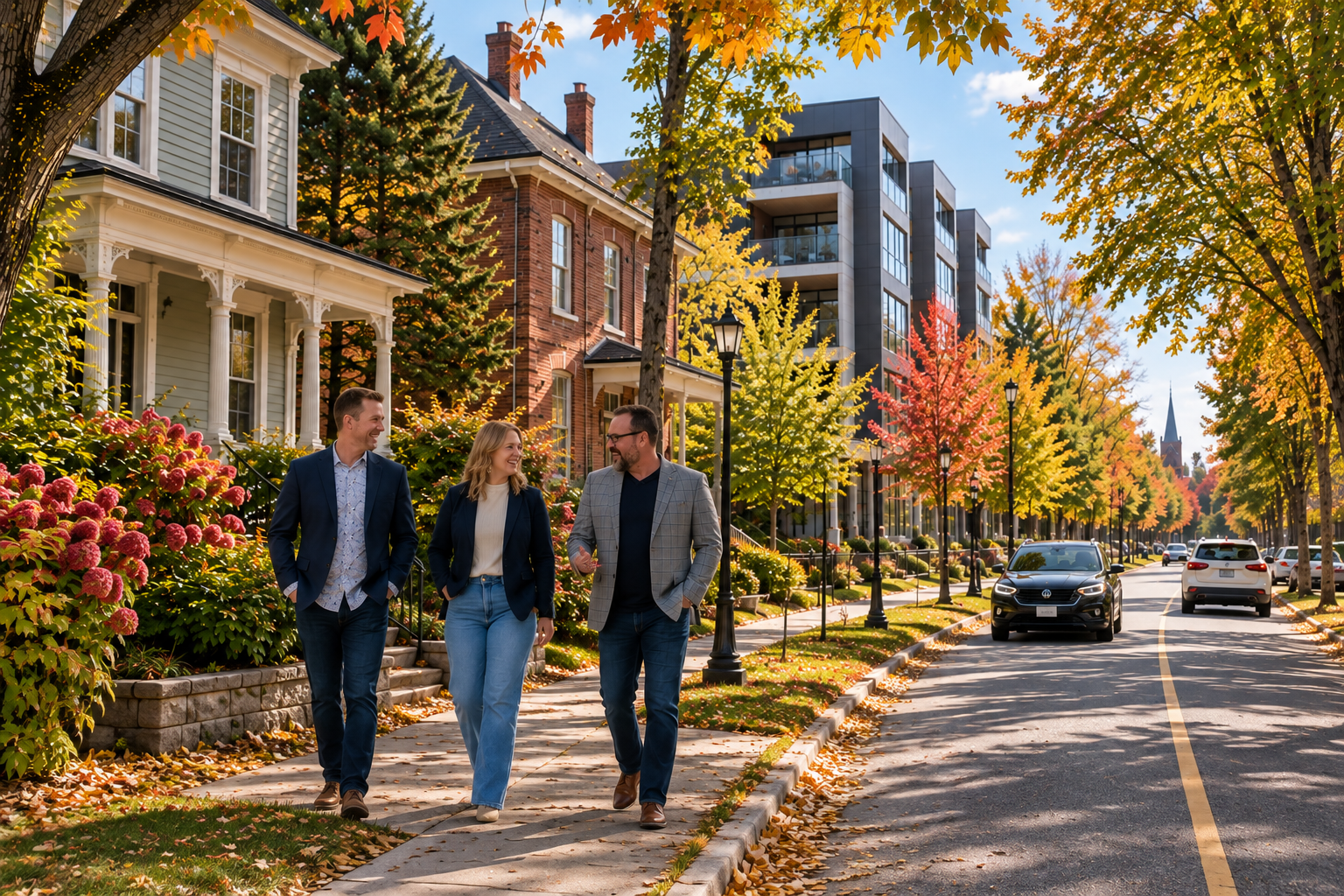
🏙️ Who Gets to Decide What Fredericton Looks Like Next? Housing, Density, Heritage & Design
🍁 The Rob Brown Realty JournalMonday | The Fredericton Conversation
Architecture, density, heritage, developers and residents — and the complicated question of who gets a say in what Fredericton looks like next.
A six-storey apartment building is proposed beside a neighbourhood of detached homes.
A century-old building stands on land that could accommodate dozens of new apartments.
A developer wants more height. Nearby residents want less traffic. Planners want density near services. Housing advocates want more homes. Heritage supporters want an existing streetscape protected.
And almost everyone says they want Fredericton to grow thoughtfully.
The disagreement usually begins with what thoughtfully actually means.
Fredericton is facing a substantial physical transformation. The City's 2025 Housing Needs Assessment estimates an existing shortage of 3,010 homes and says approximately 19,680 additional units will be required by 2044 when current shortages and future demand are combined.
Those homes have to go somewhere.
And that raises a question that is bigger than any individual development application:
Who actually gets to decide what Fredericton looks like next?
🗺️ The Short Answer? More People Than You Might Think.
Development isn't simply a negotiation between a developer and City Hall.Fredericton's Municipal Plan establishes the larger planning framework. Zoning determines what can generally happen on individual properties. City planners review proposals. The Planning Advisory Committee considers rezonings, subdivisions, plan amendments and significant variances. Some applications ultimately require decisions from City Council.
Residents have a role too.
For matters before the Planning Advisory Committee, the public can submit comments, participate virtually or attend meetings in person. PAC itself currently consists of six local citizens and three councillors.
And then there is the person who actually owns the property and may be investing millions of dollars into it.
Fredericton isn't designed by one person.
It emerges from rules, economics, professional design, private investment, public infrastructure and community reaction.
That may also explain why planning can become contentious.
Everyone gets a voice.
Not everyone gets a veto.
🏗️ Developers Decide More Than We Sometimes Acknowledge
A Municipal Plan can identify where growth should happen.Zoning can establish height, density, setbacks and permitted uses.
Design guidelines can influence how a building addresses the sidewalk.
But ultimately, somebody has to decide that a project is worth financing and building.
That gives developers considerable influence over the physical city.
They choose architects. They assemble land. They decide which projects are financially viable. They respond to construction costs, interest rates, market demand and the price people are willing to pay for housing.
That isn't inherently good or bad.
It's simply an important part of how cities get built.
A project that looks excellent on a planning map but cannot be financed remains a drawing.
And the opposite is also worth remembering:
Something being profitable doesn't automatically make it good urban design.
That's one reason cities have planning rules in the first place.
🏘️ Residents Have a Voice — But How Much Should That Voice Control?
This is where the conversation gets more difficult.Imagine someone proposes a four-storey apartment building near your house.
You may reasonably ask about:
🚗 traffic
🌳 tree removal
🏢 building height
☀️ shadowing
🚶 pedestrian safety
🚙 parking
🏠 neighbourhood character
Those aren't trivial concerns.
But now consider the person who doesn't live in the neighbourhood because there isn't a home there they can afford or rent.
Who represents them?
They won't receive a neighbourhood notice.
They probably won't attend a meeting.
They may not even know the development has been proposed.
Yet the decision affects them too.
That creates one of the fundamental tensions in housing policy:
Existing residents are easy to identify. Future residents aren't.
Fredericton's housing policy now explicitly supports a broader mixture of housing — including single-family homes, duplexes, garden suites and multi-unit buildings — as well as gentle density within existing neighbourhoods.
So when someone says “I support more housing, just not this development,” there is a reasonable follow-up question:
Then where should it go?
📏 Density Is Really a Design Question
The word density does a remarkable amount of work in development debates.But 50 homes can take very different forms.
They could be arranged in a large apartment building.
They could become townhouses.
They could be distributed among duplexes and smaller multi-unit buildings.
They could sit above commercial space.
Or they could occupy considerably more land as detached houses.
So perhaps the more useful question isn't:
“Do we want density?”
It's:
“What kind of density belongs here?”
Fredericton's downtown Built Form Design Guidelines are specifically intended to shape buildings individually so that, collectively, they create a comfortable, interesting and human-scaled pedestrian environment. They address building scale, character, heritage, parking and how development meets sidewalks and public spaces.
That's an important distinction.
Density tells us how much gets built.
Architecture determines much of what it feels like once it's there.
One has a blank ground floor, parking facing the sidewalk, little landscaping and an uninterrupted wall stretching most of a block.
The other has entrances facing the street, windows at pedestrian level, trees, smaller storefronts or residential entrances, setbacks on upper floors and materials that respond to surrounding buildings.
Both may contain the same number of homes.
They can have completely different effects on the street.
Fredericton's City Centre Plan explicitly addresses building design, sidewalks, pedestrian experience, parking, open space and land-use patterns, while its Built Form Guidelines seek to protect downtown's distinctive history while still allowing investment and revitalization.
So perhaps residents should spend less time asking only:
“How tall is it?”
And more time asking:
“What will it be like to walk past it every day for the next 50 years?”
That matters.
The City has protected heritage properties and areas where exterior alterations — including demolition — require a Certificate of Appropriateness. Proposed work is reviewed for compliance with the Preservation By-Law and compatibility with the neighbourhood.
But heritage creates legitimate competing interests.
A historic building may contribute enormously to a street while requiring expensive maintenance.
Its land may have considerably more development potential than the existing structure uses.
And Fredericton needs housing.
We've already seen another possibility in projects involving adaptive reuse: keep what is significant while giving the building a new economic purpose.
But that won't work everywhere.
Which leads to a question Fredericton will probably confront more frequently:
When does the public value of preserving a privately owned building outweigh the potential value of redeveloping the property?
And if the community insists that something must be preserved, how much responsibility should the community assume for making preservation financially realistic?
Those aren't anti-development or anti-heritage questions.
They're the practical questions underneath both positions.
Mature trees.
Traditional setbacks.
Porches.
Small commercial buildings.
Walkable blocks.
Views toward the river.
The relationship between houses and sidewalks.
Even the irregularity of buildings constructed in different decades can contribute to how a place feels.
Lose enough of those things one property at a time and no single development may appear responsible.
But eventually the street is different.
That's why the City's own downtown planning framework talks about the collective whole, not simply individual buildings.
Perhaps one of Fredericton's biggest planning challenges is learning to distinguish between nostalgia and genuine place-making.
Not everything old needs to remain.
Not everything new represents progress.
Fredericton's Housing Needs Assessment projects approximately 77,500 residents in 2024 and anticipates population growth of about 41% between 2024 and 2044.
The City's planning direction consequently includes gentle density in established neighbourhoods as well as substantial new growth areas. The planned Southeast New Neighbourhood alone is expected to accommodate roughly 5,000 to 7,000 residents over the next two decades.
So maintaining Fredericton exactly as it is isn't really one of the available options.
The city will change.
The choice is in how.
You can support more housing and dislike a particular development.
You can value heritage and believe an old building has reached the end of its useful life.
You can live beside a proposed apartment building and have legitimate concerns about it.
You can also desperately need an apartment in the neighbourhood where someone else would prefer that nothing change.
A developer can propose something completely legal that residents still dislike.
Residents can oppose something for understandable reasons even when the city desperately needs the homes it would provide.
Those positions don't automatically make anyone the villain.
The real question is how we weigh them.
Should existing residents have greater influence because they already live there?
Should citywide housing needs sometimes outweigh neighbourhood objections?
Should developers be required to meet a higher architectural standard when adding substantial density?
Should heritage protection become stronger — and should public incentives increase along with it?
And perhaps the most provocative question:
If everyone agrees Fredericton needs more housing, are we prepared to accept what a city with nearly 20,000 additional homes will actually look like?
That's the conversation worth having.
Those goals sound perfectly compatible on paper.
In practice, they're where almost every interesting planning debate begins.
Because eventually someone has to decide how tall the building can be.
Whether the old house stays.
How many apartments fit on the property.
Where the parking goes.
Which trees survive.
And what kind of street remains when construction is finished.
Maybe no single group should get to decide what Fredericton looks like next.
Developers bring investment. Planners bring long-term planning. Architects shape buildings. Residents bring lived experience. Heritage advocates remind us what can't be replaced. And future residents need homes even though they aren't yet sitting in the meeting room.
The challenge isn't choosing which one of those voices matters.
It's building a city where we can still recognize what made Fredericton special — while making enough room for the people who want to be part of what comes next.
If you're buying, selling or investing in Fredericton, understanding where a neighbourhood is heading can be every bit as important as understanding where it has been. We're always happy to help!
“What kind of density belongs here?”
Fredericton's downtown Built Form Design Guidelines are specifically intended to shape buildings individually so that, collectively, they create a comfortable, interesting and human-scaled pedestrian environment. They address building scale, character, heritage, parking and how development meets sidewalks and public spaces.
That's an important distinction.
Density tells us how much gets built.
Architecture determines much of what it feels like once it's there.
🧱 Architecture Matters More Than Height Alone
Consider two hypothetical six-storey buildings.One has a blank ground floor, parking facing the sidewalk, little landscaping and an uninterrupted wall stretching most of a block.
The other has entrances facing the street, windows at pedestrian level, trees, smaller storefronts or residential entrances, setbacks on upper floors and materials that respond to surrounding buildings.
Both may contain the same number of homes.
They can have completely different effects on the street.
Fredericton's City Centre Plan explicitly addresses building design, sidewalks, pedestrian experience, parking, open space and land-use patterns, while its Built Form Guidelines seek to protect downtown's distinctive history while still allowing investment and revitalization.
So perhaps residents should spend less time asking only:
“How tall is it?”
And more time asking:
“What will it be like to walk past it every day for the next 50 years?”
🏛️ Then Heritage Complicates Everything
Fredericton isn't building on an empty canvas.That matters.
The City has protected heritage properties and areas where exterior alterations — including demolition — require a Certificate of Appropriateness. Proposed work is reviewed for compliance with the Preservation By-Law and compatibility with the neighbourhood.
But heritage creates legitimate competing interests.
A historic building may contribute enormously to a street while requiring expensive maintenance.
Its land may have considerably more development potential than the existing structure uses.
And Fredericton needs housing.
We've already seen another possibility in projects involving adaptive reuse: keep what is significant while giving the building a new economic purpose.
But that won't work everywhere.
Which leads to a question Fredericton will probably confront more frequently:
When does the public value of preserving a privately owned building outweigh the potential value of redeveloping the property?
And if the community insists that something must be preserved, how much responsibility should the community assume for making preservation financially realistic?
Those aren't anti-development or anti-heritage questions.
They're the practical questions underneath both positions.
🌳 What About the Things Zoning Can't Easily Replace?
A building isn't the entire neighbourhood.Mature trees.
Traditional setbacks.
Porches.
Small commercial buildings.
Walkable blocks.
Views toward the river.
The relationship between houses and sidewalks.
Even the irregularity of buildings constructed in different decades can contribute to how a place feels.
Lose enough of those things one property at a time and no single development may appear responsible.
But eventually the street is different.
That's why the City's own downtown planning framework talks about the collective whole, not simply individual buildings.
Perhaps one of Fredericton's biggest planning challenges is learning to distinguish between nostalgia and genuine place-making.
Not everything old needs to remain.
Not everything new represents progress.
🏡 And We Really Do Need the Homes
This part can't disappear from the conversation.Fredericton's Housing Needs Assessment projects approximately 77,500 residents in 2024 and anticipates population growth of about 41% between 2024 and 2044.
The City's planning direction consequently includes gentle density in established neighbourhoods as well as substantial new growth areas. The planned Southeast New Neighbourhood alone is expected to accommodate roughly 5,000 to 7,000 residents over the next two decades.
So maintaining Fredericton exactly as it is isn't really one of the available options.
The city will change.
The choice is in how.
❤️ The Fredericton Conversation
Maybe this is where we need to give ourselves permission to disagree.You can support more housing and dislike a particular development.
You can value heritage and believe an old building has reached the end of its useful life.
You can live beside a proposed apartment building and have legitimate concerns about it.
You can also desperately need an apartment in the neighbourhood where someone else would prefer that nothing change.
A developer can propose something completely legal that residents still dislike.
Residents can oppose something for understandable reasons even when the city desperately needs the homes it would provide.
Those positions don't automatically make anyone the villain.
The real question is how we weigh them.
Should existing residents have greater influence because they already live there?
Should citywide housing needs sometimes outweigh neighbourhood objections?
Should developers be required to meet a higher architectural standard when adding substantial density?
Should heritage protection become stronger — and should public incentives increase along with it?
And perhaps the most provocative question:
If everyone agrees Fredericton needs more housing, are we prepared to accept what a city with nearly 20,000 additional homes will actually look like?
That's the conversation worth having.
🌿 The City We're Leaving Behind
Fredericton's Municipal Plan describes a city that is both progressive and modern while retaining its unique charm and character. The plan itself was shaped through public meetings and input from residents, businesses and other groups before its adoption in 2020.Those goals sound perfectly compatible on paper.
In practice, they're where almost every interesting planning debate begins.
Because eventually someone has to decide how tall the building can be.
Whether the old house stays.
How many apartments fit on the property.
Where the parking goes.
Which trees survive.
And what kind of street remains when construction is finished.
Maybe no single group should get to decide what Fredericton looks like next.
Developers bring investment. Planners bring long-term planning. Architects shape buildings. Residents bring lived experience. Heritage advocates remind us what can't be replaced. And future residents need homes even though they aren't yet sitting in the meeting room.
The challenge isn't choosing which one of those voices matters.
It's building a city where we can still recognize what made Fredericton special — while making enough room for the people who want to be part of what comes next.
If you're buying, selling or investing in Fredericton, understanding where a neighbourhood is heading can be every bit as important as understanding where it has been. We're always happy to help!