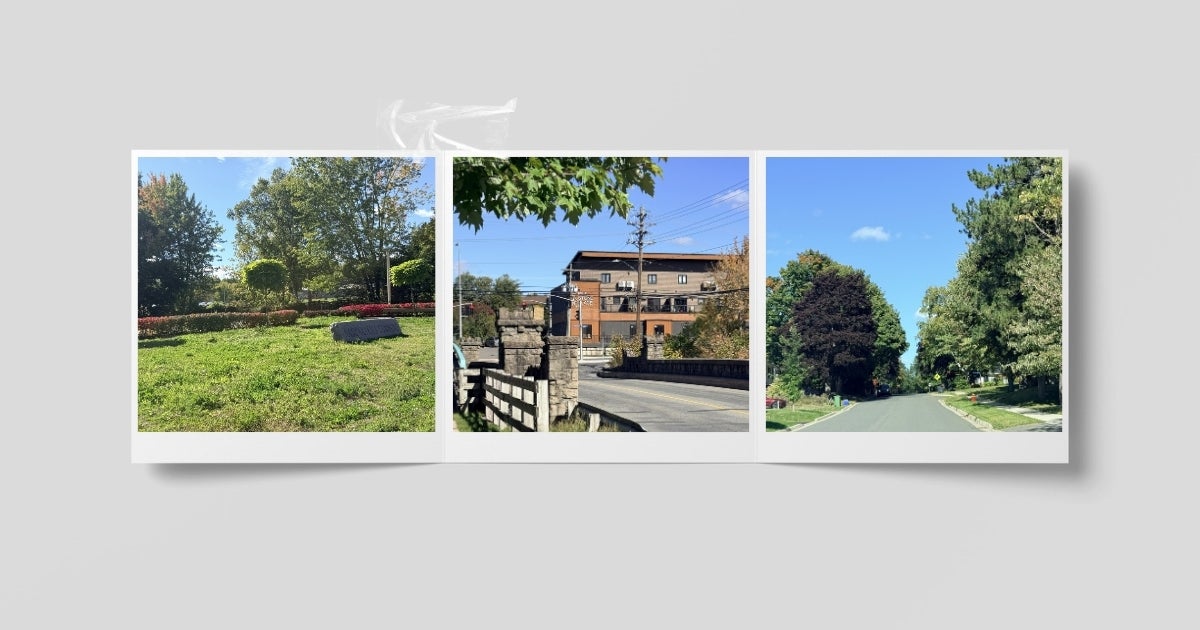
🌳 Nashwaaksis Fredericton: Why This Northside Neighbourhood Keeps Reinventing Itself
🍁 The Rob Brown Realty JournalThursday | Fredericton Neighbourhoods
Why one of Fredericton’s most established Northside neighbourhoods may also be one of its most adaptable.
Nashwaaksis is easy to underestimate.
For many Frederictonians, it is the familiar Northside of split-entries and bungalows, schools and ballfields, Main Street errands, Brookside Drive traffic and neighbourhood streets that have been there for decades.
But look more closely and Nashwaaksis has been reinventing itself for generations.
It went from a separate community to part of Fredericton. Main Street went from a rural village road to an automobile-oriented commercial strip. Postwar subdivisions filled with young families became mature neighbourhoods. And now the City is planning another transformation — more housing, more mixed-use development and a Main Street designed less like a commercial highway and more like an actual urban neighbourhood.
Nashwaaksis isn't standing still.
The more interesting question is whether its next version will be better than the last one.
Nashwaaksis existed independently until 1973, when Fredericton amalgamated Nashwaaksis, Marysville, Barker's Point, Silverwood and portions of Douglas and Lincoln.
That single expansion roughly doubled both Fredericton's population and its geographic area.
So when longtime residents say they're from Nashwaaksis rather than simply saying Fredericton, there is some history behind it.
The area had its own schools, churches, businesses and community organizations before becoming part of the city.
St. John the Evangelist Anglican Church, for example, traces its Nashwaaksis roots to the 1850s, when plans called for a small church near the mills in what was still a distinct settlement.
And in 1966 — seven years before amalgamation — residents formed the Nashwaaksis Lions Club, another reminder that community institutions here predate modern municipal boundaries.
Nashwaaksis didn't begin as a Fredericton subdivision.
Fredericton eventually grew around it.
Fredericton needed housing.
Land across the river was comparatively inexpensive.
And from the 1950s through the 1970s, Nashwaaksis experienced an explosion of residential development.
The City's Main Street Urban Design Plan describes exactly what happened: housing demand and inexpensive land brought a new suburban population to Nashwaaksis, which in turn transformed Main Street from a rural village main street into a modern commercial corridor serving people arriving primarily by automobile.
That explains a lot about the neighbourhood today.
The bungalows.
Split-levels and split-entries.
Generous residential lots.
Curving subdivision streets.
Schools embedded within neighbourhoods.
And a commercial Main Street where parking lots became nearly as important as storefronts.
At the time, that was modern planning.
Nashwaaksis was Fredericton's answer to a housing shortage.
Sound familiar?
As more families moved north, Main Street evolved to serve them.
Instead of needing to cross the river for every purchase or service, Northside residents increasingly had their own commercial centre.
Today, the Main Street/Brookside area remains a major shopping and service hub. Nashwaaksis Plaza alone, at Main Street and Brookside Drive, contains roughly 55,500 square feet and 18 stores and services, according to its property owner.
But there is a trade-off.
The same development pattern that made Main Street extremely convenient by car also produced something the City's own planning documents acknowledge:
an auto-oriented environment that isn't particularly appealing to pedestrians.
That's why what's happening on Main Street today is more significant than a road reconstruction project.
Fredericton is effectively trying to reinvent the street again.
transition Main Street from a suburban corridor into an urban centre.
The plan calls for mixed-use buildings, homes along Main Street, businesses closer to the sidewalk, improved trail connections, more pedestrian space and better connections between Main Street and the residential neighbourhoods behind it.
The physical work is already underway.
Phase 1 began the multi-year infrastructure renewal. Phase 2 between Brookside Drive and Hillcourt Drive includes replacement of water, sanitary and storm sewer infrastructure, reconstruction of the Killarney Brook Bridge and implementation of Main Street streetscape improvements. The project also includes flood-resilience measures intended to better manage heavy rainfall and higher water levels.
The City's street design manual goes even further.
Its future Main Street remains three lanes, but with narrower vehicle lanes, greater pedestrian priority, street trees and planting, improved connections to Nashwaaksis Creek and the trail system, and a streetscape intended to slow traffic and make walking more comfortable.
That's a fundamental shift in philosophy.
The first reinvention of Main Street made it easier to drive to.
The next one is trying to make people actually want to be there.
Growth is moving farther out.
The City's Growth Strategy identifies the Brookside area as one of Fredericton's major future residential growth areas, intended to accommodate substantial new housing with a mixture of types and densities.
The Northbrook subdivision, for example, is being planned around multiple housing forms, interconnected streets, pathways and neighbourhood parks.
But perhaps the most interesting piece is what the City has envisioned around Brookside Mall.
Rather than treating a shopping centre and its parking lots as permanently fixed, Fredericton's Growth Strategy identifies the Brookside Mall area as a future mixed-use node. It specifically contemplates intensification through possibilities such as housing on underused parking areas and even partial redevelopment of the mall itself.
Think about how different that is from the original suburban formula.
For decades the model was:
houses over here + shopping over there + drive between them.
The next version could be:
housing + shopping + services + transit + trails in the same area.
In some ways, Nashwaaksis could end up becoming more urban as it gets older.
Drive away from Main Street and much of Nashwaaksis feels very different.
Older residential streets have had something new subdivisions cannot manufacture quickly:
time.
Trees have matured.
Gardens have filled in.
Schools and recreation facilities have become embedded in community life.
Homes have been renovated, expanded and adapted by successive owners.
That matters because established neighbourhoods don't necessarily become obsolete when their houses get older.
Sometimes they become more desirable because the neighbourhood around the houses has matured.
And the housing stock can change without the streets disappearing.
A bungalow can be renovated.
A split-entry can accommodate another generation.
A basement can become additional living space or, where permitted and appropriate, another dwelling.
Fredericton's current housing approach specifically supports a mix ranging from single-family homes and duplexes to garden suites and multi-unit buildings, including gentle density within existing neighbourhoods.
That could make Nashwaaksis an interesting test.
Can a postwar suburb add people without losing what existing residents already like about it?
According to the New Brunswick REALTORS® du Nouveau Brunswick / CREA August 2026 market report, Nashwaaksis recorded:
🏡 31 residential sales, compared with 19 in August 2025.
📋 55 active listings, compared with 40 a year earlier.
⏱️ Just 1.8 months of inventory.
💰 A composite MLS® HPI benchmark price of $420,100, up 6.2% year over year.
That's particularly interesting because the overall Fredericton and Region market had 3.4 months of inventory in August.
In other words, while buyers had noticeably more choice across the broader region, Nashwaaksis remained considerably tighter.
That doesn't prove why people are buying there.
But it does tell us that an established postwar neighbourhood can remain relevant even while entirely new communities are being built elsewhere.
People often say they want:
🚶 more walkability
🏘️ more housing choices
🌳 mature trees
🚲 better trail connections
☕ neighbourhood businesses
🚌 stronger transit
🏡 and the quiet character of established residential streets.
The problem is that achieving some of those things can change the neighbourhood that already exists.
More housing means more people.
Mixed-use development means taller or larger buildings in some places.
A more successful Main Street can mean more activity.
Growth around Brookside can mean more traffic before transportation patterns adjust.
And gentle density can mean the house next door doesn't always remain a single-family house forever.
We can't really ask Nashwaaksis to reinvent itself while insisting that nothing about it change.
It has already lived through several versions of itself.
A separate community.
A postwar suburb.
A newly amalgamated part of Fredericton.
A car-oriented Northside commercial hub.
An established family neighbourhood.
And now, potentially, something denser, more connected and more urban.
So here's the question:
What should Nashwaaksis become next?
Should Main Street eventually have apartments over shops and considerably more people living along it?
Should Brookside Mall's large commercial properties become mixed-use neighbourhoods?
Should established residential streets accept more gentle density?
Or is the real appeal of Nashwaaksis precisely that it still offers the kind of traditional suburban neighbourhood Fredericton shouldn't be too quick to change?
There probably isn't one answer.
But Nashwaaksis has one advantage many new neighbourhoods don't:
it has already proven that it can change without losing its name, its community or its relevance.
Nashwaaksis hasn't repeatedly torn itself down and started again.
It has added layers.
The village became a suburb.
The suburb became part of the city.
Main Street became a commercial corridor.
Now that corridor is being asked to become a neighbourhood again.
And the next generation of housing is being planned alongside streets that have already housed several generations of Fredericton families.
That's what makes Nashwaaksis worth watching.
The Northside's next chapter may not be about replacing the neighbourhood that exists. It may be about figuring out how much more neighbourhood can fit inside it.
If you're considering buying or selling in Nashwaaksis, the interesting question isn't only what a particular home offers today — it's how this part of Fredericton continues to evolve around it. We're always happy to help!
Why one of Fredericton’s most established Northside neighbourhoods may also be one of its most adaptable.
Nashwaaksis is easy to underestimate.
For many Frederictonians, it is the familiar Northside of split-entries and bungalows, schools and ballfields, Main Street errands, Brookside Drive traffic and neighbourhood streets that have been there for decades.
But look more closely and Nashwaaksis has been reinventing itself for generations.
It went from a separate community to part of Fredericton. Main Street went from a rural village road to an automobile-oriented commercial strip. Postwar subdivisions filled with young families became mature neighbourhoods. And now the City is planning another transformation — more housing, more mixed-use development and a Main Street designed less like a commercial highway and more like an actual urban neighbourhood.
Nashwaaksis isn't standing still.
The more interesting question is whether its next version will be better than the last one.
🗺️ First, Nashwaaksis Wasn't Always Fredericton
That distinction helps explain why the neighbourhood still has such a strong identity.Nashwaaksis existed independently until 1973, when Fredericton amalgamated Nashwaaksis, Marysville, Barker's Point, Silverwood and portions of Douglas and Lincoln.
That single expansion roughly doubled both Fredericton's population and its geographic area.
So when longtime residents say they're from Nashwaaksis rather than simply saying Fredericton, there is some history behind it.
The area had its own schools, churches, businesses and community organizations before becoming part of the city.
St. John the Evangelist Anglican Church, for example, traces its Nashwaaksis roots to the 1850s, when plans called for a small church near the mills in what was still a distinct settlement.
And in 1966 — seven years before amalgamation — residents formed the Nashwaaksis Lions Club, another reminder that community institutions here predate modern municipal boundaries.
Nashwaaksis didn't begin as a Fredericton subdivision.
Fredericton eventually grew around it.
🏡 Then Came the Postwar Housing Boom
The Nashwaaksis most people recognize today really took shape after the Second World War.Fredericton needed housing.
Land across the river was comparatively inexpensive.
And from the 1950s through the 1970s, Nashwaaksis experienced an explosion of residential development.
The City's Main Street Urban Design Plan describes exactly what happened: housing demand and inexpensive land brought a new suburban population to Nashwaaksis, which in turn transformed Main Street from a rural village main street into a modern commercial corridor serving people arriving primarily by automobile.
That explains a lot about the neighbourhood today.
The bungalows.
Split-levels and split-entries.
Generous residential lots.
Curving subdivision streets.
Schools embedded within neighbourhoods.
And a commercial Main Street where parking lots became nearly as important as storefronts.
At the time, that was modern planning.
Nashwaaksis was Fredericton's answer to a housing shortage.
Sound familiar?
🛍️ Main Street Followed the Families
Housing wasn't the only thing changing.As more families moved north, Main Street evolved to serve them.
Instead of needing to cross the river for every purchase or service, Northside residents increasingly had their own commercial centre.
Today, the Main Street/Brookside area remains a major shopping and service hub. Nashwaaksis Plaza alone, at Main Street and Brookside Drive, contains roughly 55,500 square feet and 18 stores and services, according to its property owner.
But there is a trade-off.
The same development pattern that made Main Street extremely convenient by car also produced something the City's own planning documents acknowledge:
an auto-oriented environment that isn't particularly appealing to pedestrians.
That's why what's happening on Main Street today is more significant than a road reconstruction project.
Fredericton is effectively trying to reinvent the street again.
🚧 Main Street 3.0?
The City's 2016 Main Street Urban Design Plan contains a surprisingly ambitious instruction:transition Main Street from a suburban corridor into an urban centre.
The plan calls for mixed-use buildings, homes along Main Street, businesses closer to the sidewalk, improved trail connections, more pedestrian space and better connections between Main Street and the residential neighbourhoods behind it.
The physical work is already underway.
Phase 1 began the multi-year infrastructure renewal. Phase 2 between Brookside Drive and Hillcourt Drive includes replacement of water, sanitary and storm sewer infrastructure, reconstruction of the Killarney Brook Bridge and implementation of Main Street streetscape improvements. The project also includes flood-resilience measures intended to better manage heavy rainfall and higher water levels.
The City's street design manual goes even further.
Its future Main Street remains three lanes, but with narrower vehicle lanes, greater pedestrian priority, street trees and planting, improved connections to Nashwaaksis Creek and the trail system, and a streetscape intended to slow traffic and make walking more comfortable.
That's a fundamental shift in philosophy.
The first reinvention of Main Street made it easier to drive to.
The next one is trying to make people actually want to be there.
🏘️ And the Housing Story Isn't Finished
Nashwaaksis isn't only renovating what already exists.Growth is moving farther out.
The City's Growth Strategy identifies the Brookside area as one of Fredericton's major future residential growth areas, intended to accommodate substantial new housing with a mixture of types and densities.
The Northbrook subdivision, for example, is being planned around multiple housing forms, interconnected streets, pathways and neighbourhood parks.
But perhaps the most interesting piece is what the City has envisioned around Brookside Mall.
Rather than treating a shopping centre and its parking lots as permanently fixed, Fredericton's Growth Strategy identifies the Brookside Mall area as a future mixed-use node. It specifically contemplates intensification through possibilities such as housing on underused parking areas and even partial redevelopment of the mall itself.
Think about how different that is from the original suburban formula.
For decades the model was:
houses over here + shopping over there + drive between them.
The next version could be:
housing + shopping + services + transit + trails in the same area.
In some ways, Nashwaaksis could end up becoming more urban as it gets older.
🌲 The Established Streets May Be Its Secret Weapon
But redevelopment isn't the whole story.Drive away from Main Street and much of Nashwaaksis feels very different.
Older residential streets have had something new subdivisions cannot manufacture quickly:
time.
Trees have matured.
Gardens have filled in.
Schools and recreation facilities have become embedded in community life.
Homes have been renovated, expanded and adapted by successive owners.
That matters because established neighbourhoods don't necessarily become obsolete when their houses get older.
Sometimes they become more desirable because the neighbourhood around the houses has matured.
And the housing stock can change without the streets disappearing.
A bungalow can be renovated.
A split-entry can accommodate another generation.
A basement can become additional living space or, where permitted and appropriate, another dwelling.
Fredericton's current housing approach specifically supports a mix ranging from single-family homes and duplexes to garden suites and multi-unit buildings, including gentle density within existing neighbourhoods.
That could make Nashwaaksis an interesting test.
Can a postwar suburb add people without losing what existing residents already like about it?
📈 Buyers Are Still Voting for Nashwaaksis
The latest housing numbers suggest the neighbourhood remains highly competitive.According to the New Brunswick REALTORS® du Nouveau Brunswick / CREA August 2026 market report, Nashwaaksis recorded:
🏡 31 residential sales, compared with 19 in August 2025.
📋 55 active listings, compared with 40 a year earlier.
⏱️ Just 1.8 months of inventory.
💰 A composite MLS® HPI benchmark price of $420,100, up 6.2% year over year.
That's particularly interesting because the overall Fredericton and Region market had 3.4 months of inventory in August.
In other words, while buyers had noticeably more choice across the broader region, Nashwaaksis remained considerably tighter.
That doesn't prove why people are buying there.
But it does tell us that an established postwar neighbourhood can remain relevant even while entirely new communities are being built elsewhere.
⚖️ Reinvention Comes With a Catch
There is an obvious tension in all of this.People often say they want:
🚶 more walkability
🏘️ more housing choices
🌳 mature trees
🚲 better trail connections
☕ neighbourhood businesses
🚌 stronger transit
🏡 and the quiet character of established residential streets.
The problem is that achieving some of those things can change the neighbourhood that already exists.
More housing means more people.
Mixed-use development means taller or larger buildings in some places.
A more successful Main Street can mean more activity.
Growth around Brookside can mean more traffic before transportation patterns adjust.
And gentle density can mean the house next door doesn't always remain a single-family house forever.
We can't really ask Nashwaaksis to reinvent itself while insisting that nothing about it change.
❤️ The Fredericton Conversation
Maybe that's what makes Nashwaaksis particularly interesting.It has already lived through several versions of itself.
A separate community.
A postwar suburb.
A newly amalgamated part of Fredericton.
A car-oriented Northside commercial hub.
An established family neighbourhood.
And now, potentially, something denser, more connected and more urban.
So here's the question:
What should Nashwaaksis become next?
Should Main Street eventually have apartments over shops and considerably more people living along it?
Should Brookside Mall's large commercial properties become mixed-use neighbourhoods?
Should established residential streets accept more gentle density?
Or is the real appeal of Nashwaaksis precisely that it still offers the kind of traditional suburban neighbourhood Fredericton shouldn't be too quick to change?
There probably isn't one answer.
But Nashwaaksis has one advantage many new neighbourhoods don't:
it has already proven that it can change without losing its name, its community or its relevance.
🌿 The Next Nashwaaksis
Perhaps reinvention is the wrong word.Nashwaaksis hasn't repeatedly torn itself down and started again.
It has added layers.
The village became a suburb.
The suburb became part of the city.
Main Street became a commercial corridor.
Now that corridor is being asked to become a neighbourhood again.
And the next generation of housing is being planned alongside streets that have already housed several generations of Fredericton families.
That's what makes Nashwaaksis worth watching.
The Northside's next chapter may not be about replacing the neighbourhood that exists. It may be about figuring out how much more neighbourhood can fit inside it.
If you're considering buying or selling in Nashwaaksis, the interesting question isn't only what a particular home offers today — it's how this part of Fredericton continues to evolve around it. We're always happy to help!