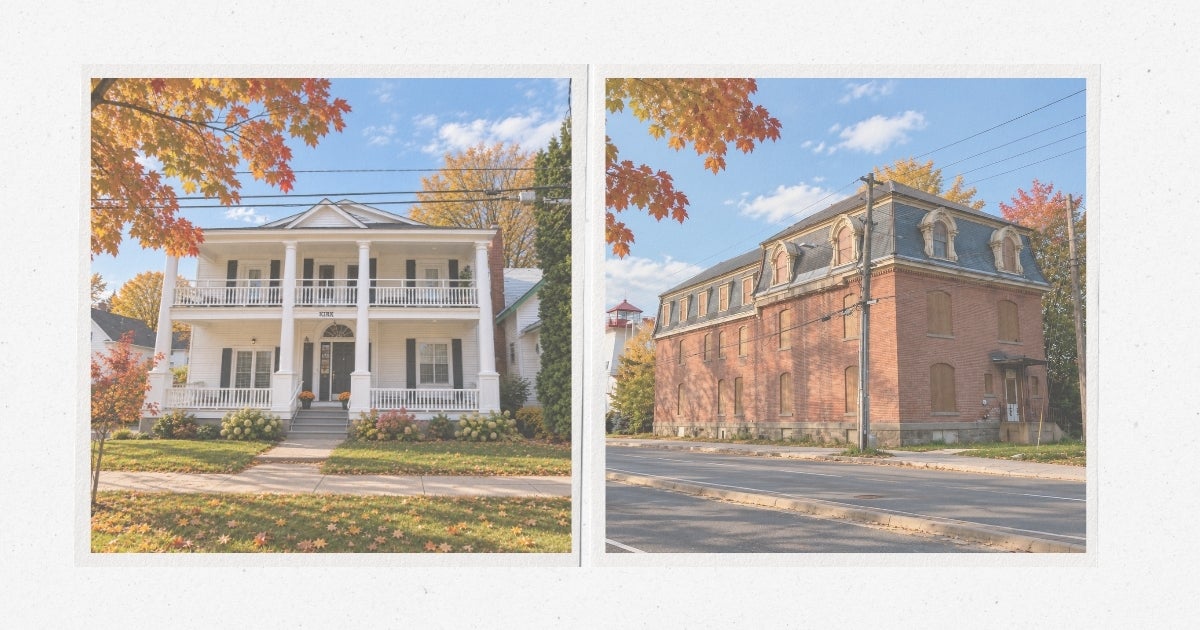
🏡 The Old Neighbourhoods We Almost Lost: Why Fredericton's Old Houses Still Matter
🍁 The Rob Brown Realty JournalWednesday | Fredericton Streets, Neighbourhoods & History
Preservation, adaptation — and why Fredericton’s old houses matter more than we sometimes realize.
Walk along Church Street, George Street, Waterloo Row or through the South Core and it is easy to assume Fredericton's historic streets were always destined to survive.
They weren't.
Buildings become obsolete. Owners change. Maintenance gets expensive. Development pressure increases. What one generation considers outdated, another may eventually consider irreplaceable.
And Fredericton has faced versions of that choice before.
The more interesting lesson isn't that every old building needs to be saved.
It's that some of the places we now consider essential to Fredericton survived precisely because someone found a way for them to change.
🏛️ Even Queen Street Wasn't Guaranteed
Perhaps the best reminder is downtown itself.In the latter part of the 20th century, Fredericton seriously considered a major redevelopment proposal for Queen Street that would have involved demolition of historic buildings. Opposition to large-scale redevelopment became part of the movement that ultimately strengthened organized heritage advocacy in the city.
Today, the conversation sounds almost strange.
Queen Street's historic buildings, City Hall, Officers' Square, the Garrison District and surrounding streetscape are now fundamental pieces of Fredericton's downtown identity.
The lesson isn't that redevelopment is inherently bad.
It's that cities sometimes recognize the value of a place only when they are close to changing it permanently.
And buildings aren't the only things that matter.
During the more recent redevelopment of Officers' Square, public concern about mature trees resulted in revised plans. In 2018, Council selected an option designed to conserve eight large, mature trees, including the prominent elm near Queen Street.
Heritage, it turns out, can include the spaces between buildings too.
⛪ One Fredericton Building Was Saved by Moving It — Twice
At 433 Charlotte Street stands one of the best examples of adaptation in the city.The Auld Kirk was originally St. Paul's Presbyterian Church, dedicated in 1830 at George and York Streets.
When a larger St. Paul's was planned, the old church was moved in 1882 rather than immediately demolished.
Then came another problem.
By 1916, the building was again in the way of new construction. Demolition was considered.
Instead, it was sold and moved again — this time to Charlotte Street.
The relocation was described in the City's historic-place records as the most substantial building-moving undertaking in Fredericton's history. The former church was subsequently converted into apartments.
Think about that for a moment.
A building erected as a church nearly two centuries ago survived because Fredericton allowed it to stop being a church.
That's not preservation through freezing something in time.
That's preservation through usefulness.
🔑 Old Houses Have Always Changed
There's a tendency to imagine a heritage house as something that should remain exactly as it appeared when it was built.Fredericton's own history tells a different story.
Homes we've explored previously in the Journal have been enlarged, divided into apartments, converted back into residences, joined to neighbouring buildings and adapted for institutional or commercial uses.
The City's current heritage guidelines explicitly accommodate additions, infill, integrated development and new development adjacent to heritage properties. They also make an important distinction: a new building doesn't need to pretend it was built in 1890 to fit beside one that was.
That's a useful way to think about preservation.
The goal isn't necessarily to preserve an old building's original use.
It is to identify what makes the building or streetscape significant — and find a viable way to carry that value forward.
🧱 Lemont House Shows What That Can Look Like
Consider Lemont House on Queen Street.Built in 1882, the Second Empire-style building began as a residence. It later became a community centre and eventually contained 15 rental units before sitting vacant for several years. The City acquired the property and gave it heritage protection, then sought a buyer willing to invest in preserving and revitalizing it.
By January 2025, City planning documents described a proposal to convert the vacant building into 17 affordable housing units, with no major alterations proposed to the site. Because of its heritage designation, exterior renovation materials were subject to heritage approval.
That's the kind of heritage conversation worth having.
An 1882 building doesn't have to become a museum.
It can become housing.
Preservation and housing aren't automatically opposing ideas.
Sometimes the old building can be part of the housing solution.
🌳 Why an Ordinary Old House Can Matter
Not every old Fredericton house was occupied by a premier, a lieutenant-governor or a famous artist.Most weren't.
But that doesn't necessarily make them disposable.
The City's South Core planning work identifies its historic character as a combination of civic buildings, former industrial structures and modest houses dating to the late 19th century. It calls for conservation, rehabilitation and adaptive reuse while asking new development to complement the structures that have shaped the area for more than a century.
That's important because neighbourhood character is cumulative.
One modest house may not seem particularly significant.
But put twelve of them along a street with similar setbacks, front porches, narrow lots and mature trees and they create something entirely different.
They create a neighbourhood.
Remove one and the street survives.
Remove another and it probably still survives.
Remove enough of them and eventually the thing we were trying to preserve wasn't any individual house.
It was the pattern they created together.
🔨 But Saving an Old House Isn't Free
This is where preservation discussions need to remain practical.Old houses can be expensive.
Foundations move. Wiring becomes outdated. Plaster cracks. Windows deteriorate. Insulation may be inadequate. Roofs, masonry, plumbing and heating systems eventually need substantial investment.
And modern expectations add another layer: accessibility, energy efficiency, fire protection and contemporary building standards.
It's easy for the public to say:
“That house should be saved.”
It's considerably harder when someone has to write the cheque.
That's why successful preservation can't rely exclusively on telling property owners what they aren't allowed to do.
Fredericton's heritage strategy also has to make rehabilitation, adaptive reuse and continued occupation realistic options.
The City itself recognizes adaptive reuse as part of its approach, and its current Preservation By-Law requires approval before exterior alterations or demolition of protected properties.
🏗️ Old and New Don't Have to Be Enemies
Fredericton needs additional housing.That isn't going away.
And protecting older neighbourhoods cannot mean putting a glass case over large portions of the city.
The better question is:
Can we add more people without automatically removing the buildings that made people want to live there in the first place?
Sometimes that might mean converting a large old house into several homes.
Sometimes it could mean an addition at the rear.
Sometimes new construction can occupy an underused portion of a property.
And sometimes a building may genuinely have reached the end of its useful life.
Fredericton's own design guidelines make room for contemporary architecture beside heritage buildings. Their principle is essentially compatibility rather than imitation: pay attention to scale, massing, proportions, materials and the pedestrian relationship of the building to the street.
A neighbourhood can evolve without becoming unrecognizable.
❤️ The Fredericton Conversation
Here's the harder question.If an ordinary 120-year-old house could be replaced by a building containing 20 much-needed homes, what should Fredericton choose?
What if the old house is architecturally significant?
What if it isn't?
What if it is one of ten similar houses creating an intact historic streetscape?
What if preserving the front building while developing the rear of the property could provide both?
There probably shouldn't be one answer.
But there should be a conversation before the excavator arrives.
Fredericton's heritage program itself is evolving. In 2026, the City held public consultations on updated preservation rules and design guidelines for the St. Anne's Point Heritage Preservation Area, with the stated goal of strengthening conservation while providing clearer direction.
That matters because development pressure is exactly when preservation decisions become real.
🍁 The Houses That Stayed
The most interesting thing about Fredericton's old neighbourhoods may be that they aren't frozen in history at all.They've been renovated.
Moved.
Divided.
Reconfigured.
Reoccupied.
And sometimes rescued.
The Auld Kirk survived by becoming apartments. Lemont House has moved toward another residential chapter. Entire historic streets have survived while the city around them changed.
Maybe that's the lesson.
An old house doesn't matter simply because it's old.
It matters when it contributes something that would be difficult — or impossible — to recreate once it's gone.
Fredericton should continue building.
But before we replace something that's been part of a street for 100 or 150 years, it is worth asking whether the better answer might be:
Don't erase it. Adapt it.
If you're considering an older Fredericton property, understanding what can be preserved, improved and reimagined can be every bit as important as understanding what can be replaced. We're always happy to help!