🏛️ Can Fredericton Grow Without Erasing Its Past? Heritage Preservation vs. Redevelopment
🍁 The Rob Brown Realty JournalMonday | The Fredericton Conversation
Heritage preservation versus redevelopment — and why Fredericton may eventually have to decide what “character” is actually worth.
Fredericton is growing. It needs housing. It needs investment. It needs buildings that work for the way people live today.
It also happens to have something many growing Canadian cities would pay dearly to get back: a remarkably intact collection of historic streets, mature neighbourhoods and buildings that give the city an identity beyond its skyline.
Those two realities are increasingly meeting on the same pieces of land.
And perhaps the wrong question is whether Fredericton should choose heritage or development.
The more difficult question is this:
Can we become a denser, more modern city without gradually removing the very things that make Fredericton worth living in?
🏠 Heritage Is More Than a Few Beautiful Houses
When people hear heritage preservation, it is easy to picture an ornate Victorian home, a plaque beside a front door or one of the grand buildings along Waterloo Row.But Fredericton's heritage character is bigger than individual landmarks.
It is the rhythm of George and Charlotte Streets. The homes around Church Street. The old Town Plat. Mature trees arching across residential streets. Narrow lots. Front porches. Houses sitting close enough to the sidewalk that pedestrians feel connected to them.
The City's own Municipal Plan recognizes heritage resources as part of Fredericton's identity, and specifically calls for conservation, adaptive reuse and development that is compatible with significant heritage resources.
That's important.
Because you can preserve individual buildings while still gradually losing the character of a neighbourhood.
🏗️ But Fredericton Can't Become a Museum
Here's where the heritage conversation gets uncomfortable.Old doesn't automatically mean untouchable.
Some older buildings are inefficient. Some have been poorly maintained. Some require enormous investment. Others sit on valuable land where substantially more housing could potentially be accommodated.
And Fredericton needs housing.
So a preservation policy that effectively says nothing can ever change isn't particularly realistic either.
Interestingly, that isn't what Fredericton's own design guidance says.
The City's heritage guidelines explicitly recognize additions, infill, integrated developments and adjacent developments. They even make the point that compatibility doesn't require new buildings to imitate old ones. Contemporary architecture can work beside historic buildings when scale, massing, proportions, materials and the pedestrian environment are thoughtfully handled.
That's a considerably more interesting philosophy than simply choosing old versus new.
Keep the history. Add the next chapter.
🧱 The Most Sustainable Heritage Building May Be One With a New Purpose
One of the strongest tools available to Fredericton isn't preservation in the traditional sense.It's adaptive reuse.
An old house doesn't necessarily have to remain a single-family house forever.
A historic commercial building doesn't necessarily need its original business.
Large older homes can sometimes accommodate additional units. Former institutional or commercial buildings can take on completely different purposes. New construction can sometimes be placed behind or beside older structures.
The Municipal Plan specifically encourages the sensitive rehabilitation and adaptive reuse of valuable heritage structures while also emphasizing their future functional and economic viability.
That last part matters.
A building that has a viable use is much easier to preserve than one whose only purpose is being old.
Fredericton's own history proves this repeatedly. Many of the historic homes we've explored in the Journal have already been enlarged, divided, connected, converted or repurposed during their lifetimes.
Change isn't necessarily what destroys heritage. Sometimes change is what allows it to survive.
A historic commercial building doesn't necessarily need its original business.
Large older homes can sometimes accommodate additional units. Former institutional or commercial buildings can take on completely different purposes. New construction can sometimes be placed behind or beside older structures.
The Municipal Plan specifically encourages the sensitive rehabilitation and adaptive reuse of valuable heritage structures while also emphasizing their future functional and economic viability.
That last part matters.
A building that has a viable use is much easier to preserve than one whose only purpose is being old.
Fredericton's own history proves this repeatedly. Many of the historic homes we've explored in the Journal have already been enlarged, divided, connected, converted or repurposed during their lifetimes.
Change isn't necessarily what destroys heritage. Sometimes change is what allows it to survive.
⛪ St. Paul’s: Preservation Through Reinvention
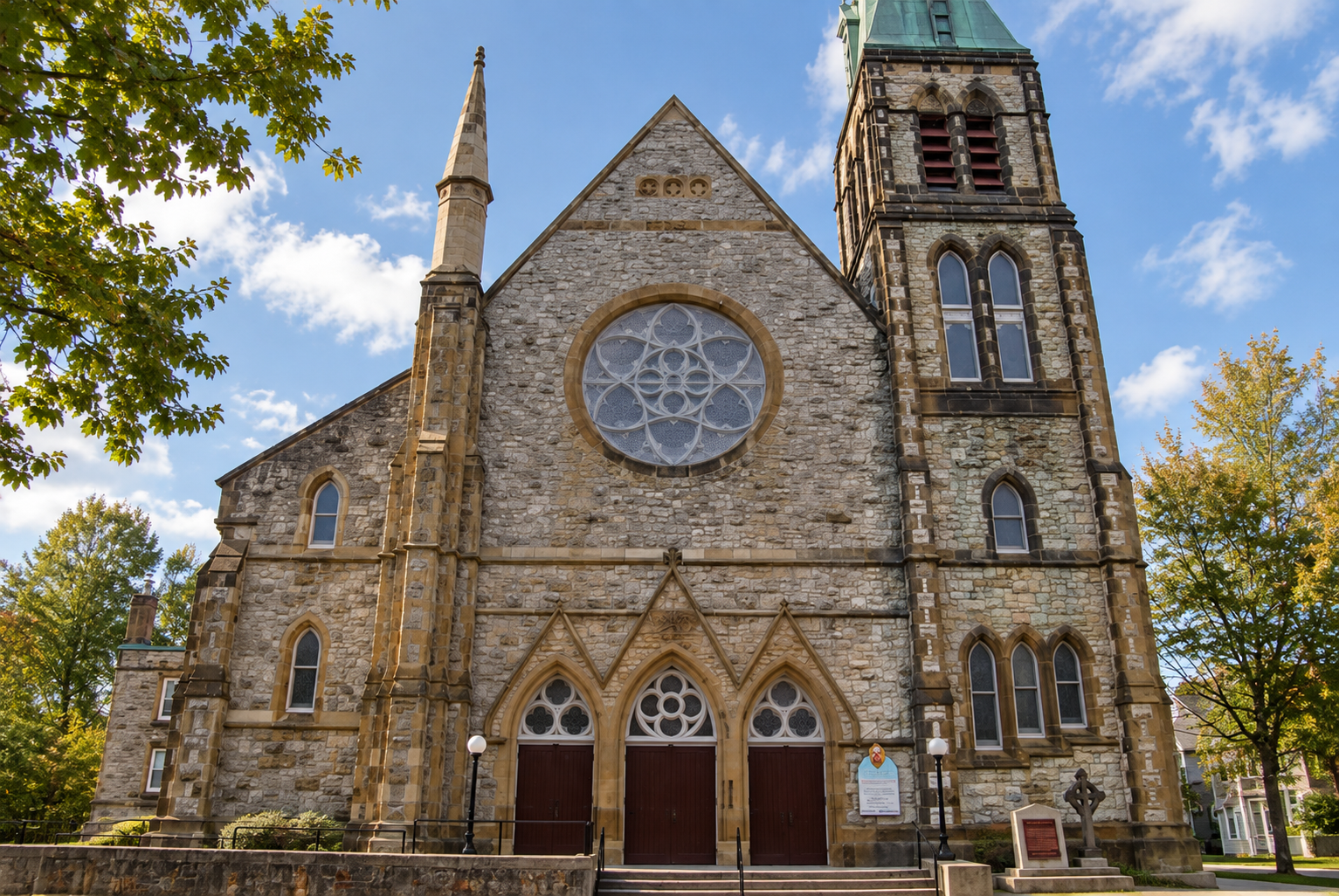
Fredericton may already be watching this idea play out at the former St. Paul’s United Church on York Street.Rather than simply clearing the property and starting again, Bella Properties is redeveloping the landmark building while retaining its distinctive historic exterior and architectural character. The plans give the interior a new purpose, including accommodation and commercial/event uses.
That makes St. Paul’s particularly relevant to Fredericton’s heritage debate.
A historic building doesn't necessarily have to continue doing what it was built to do in order to remain valuable to the city.
In fact, finding a financially sustainable new use may sometimes be the best chance an old building has of surviving another century.
There are legitimate questions whenever a significant heritage property is redeveloped: How much of the original building should remain? How much alteration is acceptable? And at what point does adaptive reuse become something entirely different?
But St. Paul’s offers Fredericton an interesting alternative to the usual preserve-or-demolish argument.
What if the third option is to keep the building, respect what makes it significant — and give it a completely new reason to exist?
⚖️ Here's Where the Debate Gets Harder
Fredericton does have formal heritage protection.The City's Preservation By-Law protects the St. Anne's Point Heritage Preservation Area as well as other designated properties. Exterior alterations to protected buildings — including demolition — require a Certificate of Appropriateness, and proposed work is reviewed for compatibility.
But much of what residents think of as historic Fredericton extends beyond individually protected buildings.
That creates a much more complicated question.
What deserves protection?
Every old house?
Probably not.
Only architecturally exceptional buildings?
That may not be enough.
A fairly ordinary 120-year-old house might not be remarkable by itself. Put twelve similar houses together beneath a mature tree canopy, however, and suddenly they form a streetscape people recognize immediately as Fredericton.
Remove them one at a time and there may never be a dramatic moment when the neighbourhood disappears.
It simply becomes less distinctive with every replacement.
🌳 Sometimes We're Preserving the Street, Not the House
This may be the part of the discussion Fredericton needs to have more often.Heritage isn't only architecture.
It's scale.
It's setbacks.
It's trees.
It's porches.
It's how buildings meet sidewalks.
It's the distance between houses.
It's whether walking down a street feels comfortable.
Fredericton's South Core planning work acknowledges exactly this kind of neighbourhood structure: long, narrow historic lots, established setbacks, low-rise buildings and development that remains compatible with the scale and massing of neighbouring homes.
A new building doesn't need gingerbread trim and fake shutters to belong there.
In fact, Fredericton's heritage guidelines specifically caution against simply producing fake historic architecture.
Good infill should look like it belongs in 2026 while respecting why the street worked in 1926.
That's a much higher design standard.
💰 We Also Need to Talk About the Cost of Preservation
This is where preservation advocates sometimes lose property owners.Maintaining a century-old building can be expensive.
Foundations. Masonry. Windows. Roofing. Electrical systems. Plumbing. Insulation. Accessibility. Fire separation.
If the public decides that a privately owned building has tremendous community value, it is reasonable for the owner to ask:
Who pays to preserve that value?
Regulation can prevent certain changes.
It doesn't automatically pay for restoration.
If Fredericton wants stronger preservation as development pressure increases, the conversation probably needs to include incentives, flexible reuse rules, technical assistance and ways of making heritage properties economically workable.
Otherwise, we risk creating a system where everyone loves heritage — until someone receives the renovation estimate.
🏙️ Redevelopment Isn't Automatically the Villain Either
A five-storey residential building replacing an underused site isn't inherently bad urbanism.Neither is an apartment building beside an older home.
Neither is density.
The real question is how it is designed.
Does it overwhelm the street?
Does it preserve mature trees where possible?
Does the ground floor engage pedestrians?
Does its massing acknowledge neighbouring buildings?
Can an existing heritage structure be incorporated rather than demolished?
Does it add housing while still contributing something positive to the neighbourhood?
Fredericton's own heritage design guidance says successful downtown development depends on the coexistence of old and new — heritage providing distinction and sense of place, while new people, activity and investment provide economic and cultural vitality.
That is probably the balance worth pursuing.
🔨 Demolition Is Easy. Recreating Character Isn't.
A building can disappear in days.A mature neighbourhood takes generations.
That's the asymmetry that should make Fredericton cautious.
We can always build another apartment building.
We cannot build another 130-year-old house.
We can plant another maple.
We cannot order a 70-year-old tree for delivery next Tuesday.
And once enough individual pieces disappear, rebuilding the collective character of a street becomes nearly impossible.
That doesn't mean nothing should ever be demolished.
It means demolition of something genuinely significant should probably be treated as an irreversible decision rather than simply another development step.
🔄 Fredericton's Heritage Rules Are Changing Too
This isn't just a theoretical debate.The City has been reviewing its heritage program and services, and in February 2026 held public sessions specifically concerning updated Heritage Preservation By-Law and design guidelines for St. Anne's Point. The stated goal was to strengthen conservation while providing clearer guidance and reflecting neighbourhood perspectives.
That timing makes sense.
Development pressure changes the stakes of preservation.
When land values are low and redevelopment is unlikely, preserving an old building is relatively easy to support philosophically.
The real test arrives when someone has a financially compelling alternative for the land beneath it.
❤️ The Fredericton Conversation
Maybe Fredericton doesn't need to choose between preserving the past and building the future.Maybe it needs to become considerably better at combining them.
Imagine more apartments tucked behind existing homes.
Thoughtful additions to historic buildings.
Modern infill that respects traditional lot patterns without pretending to be Victorian.
Older commercial buildings adapted to new businesses.
Additional housing on underused properties.
New development concentrated where substantial density makes sense — while particularly important streetscapes receive stronger protection.
That isn't anti-development.
And it isn't preservation at all costs.
It's accepting that growth is inevitable, but sameness isn't.
Here is the question worth debating:
If Fredericton needs significantly more housing, what are you willing to change to accommodate it — and what parts of the city should simply be non-negotiable?
Because if we don't answer that deliberately, the market will eventually answer it for us.
🌿 Building the Next Fredericton
A successful Fredericton in twenty years shouldn't look exactly like Fredericton today.There should be more homes, more people, new architecture and neighbourhoods that haven't even been built yet.
But someone walking down George Street, Church Street, Waterloo Row or through the South Core should still know exactly which city they're in.
Growth should add layers to Fredericton — not erase the ones already here.
If you're considering buying or selling an older home, investing near the city centre or trying to understand how redevelopment may affect a particular Fredericton neighbourhood, understanding the street can be every bit as important as understanding the property. We're always happy to help!