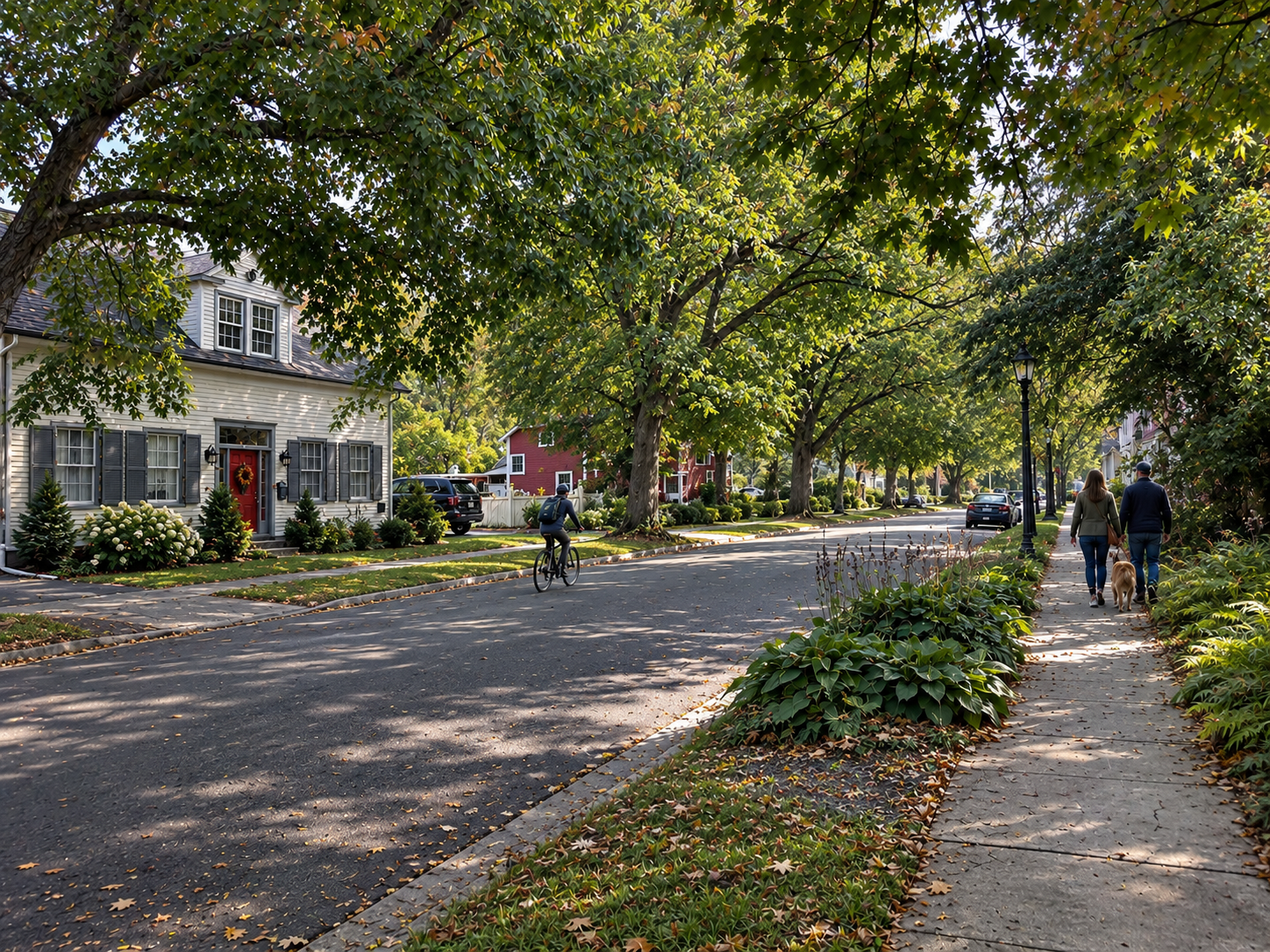
🏙️ Living in Downtown Fredericton: Is Walkability Worth the Trade-Off?
🍁The Rob Brown Realty JournalThursday | Fredericton Neighbourhoods
Imagine this version of Fredericton life.
You leave home Saturday morning and walk for coffee. The riverfront trail is a few blocks away. The library is nearby. Dinner doesn't require a car. Neither does the Playhouse, Officers' Square, the Garrison Night Market or Harvest.
You can walk to work if your office is downtown.
Sounds pretty good.
Now imagine the other version.
Your apartment has less storage than your old house. You hear people leaving a bar at midnight. Harvest closes streets. Your friends text before visiting:
"Where am I supposed to park?"
And the backyard?
You may not have one.
That's the bargain downtown living asks you to consider.
You give up some private space to gain access to a lot more shared space.
Would Frederictonians actually make that trade?
That's becoming a much more important question.
Fredericton's Municipal Plan identifies the City Centre as an area of economic, social and cultural significance and calls for development that adds vibrancy and livability, improves the pedestrian experience, incorporates ground-floor shops and restaurants and strengthens connections to the Wolastoq/Saint John River.
The City Centre Plan goes even further.
Its vision is for downtown to be a place to live, work, play and visit, with specific attention paid to sidewalks, pedestrian experience, open space, parking and building design.
That word — live — matters.
Because a successful downtown can't survive entirely on people arriving at 8:30 in the morning and leaving at 5:00.
Restaurants need customers at night.
Coffee shops need weekend traffic.
Small retailers need people nearby.
Public spaces need regular users.
A downtown with residents behaves differently from a downtown with commuters.
The question is whether Fredericton is offering the kind of downtown lifestyle enough people actually want.
Proximity.
Downtown Fredericton compresses a surprising amount of daily life into a relatively small area.
Restaurants.
Coffee shops.
Government offices.
Local businesses.
The public library.
Beaverbrook Art Gallery.
Fredericton Playhouse.
Officers' Square.
The Historic Garrison District.
The riverfront trail.
Parks.
Pubs.
Festivals.
And during Summer, Officers' Square hosts free concerts and films while the Garrison Night Market runs every Thursday evening from June into September.
That's the part of downtown living that's difficult to reproduce elsewhere.
Not because suburban Fredericton lacks amenities.
But because downtown allows several of them to become part of the same walk.
Coffee can turn into the market.
The market can turn into dinner.
Dinner can turn into a show.
A walk along the river can turn into running into someone you know.
You stop making trips and start combining experiences.
That's one of the genuine advantages of urban living.
Parking.
What's interesting is that Fredericton doesn't actually lack parking altogether.
The City manages more than 500 on-street parking spaces, along with off-street facilities, hourly parking and daily, monthly and annual permit options. There are also resident permit zones immediately around portions of downtown.
The City has an entire Parking Master Plan devoted to balancing supply, demand, pricing, technology and mobility.
So perhaps the real issue isn't simply:
"Is there parking?"
It's:
"Can I park exactly where I want, exactly when I want, for exactly as long as I want?"
Those are different questions.
And this is where downtown debates become uncomfortable.
A lot of it.
And downtown land can also be used for housing, businesses, patios, sidewalks, trees, public spaces or buildings that generate tax revenue.
Fredericton's own City Centre design guidelines acknowledge this conflict quite directly.
They describe large surface parking lots as inappropriate downtown and note that parking lots and vehicle thoroughfares have compromised parts of the pedestrian environment. The City's preferred approach is parking underground, behind buildings or incorporated into structures rather than dominating street frontage.
That's not an anti-car position.
It's an urban land-use question.
Should some of the most valuable land in the centre of Fredericton primarily exist so somebody from outside downtown can leave a vehicle there for eight hours?
There are legitimate arguments on both sides.
Businesses need customers.
Workers need access.
People with mobility limitations need convenient parking.
Fredericton serves a much larger region than the downtown population alone.
But if every new downtown housing project must also preserve abundant inexpensive parking, we shouldn't be surprised if downtown becomes more expensive to build in — or if valuable land remains occupied by parking instead of housing.
You can't simultaneously demand a denser, more walkable downtown and insist that parking remain the dominant design consideration.
Eventually, one priority starts competing with the other.
Fredericton is not Toronto.
For many households here, the alternative to downtown living isn't a tiny apartment an hour outside the city.
It might be a detached house fifteen minutes away.
With a driveway.
A basement.
A garage.
A deck.
A lawn.
Perhaps three bedrooms and somewhere to put the snowblower.
That's formidable competition.
Downtown living therefore has to offer something valuable enough to compensate for the space you're giving up.
And "you can walk to restaurants" won't be enough for everybody.
A young professional may consider that an excellent trade.
A retired couple tired of maintaining a large property might too.
Someone who travels frequently may love being able to lock the door and leave.
A family with three children, two vehicles, hockey equipment and a Labrador may reach a different conclusion.
Neither lifestyle is more enlightened.
They're simply different.
We celebrate downtown vibrancy until it becomes audible from the bedroom.
Harvest is exciting.
Until you're trying to sleep.
Patios are great.
Until closing time.
Officers' Square full of people is wonderful.
Unless you'd prefer Officers' Square to be quiet.
Traffic, delivery vehicles, snow clearing, construction, emergency vehicles and nightlife all produce noise.
That's part of living where activity is concentrated.
We can't demand a vibrant downtown and then require it to behave like a cul-de-sac after 9 p.m.
That doesn't mean residents should tolerate unreasonable noise.
Good cities establish rules and find compromises.
But anyone buying or renting downtown should understand something fundamental:
Activity isn't an unfortunate side effect of downtown living.
It's largely the point.
Now imagine experiencing it from your living room.
For some people, that sounds incredible.
Walk outside and you're in it.
No parking.
No shuttle.
No designated driver.
No commute home.
For someone else?
Six days of crowds, road closures and music may feel like a very long week.
And that tells us something important about downtown housing.
The amenity and the inconvenience are sometimes exactly the same thing.
One person's nightlife is another person's noise.
One person's pedestrian street is another person's road closure.
One person's compact apartment is another person's low-maintenance home.
One person's lack of parking is another person's reason to stop owning a second car.
That's why downtown living is less about whether downtown is objectively "better."
It's about what you value.
Fredericton is growing.
The City wants a greater share of future development directed toward established urban areas rather than pushing every new household farther outward. Its Municipal Plan explicitly encourages greater vibrancy, mixed uses and residential development within the City Centre.
That makes sense.
Housing people close to existing streets, water infrastructure, employment, services and transit can make more efficient use of infrastructure already in place.
More downtown residents can also create something businesses desperately need:
Customers who don't have to decide to go downtown.
They're already there.
That's very different from depending entirely on office workers, tourists and suburban residents driving in for dinner.
Think about the customer base created by an office building.
Monday through Friday.
Mostly daytime.
Now think about a residential building.
Breakfast.
Evenings.
Weekends.
Winter.
Residents buy groceries.
Order takeout.
Walk dogs.
Drink coffee.
Use parks.
Attend events.
Go to restaurants.
And importantly, they provide activity during periods when traditional office downtowns can feel empty.
That's why residential development isn't merely about putting apartments downtown.
Residents are part of downtown infrastructure.
They create the everyday demand that helps neighbourhood businesses survive between festivals.
You can build density badly.
A building can technically contain 150 apartments and still contribute almost nothing to street life.
Blank walls.
Parking at street level.
Dead ground floors.
Entrances designed around vehicles.
Little landscaping.
No relationship to the sidewalk.
Fredericton's planning rules explicitly try to avoid this. New City Centre development is expected to enhance the pedestrian experience, orient buildings toward the street, incorporate active ground-floor uses and keep parking from dominating the public realm.
That's encouraging.
Because the goal shouldn't simply be:
"Get more units downtown."
It should be:
"Build more homes downtown that make downtown better."
Those are not automatically the same thing.
Our downtown isn't surrounded entirely by towers.
Walk only a few blocks from Queen Street and you're into the Town Plat — George, Charlotte, Church, Brunswick and surrounding streets with mature trees, older homes, porches and small-scale residential buildings.
That transition matters.
It means Fredericton has an opportunity to create something many larger cities struggle to offer:
Urban convenience without necessarily requiring big-city intensity.
More apartments along appropriate corridors.
Heritage buildings reused as housing.
Smaller infill projects.
Townhouses.
Apartments above shops.
Larger residential projects where the scale makes sense.
And established streets remaining established streets.
Downtown doesn't have to choose between becoming Toronto and becoming a museum.
There's a considerable amount of territory in between.
Downtown probably gives you less of some things:
🚗 private parking
📦 storage
🌳 private yard space
🤫 quiet
🏠 house size
🔒 separation from other people
But it can give you more of others:
🚶 walkability
☕ restaurants and cafés
🎭 culture
🎶 events
🌊 riverfront access
👋 spontaneous social interaction
🚲 transportation choices
⏱️ less time spent driving
Which list matters more?
That answer will vary dramatically by household.
And that's exactly why Fredericton needs different kinds of neighbourhoods.
Does Fredericton actually want downtown living — or do we mostly want downtown amenities with suburban convenience?
Because those aren't the same thing.
We say we want a vibrant downtown.
Then complain about parking.
We say we want restaurants and nightlife.
Then complain about noise.
We say we want more housing.
Then worry about taller buildings.
We say we want walkability.
Then measure convenience by how close we can park to the front door.
None of those concerns are unreasonable individually.
Collectively, though, they reveal the central contradiction of downtown development:
We want urban benefits without always accepting urban trade-offs.
Perhaps the question isn't whether everybody should live downtown.
Clearly they shouldn't.
It's whether Fredericton can create a downtown compelling enough that more people genuinely want to.
Because if nobody wants to live there, we haven't really built a neighbourhood.
We've built a destination.
And great downtowns should be both.
💬 Your turn: If you could trade some parking, yard space and quiet for the ability to walk to restaurants, trails, culture and events — would you live downtown Fredericton?
For one buyer, it's a large yard and quiet street.
For another, it's walking to coffee Saturday morning and the Playhouse Saturday night.
The important part is understanding the trade-offs before you choose the house.
If you're thinking about buying, selling or making a neighbourhood change in Fredericton, that's a conversation we're always happy to have.
Imagine this version of Fredericton life.
You leave home Saturday morning and walk for coffee. The riverfront trail is a few blocks away. The library is nearby. Dinner doesn't require a car. Neither does the Playhouse, Officers' Square, the Garrison Night Market or Harvest.
You can walk to work if your office is downtown.
Sounds pretty good.
Now imagine the other version.
Your apartment has less storage than your old house. You hear people leaving a bar at midnight. Harvest closes streets. Your friends text before visiting:
"Where am I supposed to park?"
And the backyard?
You may not have one.
That's the bargain downtown living asks you to consider.
You give up some private space to gain access to a lot more shared space.
Would Frederictonians actually make that trade?
That's becoming a much more important question.
🏗️ Fredericton Doesn't Just Want People Downtown During Business Hours
The City's own planning documents are remarkably clear about this.Fredericton's Municipal Plan identifies the City Centre as an area of economic, social and cultural significance and calls for development that adds vibrancy and livability, improves the pedestrian experience, incorporates ground-floor shops and restaurants and strengthens connections to the Wolastoq/Saint John River.
The City Centre Plan goes even further.
Its vision is for downtown to be a place to live, work, play and visit, with specific attention paid to sidewalks, pedestrian experience, open space, parking and building design.
That word — live — matters.
Because a successful downtown can't survive entirely on people arriving at 8:30 in the morning and leaving at 5:00.
Restaurants need customers at night.
Coffee shops need weekend traffic.
Small retailers need people nearby.
Public spaces need regular users.
A downtown with residents behaves differently from a downtown with commuters.
The question is whether Fredericton is offering the kind of downtown lifestyle enough people actually want.
🚶 The Case for Downtown Is Pretty Compelling
Let's start with its biggest advantage.Proximity.
Downtown Fredericton compresses a surprising amount of daily life into a relatively small area.
Restaurants.
Coffee shops.
Government offices.
Local businesses.
The public library.
Beaverbrook Art Gallery.
Fredericton Playhouse.
Officers' Square.
The Historic Garrison District.
The riverfront trail.
Parks.
Pubs.
Festivals.
And during Summer, Officers' Square hosts free concerts and films while the Garrison Night Market runs every Thursday evening from June into September.
That's the part of downtown living that's difficult to reproduce elsewhere.
Not because suburban Fredericton lacks amenities.
But because downtown allows several of them to become part of the same walk.
Coffee can turn into the market.
The market can turn into dinner.
Dinner can turn into a show.
A walk along the river can turn into running into someone you know.
You stop making trips and start combining experiences.
That's one of the genuine advantages of urban living.
🚗 And Then We Have to Talk About Parking
Ask Frederictonians what makes downtown difficult and eventually you'll hear the word.Parking.
What's interesting is that Fredericton doesn't actually lack parking altogether.
The City manages more than 500 on-street parking spaces, along with off-street facilities, hourly parking and daily, monthly and annual permit options. There are also resident permit zones immediately around portions of downtown.
The City has an entire Parking Master Plan devoted to balancing supply, demand, pricing, technology and mobility.
So perhaps the real issue isn't simply:
"Is there parking?"
It's:
"Can I park exactly where I want, exactly when I want, for exactly as long as I want?"
Those are different questions.
And this is where downtown debates become uncomfortable.
🅿️ How Much of Downtown Should Be Used to Store Cars?
A parked vehicle needs land.A lot of it.
And downtown land can also be used for housing, businesses, patios, sidewalks, trees, public spaces or buildings that generate tax revenue.
Fredericton's own City Centre design guidelines acknowledge this conflict quite directly.
They describe large surface parking lots as inappropriate downtown and note that parking lots and vehicle thoroughfares have compromised parts of the pedestrian environment. The City's preferred approach is parking underground, behind buildings or incorporated into structures rather than dominating street frontage.
That's not an anti-car position.
It's an urban land-use question.
Should some of the most valuable land in the centre of Fredericton primarily exist so somebody from outside downtown can leave a vehicle there for eight hours?
There are legitimate arguments on both sides.
Businesses need customers.
Workers need access.
People with mobility limitations need convenient parking.
Fredericton serves a much larger region than the downtown population alone.
But if every new downtown housing project must also preserve abundant inexpensive parking, we shouldn't be surprised if downtown becomes more expensive to build in — or if valuable land remains occupied by parking instead of housing.
You can't simultaneously demand a denser, more walkable downtown and insist that parking remain the dominant design consideration.
Eventually, one priority starts competing with the other.
🏡 Then There's Space
This may be the harder sell.Fredericton is not Toronto.
For many households here, the alternative to downtown living isn't a tiny apartment an hour outside the city.
It might be a detached house fifteen minutes away.
With a driveway.
A basement.
A garage.
A deck.
A lawn.
Perhaps three bedrooms and somewhere to put the snowblower.
That's formidable competition.
Downtown living therefore has to offer something valuable enough to compensate for the space you're giving up.
And "you can walk to restaurants" won't be enough for everybody.
A young professional may consider that an excellent trade.
A retired couple tired of maintaining a large property might too.
Someone who travels frequently may love being able to lock the door and leave.
A family with three children, two vehicles, hockey equipment and a Labrador may reach a different conclusion.
Neither lifestyle is more enlightened.
They're simply different.
🔊 And Yes, Downtown Is Noisier
This one deserves more honesty.We celebrate downtown vibrancy until it becomes audible from the bedroom.
Harvest is exciting.
Until you're trying to sleep.
Patios are great.
Until closing time.
Officers' Square full of people is wonderful.
Unless you'd prefer Officers' Square to be quiet.
Traffic, delivery vehicles, snow clearing, construction, emergency vehicles and nightlife all produce noise.
That's part of living where activity is concentrated.
We can't demand a vibrant downtown and then require it to behave like a cul-de-sac after 9 p.m.
That doesn't mean residents should tolerate unreasonable noise.
Good cities establish rules and find compromises.
But anyone buying or renting downtown should understand something fundamental:
Activity isn't an unfortunate side effect of downtown living.
It's largely the point.
🎶 Harvest Week Is Probably the Ultimate Test
We've just written about what happens when Harvest takes over Fredericton.Now imagine experiencing it from your living room.
For some people, that sounds incredible.
Walk outside and you're in it.
No parking.
No shuttle.
No designated driver.
No commute home.
For someone else?
Six days of crowds, road closures and music may feel like a very long week.
And that tells us something important about downtown housing.
The amenity and the inconvenience are sometimes exactly the same thing.
One person's nightlife is another person's noise.
One person's pedestrian street is another person's road closure.
One person's compact apartment is another person's low-maintenance home.
One person's lack of parking is another person's reason to stop owning a second car.
That's why downtown living is less about whether downtown is objectively "better."
It's about what you value.
🏢 But Fredericton May Need More People to Choose It
Here's where personal preference becomes a city-planning issue.Fredericton is growing.
The City wants a greater share of future development directed toward established urban areas rather than pushing every new household farther outward. Its Municipal Plan explicitly encourages greater vibrancy, mixed uses and residential development within the City Centre.
That makes sense.
Housing people close to existing streets, water infrastructure, employment, services and transit can make more efficient use of infrastructure already in place.
More downtown residents can also create something businesses desperately need:
Customers who don't have to decide to go downtown.
They're already there.
That's very different from depending entirely on office workers, tourists and suburban residents driving in for dinner.
☕ A Great Downtown Needs Customers at 8 A.M. AND 8 P.M.
This may be the strongest argument for downtown housing.Think about the customer base created by an office building.
Monday through Friday.
Mostly daytime.
Now think about a residential building.
Breakfast.
Evenings.
Weekends.
Winter.
Residents buy groceries.
Order takeout.
Walk dogs.
Drink coffee.
Use parks.
Attend events.
Go to restaurants.
And importantly, they provide activity during periods when traditional office downtowns can feel empty.
That's why residential development isn't merely about putting apartments downtown.
Residents are part of downtown infrastructure.
They create the everyday demand that helps neighbourhood businesses survive between festivals.
🏗️ But Here's the Part Fredericton Shouldn't Get Wrong
More downtown housing does not automatically create a better downtown.You can build density badly.
A building can technically contain 150 apartments and still contribute almost nothing to street life.
Blank walls.
Parking at street level.
Dead ground floors.
Entrances designed around vehicles.
Little landscaping.
No relationship to the sidewalk.
Fredericton's planning rules explicitly try to avoid this. New City Centre development is expected to enhance the pedestrian experience, orient buildings toward the street, incorporate active ground-floor uses and keep parking from dominating the public realm.
That's encouraging.
Because the goal shouldn't simply be:
"Get more units downtown."
It should be:
"Build more homes downtown that make downtown better."
Those are not automatically the same thing.
🌳 And Maybe "Downtown" Should Feel More Residential Than We Think
There's another Fredericton advantage worth protecting.Our downtown isn't surrounded entirely by towers.
Walk only a few blocks from Queen Street and you're into the Town Plat — George, Charlotte, Church, Brunswick and surrounding streets with mature trees, older homes, porches and small-scale residential buildings.
That transition matters.
It means Fredericton has an opportunity to create something many larger cities struggle to offer:
Urban convenience without necessarily requiring big-city intensity.
More apartments along appropriate corridors.
Heritage buildings reused as housing.
Smaller infill projects.
Townhouses.
Apartments above shops.
Larger residential projects where the scale makes sense.
And established streets remaining established streets.
Downtown doesn't have to choose between becoming Toronto and becoming a museum.
There's a considerable amount of territory in between.
🤔 So... Would You Actually Live Here?
Let's make the trade-off simple.Downtown probably gives you less of some things:
🚗 private parking
📦 storage
🌳 private yard space
🤫 quiet
🏠 house size
🔒 separation from other people
But it can give you more of others:
🚶 walkability
☕ restaurants and cafés
🎭 culture
🎶 events
🌊 riverfront access
👋 spontaneous social interaction
🚲 transportation choices
⏱️ less time spent driving
Which list matters more?
That answer will vary dramatically by household.
And that's exactly why Fredericton needs different kinds of neighbourhoods.
❤️ The Fredericton Conversation
Here's the question worth debating:Does Fredericton actually want downtown living — or do we mostly want downtown amenities with suburban convenience?
Because those aren't the same thing.
We say we want a vibrant downtown.
Then complain about parking.
We say we want restaurants and nightlife.
Then complain about noise.
We say we want more housing.
Then worry about taller buildings.
We say we want walkability.
Then measure convenience by how close we can park to the front door.
None of those concerns are unreasonable individually.
Collectively, though, they reveal the central contradiction of downtown development:
We want urban benefits without always accepting urban trade-offs.
Perhaps the question isn't whether everybody should live downtown.
Clearly they shouldn't.
It's whether Fredericton can create a downtown compelling enough that more people genuinely want to.
Because if nobody wants to live there, we haven't really built a neighbourhood.
We've built a destination.
And great downtowns should be both.
💬 Your turn: If you could trade some parking, yard space and quiet for the ability to walk to restaurants, trails, culture and events — would you live downtown Fredericton?
🌿 Find the Fredericton That Fits You
There isn't one "best" Fredericton neighbourhood.For one buyer, it's a large yard and quiet street.
For another, it's walking to coffee Saturday morning and the Playhouse Saturday night.
The important part is understanding the trade-offs before you choose the house.
If you're thinking about buying, selling or making a neighbourhood change in Fredericton, that's a conversation we're always happy to have.