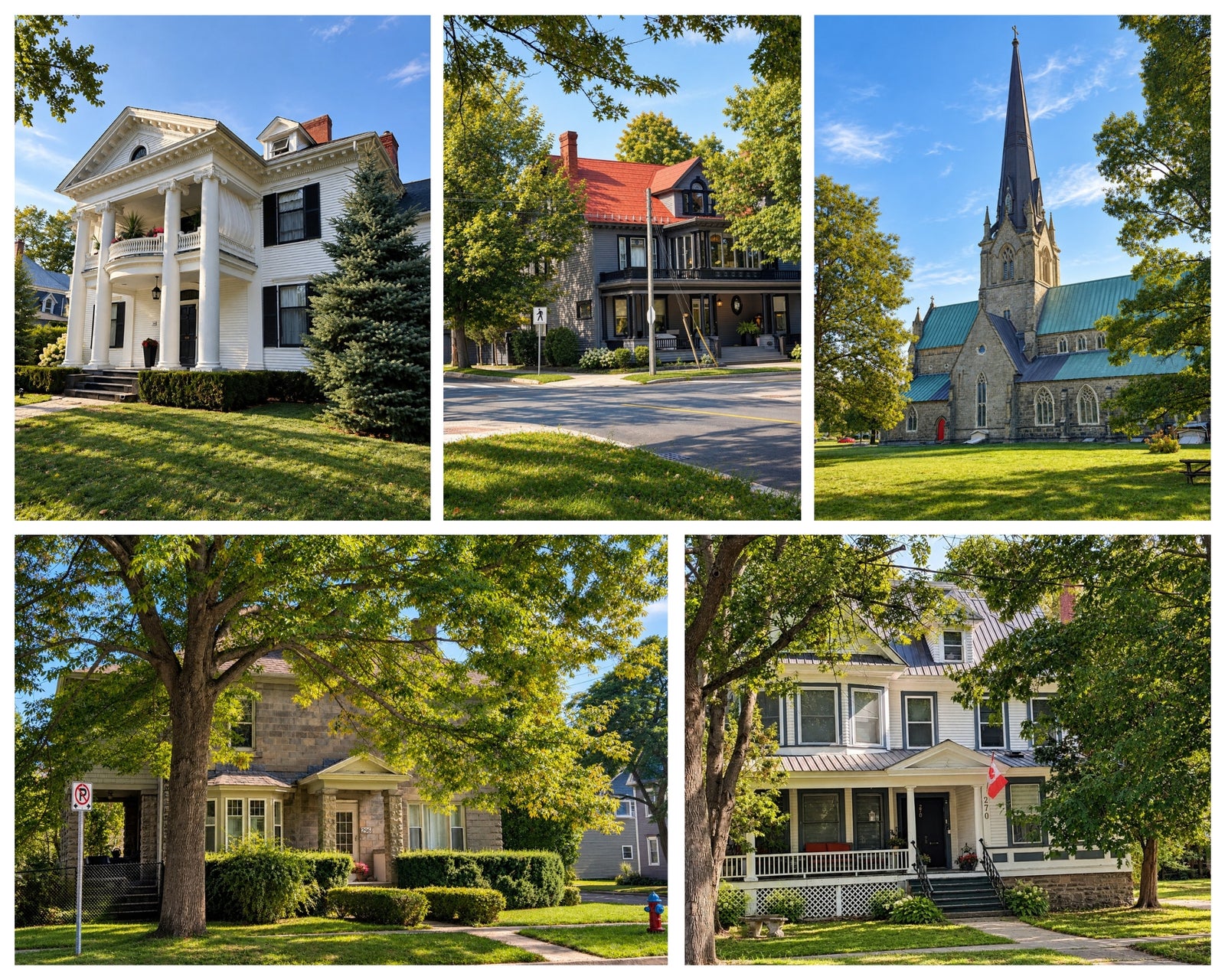
🚶 Church Street Fredericton: History, Architecture & One of the City's Best Walks
🍁The Rob Brown Realty JournalWednesday | Fredericton Streets
Church Street isn't hidden.
It's right there in the middle of old Fredericton, crossing some of the city's most familiar east-west streets and passing one of its most recognizable landmarks.
And yet it's remarkably easy to miss.
Drive it and you notice the cathedral spire, a few beautiful old houses and perhaps the trees.
Walk it and Church Street becomes something completely different.
You start noticing that one house belonged to Fredericton's first Anglican bishop. Another was built for a former mayor. Farther along is a house constructed from concrete block during the First World War. At George Street, one property is actually the product of several buildings being joined together over time.
And towering over the southern end is a cathedral that helped influence church architecture across Canada.
Church Street isn't Fredericton's grandest street.
It might be one of its best slow streets.
Construction began in 1845 after John Medley arrived as Fredericton's first Anglican bishop. The cornerstone was laid on October 15 of that year, and construction continued until 1853.
The building was modelled after the medieval church of St. Mary's in Snettisham, Norfolk, England, with plans prepared by English architect Frank Wills. Architect William Butterfield later modified the east end.
But here's the part worth stopping for:
Christ Church Cathedral wasn't merely an impressive church for a small colonial city.
Parks Canada calls it one of the best and earliest examples of Gothic Revival architecture in Canada. It was designated a National Historic Site in 1981, and its design became influential in Canadian church architecture during the 19th century.
Look closely at the stone, too.
The cathedral incorporates New Brunswick sandstone, including stone from Grindstone Island in the Bay of Fundy, while its Gothic window tracery incorporates Caen stone.
That is the difference between driving and walking.
From the car:
Nice cathedral.
From the sidewalk:
Why does Fredericton have a nationally significant Gothic Revival cathedral modelled after a medieval English church?
Now we're getting somewhere.
In 1911, the cathedral was struck by lightning and damaged by fire.
The subsequent 1911–13 restoration, led by New York architect J. deLancey Robinson, included lengthening the spire and converting the former vestry into the present chapel.
And one of the people involved in supervising that reconstruction?
Moses Mitchell.
Remember that name.
We'll meet him again a few blocks away.
97 Church Street dates to 1851.
It was associated first with Benjamin Wolhaupter, a former High Sheriff of York County and friend of Bishop Medley. While the cathedral was being built, Medley lived outside the town limits at Salamanca.
By 1865, Medley had purchased Wolhaupter's Church Street house.
He lived there until his death in 1892, and his widow Margaret remained until 1905.
So the man responsible for establishing that enormous Gothic landmark eventually lived just down the street from it.
But look at the house today and there's another surprise.
It didn't always look that way.
Then former Fredericton mayor William Turney Whitehead bought it in 1905.
And changed it.
Substantially.
The City says the renovations and additions introduced fashionable Queen Anne elements, including an asymmetrical composition, verandah, enclosed upper porch and circular side tower with curved glass windows.
That's an important little lesson about heritage architecture.
We often look at old houses today and assume there was some pristine historical moment when they became "finished."
There usually wasn't.
People renovated them.
Added onto them.
Modernized them.
Changed porches.
Changed windows.
Changed how rooms were used.
Old Fredericton was constantly renovating old Fredericton.
The reason many of these houses survived wasn't necessarily because nobody touched them.
Sometimes it was because each generation found another reason to keep using them.
You won't have much trouble spotting it.
Built in 1906 for Dr. William Caldwell Crocket, this 2½-storey Beaux-Arts residence has enormous Ionic columns and a grand, symmetrical, almost temple-like façade.
Crocket wasn't simply a wealthy homeowner.
He had served as Mayor of Fredericton, later represented York County in the New Brunswick Legislature and sat on the UNB Senate. His father, William Crocket, had been the first principal of the Provincial Normal School and later Chief Superintendent of Education.
The architect was G. Ernest Fairweather, whose Fredericton work also included UNB's Engineering Building and Gymnasium and later renovations to the Provincial Normal School.
There's another twist.
The Crocket family lived here until the early 1940s.
Then in 1944, the provincial government rented the house for office space for newly established ministries.
A mayor's grand private residence became government offices.
Again:
Fredericton's historic buildings survived partly because they adapted.
At 235 Church Street stands a Queen Anne Revival house built in 1898 by Harry M. Clark for W.E. Smith.
That's useful context because Church Street isn't architecturally frozen in one period.
Within a relatively short walk, you're moving past buildings associated with different decades, different owners and different architectural fashions.
Georgian foundations.
Gothic Revival.
Queen Anne.
Beaux-Arts.
Early 20th-century construction.
And then something much less glamorous — but arguably just as interesting.
Don't.
296 Church Street was built in 1916, in the middle of the First World War.
Instead of the wood construction we associate with so many older Fredericton houses, it was built using concrete block.
The City's heritage record points out why that matters.
Construction materials were expensive and in short supply during the war, and concrete block offered a relatively cost-effective alternative to stone. Despite wartime conditions, residential development in Fredericton continued.
Its earliest occupant, Silas B. Waas, was assistant superintendent of the Chipman Grand Lake Railway.
This isn't the sort of house that usually makes the tourism brochure.
That's precisely why it's interesting.
Heritage isn't only cathedrals and mansions.
Sometimes it's a building material chosen because there was a war on and somebody still needed a house.
The property now known as 806 George Street is an amalgamation of at least three separate periods of construction.
The original Church Street dwelling predates the middle of the 19th century.
It belonged to George F. Gregory, a New Brunswick Supreme Court judge who also served two periods as Fredericton's mayor.
A George Street portion was added later.
Then Christ Church Cathedral Chapter purchased the property in 1912 for use as the bishop's residence and added a one-storey corner library. Bishop John Richardson and his family lived there until his death in 1938.
UNB bought the property in 1960 and converted it into a residence known as Murray House.
One property.
Multiple structures.
Judge.
Mayor.
Bishop.
University.
That's not a building frozen in history.
That's a building collecting history.
One block of Church Street gives us another connection.
In 1910, Mitchell built 270 Church Street for Richard B. Hanson.
The coincidence is almost too good:
It was a house built by a future mayor for a future mayor.
Mitchell became Mayor of Fredericton in 1914.
Hanson would also later serve as mayor.
Mitchell came from a family deeply connected to Fredericton construction. His uncle Robert Mitchell had helped build Christ Church Cathedral decades earlier; Moses later supervised its reconstruction following the lightning strike.
So within one walk, the same family story connects a private residence to one of Canada's significant Gothic Revival buildings.
You would almost certainly miss that from the driver's seat.
Church Street works because the individual buildings aren't isolated objects.
There are houses close enough to the sidewalk to notice.
Large trees break up the streetscape.
Porches face the street.
Intersections arrive frequently.
The cathedral grounds create a dramatic opening toward the river.
And the surrounding Town Plat gives the street a scale that was created long before modern suburban road design.
None of that sounds revolutionary.
But we're surprisingly bad at building it now.
Modern neighbourhoods often have wider roads, deeper setbacks, larger garages and greater separation between destinations.
They're excellent at accommodating vehicles.
Older streets like Church quietly demonstrate something different:
A street can be useful for transportation while still being interesting at walking speed.
That distinction matters as Fredericton grows.
Does it have a sidewalk?
Is there a crosswalk?
How far is the destination?
Those things absolutely matter.
But there's another question:
Is there anything worth noticing along the way?
Church Street offers changing architecture, mature vegetation, short blocks, historic buildings, residential frontages, institutional spaces and glimpses toward the river.
Your surroundings keep changing.
That gives your brain a reason to keep walking.
Compare that with walking the same distance beside a large parking lot or along the edge of a high-speed arterial.
Both trips might technically have sidewalks.
They are not remotely the same pedestrian experience.
Walkability is partly infrastructure.
It's also interest.
That means new neighbourhoods, apartments, infill and greater density.
The answer isn't to recreate Church Street building-for-building.
We shouldn't be constructing fake Victorian houses in 2026 and pretending we've preserved character.
But we can steal the things that work.
🌳 Trees that eventually create canopy.
🚶 Sidewalks people actually want to use.
🏠 Buildings that address the street instead of hiding behind parking.
📏 A comfortable human scale.
🪑 Porches, entrances and windows that create some relationship between private buildings and public streets.
🔀 A mixture of uses and building ages rather than entire districts constructed at once.
And perhaps most importantly:
Streets designed to reward someone travelling at 5 km/h, not just 50.
That's something Church Street figured out largely by accident more than a century ago.
It wasn't planned according to a modern theory of walkable urbanism.
And not every old building deserves preservation simply because it's old.
But the street raises a useful question as Fredericton grows:
Are we building streets people will someday want to walk just to see what's there?
That's a much higher bar than asking whether we've installed a sidewalk.
Because fifty or a hundred years from now, the success of today's neighbourhoods won't be measured only by how many housing units we managed to fit into them.
People will also inherit the streets between those houses.
Church Street reminds us that those spaces matter.
So sometime this September, try something simple.
Park the car.
Start near the cathedral.
Walk Church Street.
Look up.
Look at the houses.
Look at how close everything feels.
And notice how much Fredericton disappears when we experience it through a windshield.
💬 Which Fredericton street do you think is dramatically better on foot than it is from a car?
They can't tell you what it feels like to walk out the front door and actually experience the neighbourhood.
That's why understanding Fredericton means understanding its streets, not just its houses.
If you're considering a move within Fredericton — particularly into one of its established neighbourhoods — take the walk before you make the decision.
You may notice something the listing photos never showed you.
Church Street isn't hidden.
It's right there in the middle of old Fredericton, crossing some of the city's most familiar east-west streets and passing one of its most recognizable landmarks.
And yet it's remarkably easy to miss.
Drive it and you notice the cathedral spire, a few beautiful old houses and perhaps the trees.
Walk it and Church Street becomes something completely different.
You start noticing that one house belonged to Fredericton's first Anglican bishop. Another was built for a former mayor. Farther along is a house constructed from concrete block during the First World War. At George Street, one property is actually the product of several buildings being joined together over time.
And towering over the southern end is a cathedral that helped influence church architecture across Canada.
Church Street isn't Fredericton's grandest street.
It might be one of its best slow streets.
⛪ Start With the Obvious: That Cathedral Is More Important Than It Looks
It's difficult to talk about Church Street without starting with Christ Church Cathedral.Construction began in 1845 after John Medley arrived as Fredericton's first Anglican bishop. The cornerstone was laid on October 15 of that year, and construction continued until 1853.
The building was modelled after the medieval church of St. Mary's in Snettisham, Norfolk, England, with plans prepared by English architect Frank Wills. Architect William Butterfield later modified the east end.
But here's the part worth stopping for:
Christ Church Cathedral wasn't merely an impressive church for a small colonial city.
Parks Canada calls it one of the best and earliest examples of Gothic Revival architecture in Canada. It was designated a National Historic Site in 1981, and its design became influential in Canadian church architecture during the 19th century.
Look closely at the stone, too.
The cathedral incorporates New Brunswick sandstone, including stone from Grindstone Island in the Bay of Fundy, while its Gothic window tracery incorporates Caen stone.
That is the difference between driving and walking.
From the car:
Nice cathedral.
From the sidewalk:
Why does Fredericton have a nationally significant Gothic Revival cathedral modelled after a medieval English church?
Now we're getting somewhere.
⚡ And Then Lightning Struck It
Church Street also comes with a good plot twist.In 1911, the cathedral was struck by lightning and damaged by fire.
The subsequent 1911–13 restoration, led by New York architect J. deLancey Robinson, included lengthening the spire and converting the former vestry into the present chapel.
And one of the people involved in supervising that reconstruction?
Moses Mitchell.
Remember that name.
We'll meet him again a few blocks away.
🏡 97 Church Street: The Bishop Lived Here
Continue along Church Street and one of its most interesting houses reveals another layer of the cathedral story.97 Church Street dates to 1851.
It was associated first with Benjamin Wolhaupter, a former High Sheriff of York County and friend of Bishop Medley. While the cathedral was being built, Medley lived outside the town limits at Salamanca.
By 1865, Medley had purchased Wolhaupter's Church Street house.
He lived there until his death in 1892, and his widow Margaret remained until 1905.
So the man responsible for establishing that enormous Gothic landmark eventually lived just down the street from it.
But look at the house today and there's another surprise.
It didn't always look that way.
🪚 Fredericton's Old Houses Weren't Always Preserved in Amber
The original house at 97 Church was a fairly straightforward five-bay Georgian dwelling.Then former Fredericton mayor William Turney Whitehead bought it in 1905.
And changed it.
Substantially.
The City says the renovations and additions introduced fashionable Queen Anne elements, including an asymmetrical composition, verandah, enclosed upper porch and circular side tower with curved glass windows.
That's an important little lesson about heritage architecture.
We often look at old houses today and assume there was some pristine historical moment when they became "finished."
There usually wasn't.
People renovated them.
Added onto them.
Modernized them.
Changed porches.
Changed windows.
Changed how rooms were used.
Old Fredericton was constantly renovating old Fredericton.
The reason many of these houses survived wasn't necessarily because nobody touched them.
Sometimes it was because each generation found another reason to keep using them.
🏛️ 171 Church Street: When a House Wanted to Make an Entrance
Then there's 171 Church Street.You won't have much trouble spotting it.
Built in 1906 for Dr. William Caldwell Crocket, this 2½-storey Beaux-Arts residence has enormous Ionic columns and a grand, symmetrical, almost temple-like façade.
Crocket wasn't simply a wealthy homeowner.
He had served as Mayor of Fredericton, later represented York County in the New Brunswick Legislature and sat on the UNB Senate. His father, William Crocket, had been the first principal of the Provincial Normal School and later Chief Superintendent of Education.
The architect was G. Ernest Fairweather, whose Fredericton work also included UNB's Engineering Building and Gymnasium and later renovations to the Provincial Normal School.
There's another twist.
The Crocket family lived here until the early 1940s.
Then in 1944, the provincial government rented the house for office space for newly established ministries.
A mayor's grand private residence became government offices.
Again:
Fredericton's historic buildings survived partly because they adapted.
🏠 235 Church Street: Watch the Architecture Change
Continue north and the street begins telling a different story.At 235 Church Street stands a Queen Anne Revival house built in 1898 by Harry M. Clark for W.E. Smith.
That's useful context because Church Street isn't architecturally frozen in one period.
Within a relatively short walk, you're moving past buildings associated with different decades, different owners and different architectural fashions.
Georgian foundations.
Gothic Revival.
Queen Anne.
Beaux-Arts.
Early 20th-century construction.
And then something much less glamorous — but arguably just as interesting.
🧱 296 Church Street: A House Built During a World War
This one is easy to walk past.Don't.
296 Church Street was built in 1916, in the middle of the First World War.
Instead of the wood construction we associate with so many older Fredericton houses, it was built using concrete block.
The City's heritage record points out why that matters.
Construction materials were expensive and in short supply during the war, and concrete block offered a relatively cost-effective alternative to stone. Despite wartime conditions, residential development in Fredericton continued.
Its earliest occupant, Silas B. Waas, was assistant superintendent of the Chipman Grand Lake Railway.
This isn't the sort of house that usually makes the tourism brochure.
That's precisely why it's interesting.
Heritage isn't only cathedrals and mansions.
Sometimes it's a building material chosen because there was a war on and somebody still needed a house.
🏠 At George Street, One Building Is Actually Several
Here's another reason to slow down around the intersection of Church and George.The property now known as 806 George Street is an amalgamation of at least three separate periods of construction.
The original Church Street dwelling predates the middle of the 19th century.
It belonged to George F. Gregory, a New Brunswick Supreme Court judge who also served two periods as Fredericton's mayor.
A George Street portion was added later.
Then Christ Church Cathedral Chapter purchased the property in 1912 for use as the bishop's residence and added a one-storey corner library. Bishop John Richardson and his family lived there until his death in 1938.
UNB bought the property in 1960 and converted it into a residence known as Murray House.
One property.
Multiple structures.
Judge.
Mayor.
Bishop.
University.
That's not a building frozen in history.
That's a building collecting history.
🔨 And Remember Moses Mitchell?
We left him helping reconstruct Christ Church Cathedral after the 1911 fire.One block of Church Street gives us another connection.
In 1910, Mitchell built 270 Church Street for Richard B. Hanson.
The coincidence is almost too good:
It was a house built by a future mayor for a future mayor.
Mitchell became Mayor of Fredericton in 1914.
Hanson would also later serve as mayor.
Mitchell came from a family deeply connected to Fredericton construction. His uncle Robert Mitchell had helped build Christ Church Cathedral decades earlier; Moses later supervised its reconstruction following the lightning strike.
So within one walk, the same family story connects a private residence to one of Canada's significant Gothic Revival buildings.
You would almost certainly miss that from the driver's seat.
🌳 But Architecture Isn't Actually the Best Part of Church Street
Here's where we push the conversation a little further.Church Street works because the individual buildings aren't isolated objects.
There are houses close enough to the sidewalk to notice.
Large trees break up the streetscape.
Porches face the street.
Intersections arrive frequently.
The cathedral grounds create a dramatic opening toward the river.
And the surrounding Town Plat gives the street a scale that was created long before modern suburban road design.
None of that sounds revolutionary.
But we're surprisingly bad at building it now.
Modern neighbourhoods often have wider roads, deeper setbacks, larger garages and greater separation between destinations.
They're excellent at accommodating vehicles.
Older streets like Church quietly demonstrate something different:
A street can be useful for transportation while still being interesting at walking speed.
That distinction matters as Fredericton grows.
🚶 Maybe Walkability Isn't Just About Sidewalks
We often reduce walkability to infrastructure.Does it have a sidewalk?
Is there a crosswalk?
How far is the destination?
Those things absolutely matter.
But there's another question:
Is there anything worth noticing along the way?
Church Street offers changing architecture, mature vegetation, short blocks, historic buildings, residential frontages, institutional spaces and glimpses toward the river.
Your surroundings keep changing.
That gives your brain a reason to keep walking.
Compare that with walking the same distance beside a large parking lot or along the edge of a high-speed arterial.
Both trips might technically have sidewalks.
They are not remotely the same pedestrian experience.
Walkability is partly infrastructure.
It's also interest.
🏗️ There's a Lesson Here for New Fredericton
Fredericton needs more housing.That means new neighbourhoods, apartments, infill and greater density.
The answer isn't to recreate Church Street building-for-building.
We shouldn't be constructing fake Victorian houses in 2026 and pretending we've preserved character.
But we can steal the things that work.
🌳 Trees that eventually create canopy.
🚶 Sidewalks people actually want to use.
🏠 Buildings that address the street instead of hiding behind parking.
📏 A comfortable human scale.
🪑 Porches, entrances and windows that create some relationship between private buildings and public streets.
🔀 A mixture of uses and building ages rather than entire districts constructed at once.
And perhaps most importantly:
Streets designed to reward someone travelling at 5 km/h, not just 50.
That's something Church Street figured out largely by accident more than a century ago.
❤️ The Fredericton Conversation
Church Street isn't perfect.It wasn't planned according to a modern theory of walkable urbanism.
And not every old building deserves preservation simply because it's old.
But the street raises a useful question as Fredericton grows:
Are we building streets people will someday want to walk just to see what's there?
That's a much higher bar than asking whether we've installed a sidewalk.
Because fifty or a hundred years from now, the success of today's neighbourhoods won't be measured only by how many housing units we managed to fit into them.
People will also inherit the streets between those houses.
Church Street reminds us that those spaces matter.
So sometime this September, try something simple.
Park the car.
Start near the cathedral.
Walk Church Street.
Look up.
Look at the houses.
Look at how close everything feels.
And notice how much Fredericton disappears when we experience it through a windshield.
💬 Which Fredericton street do you think is dramatically better on foot than it is from a car?
🌿 Some Neighbourhoods Need to Be Walked
Real estate listings can tell you the number of bedrooms, lot size and square footage.They can't tell you what it feels like to walk out the front door and actually experience the neighbourhood.
That's why understanding Fredericton means understanding its streets, not just its houses.
If you're considering a move within Fredericton — particularly into one of its established neighbourhoods — take the walk before you make the decision.
You may notice something the listing photos never showed you.