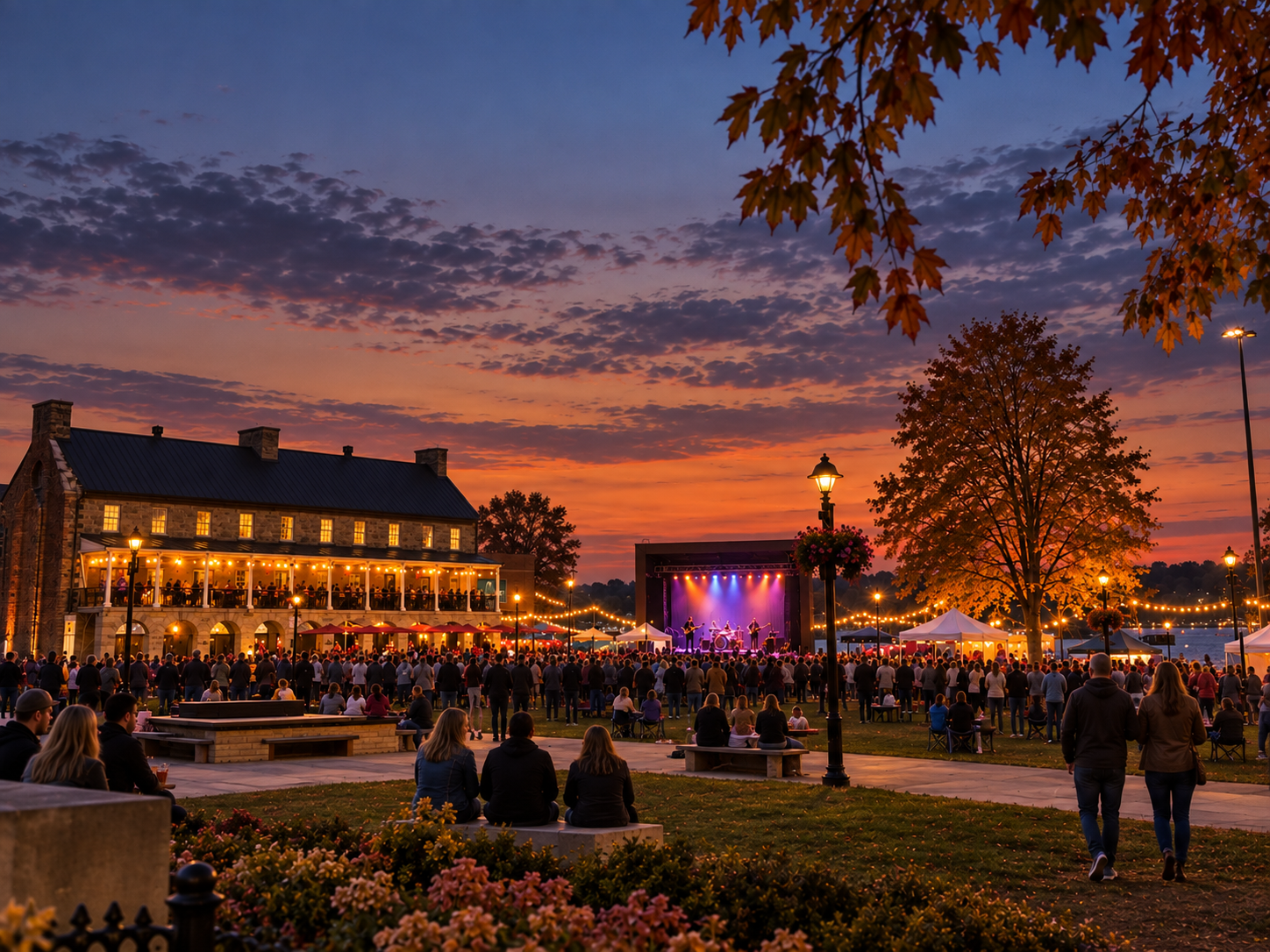
🎶 Harvest Music Festival Fredericton: The Real Economic & Community Impact
🍁The Rob Brown Realty JournalMonday | The Fredericton Conversation
For six days every September, downtown Fredericton stops behaving quite like downtown Fredericton.
Streets close. Tents appear. Hotel rooms become scarce. Restaurants fill. Music spills out of venues. People who haven't seen each other in months somehow find each other on Queen Street.
This year, Harvest Music Festival runs September 15–20, with headliners including Barenaked Ladies, Graham Nash, Young the Giant and The Beaches. The festival describes itself as hundreds of performers spread across dozens of stages in downtown Fredericton.
But here's the more interesting question:
What does it actually mean when a festival becomes big enough to temporarily take over part of a city?
Because Harvest isn't just a collection of concerts anymore.
For one week, it changes how Fredericton moves, spends, socializes and presents itself to outsiders.
And mostly, that's a very good thing.
Mostly.
That first festival lasted four days, welcomed approximately 9,500 patrons, presented 25 musical acts and used 17 downtown venues.
It grew from there.
The first big-top tent arrived in 1993, and over the following decades the festival expanded across downtown and broadened well beyond its original jazz-and-blues format.
In fact, the name itself changed.
In 2021, Harvest Jazz & Blues Festival became Harvest Music Festival, a decision the organization says reflected an increasingly diverse musical lineup and the need to remain competitive in a changing festival industry.
The blues hasn't disappeared — Harvest says nearly 20 blues artists are appearing in 2026 — but the audience it is trying to reach has clearly expanded.
That's an interesting evolution.
A festival originally built around a relatively specific musical identity has gradually become something much bigger:
Fredericton's unofficial homecoming week.
For six days every September, downtown Fredericton stops behaving quite like downtown Fredericton.
Streets close. Tents appear. Hotel rooms become scarce. Restaurants fill. Music spills out of venues. People who haven't seen each other in months somehow find each other on Queen Street.
This year, Harvest Music Festival runs September 15–20, with headliners including Barenaked Ladies, Graham Nash, Young the Giant and The Beaches. The festival describes itself as hundreds of performers spread across dozens of stages in downtown Fredericton.
But here's the more interesting question:
What does it actually mean when a festival becomes big enough to temporarily take over part of a city?
Because Harvest isn't just a collection of concerts anymore.
For one week, it changes how Fredericton moves, spends, socializes and presents itself to outsiders.
And mostly, that's a very good thing.
Mostly.
🎷 First, Harvest Wasn't Always This Big
Harvest began in 1991 as a locally organized jazz and blues festival.That first festival lasted four days, welcomed approximately 9,500 patrons, presented 25 musical acts and used 17 downtown venues.
It grew from there.
The first big-top tent arrived in 1993, and over the following decades the festival expanded across downtown and broadened well beyond its original jazz-and-blues format.
In fact, the name itself changed.
In 2021, Harvest Jazz & Blues Festival became Harvest Music Festival, a decision the organization says reflected an increasingly diverse musical lineup and the need to remain competitive in a changing festival industry.
The blues hasn't disappeared — Harvest says nearly 20 blues artists are appearing in 2026 — but the audience it is trying to reach has clearly expanded.
That's an interesting evolution.
A festival originally built around a relatively specific musical identity has gradually become something much bigger:
Fredericton's unofficial homecoming week.
💰 So, Does Harvest Actually Make Fredericton Money?
Almost certainly.But this is where we should be careful with the numbers.
You will sometimes see older claims that Harvest creates $7–8 million in economic activity. That estimate was publicly cited by festival founder David Seabrook more than a decade ago, when Harvest was reporting close to 80,000 admissions over six days.
That's useful historical context.
It is not a current 2026 economic-impact study.
I couldn't find a recent independently published economic-impact assessment that would justify presenting a precise 2026 dollar figure as fact.
And we shouldn't need to exaggerate the case.
The economic mechanics are visible.
Harvest says thousands of visitors come to Fredericton each September, and warns that downtown hotels within walking distance can fill roughly six months in advance. Its 2026 visitor information lists nine accommodation partners around the city.
Those visitors don't just buy concert tickets.
They need hotel rooms.
They eat breakfast.
They buy coffee.
They have dinner.
They take taxis.
They shop.
They buy drinks.
They stay another night.
And sometimes they discover a Fredericton business they would never have encountered otherwise.
🍽️ The Festival Has Started Deliberately Sending Money Beyond the Tents
One of the more revealing parts of Harvest 2026 isn't actually on a stage.It's the Downtown Passport.
Festival-goers are encouraged to visit participating downtown businesses, collect stamps by dining, buying drinks, ordering takeout and making other purchases, and enter to win a prize package contributed by local businesses and Harvest.
The festival explicitly describes the program as a way of boosting downtown tourism and building relationships with the local business community.
That's significant.
A successful downtown festival shouldn't function like a cruise ship where people enter a self-contained entertainment environment, spend all their money inside it and leave.
The better model is the opposite:
Get people into the city and then let the city benefit.
Harvest's geography makes that possible.
🚶 Fredericton's Size May Actually Be Its Advantage
Harvest doesn't happen at a fairground outside the city.It happens inside downtown Fredericton.
The festival describes itself as a multi-venue event spread through the city centre, with tents, established venues, vendors, buskers, pubs, clubs and free performances all connected largely on foot.
That creates something a suburban festival site can't easily reproduce.
You don't really leave Fredericton to enter Harvest.
Fredericton becomes Harvest.
The restaurant is part of the experience.
The walk down Queen Street is part of it.
The patio is part of it.
The person playing music on the sidewalk is part of it.
So is running into someone you haven't seen since last year's Harvest.
For a city our size, that concentration creates an intensity that would be much harder to produce if everything were spread across kilometres of parking lots and isolated venues.
🏨 But Here's Where the Conversation Gets More Complicated
Economic impact is often discussed as though every additional visitor automatically equals an additional benefit.Cities don't work quite that neatly.
When downtown hotels fill, that's excellent for accommodation operators.
When restaurants are packed, that's excellent for many restaurants.
When thousands of people are walking downtown, that's excellent exposure for businesses.
But what about the customer who decides downtown is too crowded and stays home?
What about a business whose normal clientele avoids the area during Harvest?
What about residents dealing with late-night noise?
What about employees trying to park or commute through street closures?
Or people who simply don't like crowds?
Those effects are much harder to put into a celebratory economic-impact number.
And acknowledging them isn't anti-Harvest.
It's part of taking Harvest seriously as a major urban event.
🚧 A Festival Taking Over Downtown Has a Cost
Harvest itself warns visitors that parking is very limited downtown during the festival, congestion increases and some streets are closed to vehicles.That inconvenience isn't accidental.
It's the trade-off involved in temporarily giving more downtown space to people instead of vehicles.
Interestingly, Harvest also provides a small experiment in what Fredericton looks like when transportation works differently.
Through the ANBL Safe Ride program, Harvest, ANBL and the City provide free transit to and from the festival, including service on both sides of the river and late-night return routes. Hotel shuttles are also offered.
For several nights, people who might normally insist they need their car downtown suddenly don't.
They walk.
They take the bus.
They use a shuttle.
And streets normally dominated by vehicles become gathering places.
That raises a question bigger than Harvest:
If people enjoy a more pedestrian downtown during festival week, why do we struggle so much with the idea the other 51 weeks of the year?
Now that could start a Fredericton conversation.
🙋 The Number Behind Harvest That Might Matter Most: 700
Here's an economic statistic that doesn't involve dollars.Harvest says it takes more than 700 volunteers to make the festival happen.
Think about that in a city of roughly 79,000 people.
Hundreds of residents give their time to admissions, accessibility, merchandise, bars, security support, safer spaces and other festival operations.
That's not merely free labour.
It's social infrastructure.
People work beside neighbours they may otherwise never meet. Students volunteer alongside longtime residents. Businesses sponsor events. Musicians meet audiences. Visitors interact with locals.
The economic value matters.
But there's another kind of value being created that doesn't appear on a restaurant receipt.
People become participants in their city rather than simply residents of it.
That's harder to measure.
It may also be one of Harvest's biggest contributions.
🏛️ And Yes — Taxpayers Help Support It
This part belongs in the conversation too.Harvest isn't entirely separate from municipal government.
Fredericton's 2025 budget proposed $70,000 in community funding for Harvest, following $67,000 approved the previous year. The City's 2024 annual report separately recorded $117,000 associated with the Harvest Jazz & Blues Festival among its community-services expenditures.
That raises a perfectly reasonable question:
Should public money support a music festival?
There are two legitimate ways of looking at it.
One argument says entertainment should pay for itself. If people want concerts, sell tickets and let ticket revenue and sponsorship cover the cost.
The other says Harvest isn't merely entertainment.
It attracts visitors, supports tourism, animates public space, provides free programming, creates business activity, markets Fredericton outside the province and contributes to the kind of cultural environment that makes people want to live here.
Under that interpretation, festival funding isn't simply an arts subsidy.
It's economic development and city-building.
The real test should be whether the public benefit justifies the public investment.
And that's a conversation worth having without assuming the answer in advance.
🏙️ Festivals Also Sell Something We Rarely Include in Economic Studies
They sell the city itself.Imagine someone from Halifax, Toronto or Boston visiting Fredericton for the first time during Harvest.
They don't experience Fredericton through a tourism advertisement.
They experience it walking from a hotel to Queen Street on a September evening.
They see the historic downtown full of people.
They cross paths with students.
They eat at a local restaurant.
They walk along the river.
They hear music coming from several directions.
And perhaps they think:
I didn't realize Fredericton was like this.
That impression has value.
Maybe they return as a tourist.
Maybe their company holds a meeting here.
Maybe their child considers UNB or STU.
Maybe, eventually, they consider living here.
You can't responsibly attribute all of those decisions to a festival.
But cities spend enormous amounts of effort trying to create exactly that kind of positive impression.
For six days, Harvest does it naturally.
⚖️ So... Can a Festival Become Too Successful?
Here's the question we don't ask very often.At what point does a festival stop fitting into a downtown and start overwhelming it?
More people isn't automatically better.
More tents aren't automatically better.
More headliners aren't automatically better.
There is probably a point where growth could begin undermining the thing people actually like about Harvest: its intimacy.
You can walk between venues.
You recognize people.
Local musicians still matter.
Downtown businesses remain part of the experience.
The city itself is still visible underneath the festival.
Harvest's challenge over the next decade may not simply be getting bigger.
It may be resisting the assumption that bigger always means better.
Because the real competitive advantage of Harvest isn't that Fredericton can imitate a giant urban music festival.
It's that it can't.
And perhaps it shouldn't try.
❤️ The Fredericton Conversation
Harvest is easy to describe as six days of music.It's harder — and more interesting — to recognize it as six days when Fredericton experiments with being a slightly different city.
More pedestrians.
More visitors.
More public transit.
More late-night activity.
More street life.
More people downtown.
More strangers talking to one another.
And, yes, more noise, congestion and inconvenience.
That's what happens when a festival genuinely becomes part of a city rather than simply taking place inside it.
So maybe the measure of Harvest's success shouldn't only be how many tickets it sells or how much money visitors spend.
Maybe we should also ask:
What does Fredericton learn about itself during Harvest week — and which parts of that city would we actually like to keep once the tents come down?
💬 Your turn: Does Harvest make Fredericton a better city — or has it become big enough that we should start talking more seriously about its impact on downtown residents, businesses and public space?
That's a conversation worth having.
🌿 The City Between the Listings
A neighbourhood isn't defined only by houses.It's shaped by what happens outside them — the restaurants we support, the streets we walk, the events we attend and the communities we build.
That's why The Rob Brown Realty Journal keeps looking beyond real estate statistics to the things that make Fredericton somewhere people actually want to call home.