🎓 College Hill Fredericton: Students, Professors, Families — a Neighbourhood in Transition
🍁The Rob Brown Realty JournalThursday | Fredericton Neighbourhoods
Ask someone where College Hill is and the easiest answer is probably: around UNB and STU.
Technically true.
But it misses what makes this part of Fredericton interesting.
College Hill isn't simply a university district. It is one of the city's clearest examples of a neighbourhood shaped by education, postwar growth, student housing, established family homes and changing ideas about how Fredericton should grow.
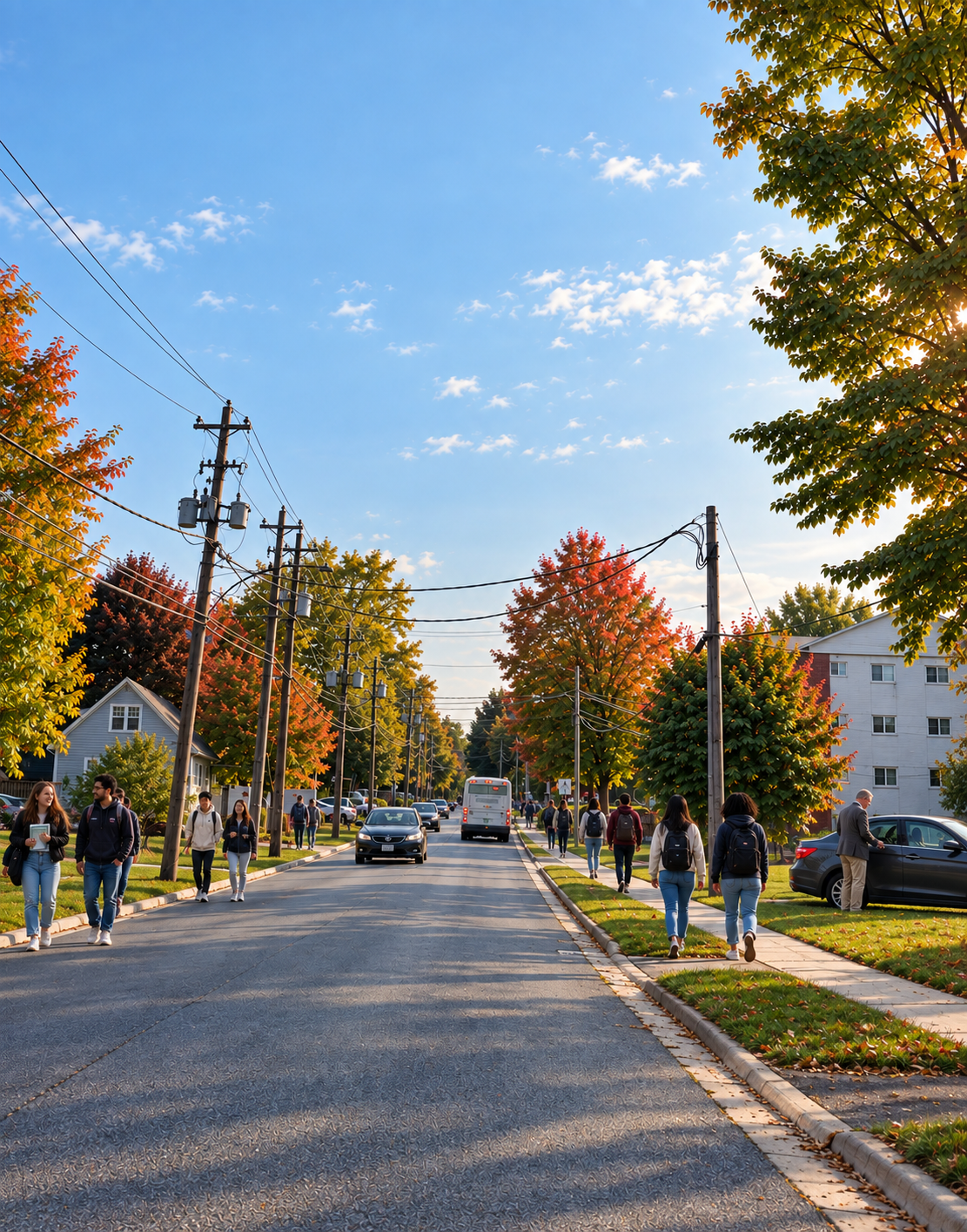
Walk Windsor Street, Graham Avenue, Montgomery Street or the quieter residential streets running off them and you'll see that tension almost immediately.
A professor's longtime family home can sit near a student rental. An older bungalow may be a few properties away from an apartment building. University residences rise above streets developed decades earlier for detached houses.
And right now, College Hill is entering another period of change.
Although the institution that became the University of New Brunswick dates to 1785, development of the present Fredericton campus began in 1829, when the New College Building — today's Sir Howard Douglas Hall — opened on the hill above the city.
For decades, it was essentially the campus.
In fact, UNB says it remained the university's only major building until 1900, when a new engineering building effectively doubled its classroom space.
That is worth picturing.
Today we think of College Hill as a large institutional district surrounded by residential streets.
In the 19th century, there was essentially one imposing college building standing above a much smaller Fredericton.
The neighbourhood grew around the university — not the other way around.
After the Second World War, returning veterans pushed UNB enrolment to more than 770 students in 1946 — nearly double its 1941 level.
That growth triggered a major expansion. UNB describes the period from 1953 to 1977 as a surge of construction that transformed the campus.
Then came a particularly important year:
1964.
Three major things happened.
Teachers' College relocated to the campus and was later incorporated into UNB's Faculty of Education.
St. Thomas University relocated from Chatham to Fredericton and affiliated with UNB.
And UNB established its Saint John campus.
For College Hill, the first two developments were transformative.
Suddenly, the hill wasn't simply home to one expanding university.
It was becoming an education district.
They need professors.
Employees.
Students.
Apartments.
Parking.
Daycares.
Services.
And housing within a reasonable distance of campus.
Over time, the residential streets bordering UNB and STU absorbed much of that demand.
That helps explain why College Hill can feel different from neighbourhoods such as Skyline Acres or Southwood Park.
Those areas are primarily residential.
College Hill has always had another force acting on it:
The campuses next door.
That creates value — walkability to major employers and institutions, proximity to amenities and a constant influx of new residents.
But it also creates pressure.
The former College Hill Secondary Municipal Plan specifically recognized a mix of single-detached homes, two-unit properties and multiple-unit housing in portions of the neighbourhood.
It even identified existing higher-density properties along Graham Avenue and Windsor Street individually.
That means the mixture we see today isn't new.
College Hill has been negotiating the boundary between traditional residential neighbourhood and university-oriented housing for decades.
Some streets remain dominated by detached houses and mature yards.
Others have accumulated duplexes, basement apartments, small multi-unit properties and larger apartment buildings.
The result is not a perfectly uniform neighbourhood.
That's arguably what makes it interesting.
In 1994, Fredericton adopted an entire Secondary Municipal Plan specifically for College Hill.
Why?
Because residents were concerned about the increasing number of non-owner-occupied homes and the conversion of properties to greater residential densities.
The stated objective was to “stabilize and enhance the residential character” of College Hill.
The plan divided the neighbourhood into four policy areas.
Some areas were intended to remain predominantly large single-detached homes on larger lots.
Others already contained a mixture of detached houses, two-unit properties, multi-unit housing and commercial buildings.
For more than 30 years, that planning framework limited how easily additional units could be added in parts of the neighbourhood.
That tells us something important:
The debate over housing density in College Hill isn't new.
Fredericton was having versions of today's conversation in the early 1990s.
The City proposed repealing the College Hill Secondary Municipal Plan and allowing more housing types and additional density near the university and college campuses.
The reasoning was straightforward: the 1994 plan no longer aligned with Fredericton's current housing, growth and affordability policies.
The College Hill Secondary Municipal Plan was formally repealed in June 2025.
That is a significant shift.
For three decades, College Hill had a special planning document partly designed to restrain residential intensification.
Today, City policy is moving in almost the opposite direction:
College Hill is being asked to accommodate more housing.
College Hill sits close to:
🎓 UNB
🎓 St. Thomas University
🏫 other post-secondary institutions
🏥 the Dr. Everett Chalmers Regional Hospital
🛍️ Regent Street commercial services
🚌 transit routes
🚶 pedestrian connections
🚲 Fredericton's broader active transportation network
The City's 2025 planning work specifically identified the lands around the top of the hill — between Regent Street, Priestman Street, Route 8 and Montgomery Street — as an area that could eventually transition toward a more comprehensively planned mixed-use neighbourhood connecting the educational campuses with the hospital area.
That's a bigger idea than adding a few apartments.
It potentially changes how this entire part of Fredericton functions.
One reason College Hill works as a neighbourhood is precisely because the institutional campuses don't consume everything around them.
There are still mature residential streets.
Older homes.
Large trees.
Front yards.
Longtime homeowners.
Families.
Faculty and staff who walk to work.
Students renting rooms or apartments.
And people who have no connection to the universities at all.
Even UNB's own campus planning has acknowledged the importance of being a good neighbour to College Hill, including creating better campus edges and buffering residential areas from incompatible institutional uses.
That's an important point.
The question isn't simply whether College Hill should change.
It always has.
The more useful question is whether new development can add housing without erasing the characteristics that make the surrounding streets desirable in the first place.
That isn't accurate.
The City itself describes College Hill as a community shared by students, landlords, post-secondary institutions and area residents, and its annual back-to-campus planning specifically involves UNB, STU, NBCC and the New Brunswick College of Craft and Design alongside neighbourhood residents.
There is even a small clue to the neighbourhood's family side right on campus.
The College Hill Early Learning Co-operative traces its origins to faculty and staff demand for campus child care in the late 1980s and opened in 1994, supported by UNB, STU and other university groups.
That's College Hill in miniature.
A neighbourhood built around students — but never exclusively for students.
UNB began building on the hill in 1829, and today's residential neighbourhood developed in the orbit of institutions that continued expanding for nearly two centuries.
🏠 Housing diversity isn't new.
Detached homes, basement apartments and multi-unit buildings have coexisted along streets such as Graham and Windsor for decades.
📜 Fredericton once deliberately restricted density here.
The 1994 College Hill plan arose partly because residents were concerned about increasing non-owner-occupied housing.
🏗️ Today, the City is deliberately encouraging more housing.
Repealing that plan in 2025 marked a clear change in planning philosophy as Fredericton looks for more homes near major institutions and services.
Put those four facts together and College Hill becomes much more than an attractive collection of streets beside a university.
It is one of the places where Fredericton's housing debate is actually playing out on the ground.
It's academic and residential.
Historic and postwar.
Temporary and permanent.
Student-oriented and family-oriented.
Low-density in some places and surprisingly urban in others.
And that's exactly why it matters.
As Fredericton grows, College Hill may become one of the city's clearest tests of whether we can add substantially more housing near the places people study, work and access services — while still protecting mature trees, established streets and a genuine residential community.
The interesting question isn't whether College Hill will change.
It already is.
Two homes only a few blocks apart can have very different relationships to campus, student housing, traffic, redevelopment and neighbourhood character.
If you're considering buying or selling in College Hill or anywhere around Fredericton, understanding the street as well as the house can make a meaningful difference. We're always here to help!
Ask someone where College Hill is and the easiest answer is probably: around UNB and STU.
Technically true.
But it misses what makes this part of Fredericton interesting.
College Hill isn't simply a university district. It is one of the city's clearest examples of a neighbourhood shaped by education, postwar growth, student housing, established family homes and changing ideas about how Fredericton should grow.
Walk Windsor Street, Graham Avenue, Montgomery Street or the quieter residential streets running off them and you'll see that tension almost immediately.
A professor's longtime family home can sit near a student rental. An older bungalow may be a few properties away from an apartment building. University residences rise above streets developed decades earlier for detached houses.
And right now, College Hill is entering another period of change.
🏛️ Why Is There a "College Hill" in the First Place?
The answer goes back almost two centuries.Although the institution that became the University of New Brunswick dates to 1785, development of the present Fredericton campus began in 1829, when the New College Building — today's Sir Howard Douglas Hall — opened on the hill above the city.
For decades, it was essentially the campus.
In fact, UNB says it remained the university's only major building until 1900, when a new engineering building effectively doubled its classroom space.
That is worth picturing.
Today we think of College Hill as a large institutional district surrounded by residential streets.
In the 19th century, there was essentially one imposing college building standing above a much smaller Fredericton.
The neighbourhood grew around the university — not the other way around.
🎓 The Hill Changed Dramatically After the Second World War
College Hill as many Frederictonians recognize it today is largely a product of the 20th century, particularly the postwar period.After the Second World War, returning veterans pushed UNB enrolment to more than 770 students in 1946 — nearly double its 1941 level.
That growth triggered a major expansion. UNB describes the period from 1953 to 1977 as a surge of construction that transformed the campus.
Then came a particularly important year:
1964.
Three major things happened.
Teachers' College relocated to the campus and was later incorporated into UNB's Faculty of Education.
St. Thomas University relocated from Chatham to Fredericton and affiliated with UNB.
And UNB established its Saint John campus.
For College Hill, the first two developments were transformative.
Suddenly, the hill wasn't simply home to one expanding university.
It was becoming an education district.
🏠 And That's Where the Neighbourhood Story Gets Interesting
Universities need more than classrooms.They need professors.
Employees.
Students.
Apartments.
Parking.
Daycares.
Services.
And housing within a reasonable distance of campus.
Over time, the residential streets bordering UNB and STU absorbed much of that demand.
That helps explain why College Hill can feel different from neighbourhoods such as Skyline Acres or Southwood Park.
Those areas are primarily residential.
College Hill has always had another force acting on it:
The campuses next door.
That creates value — walkability to major employers and institutions, proximity to amenities and a constant influx of new residents.
But it also creates pressure.
🗺️ Windsor Street and Graham Avenue Tell the Story
If you want to understand College Hill, Windsor Street and Graham Avenue are particularly revealing.The former College Hill Secondary Municipal Plan specifically recognized a mix of single-detached homes, two-unit properties and multiple-unit housing in portions of the neighbourhood.
It even identified existing higher-density properties along Graham Avenue and Windsor Street individually.
That means the mixture we see today isn't new.
College Hill has been negotiating the boundary between traditional residential neighbourhood and university-oriented housing for decades.
Some streets remain dominated by detached houses and mature yards.
Others have accumulated duplexes, basement apartments, small multi-unit properties and larger apartment buildings.
The result is not a perfectly uniform neighbourhood.
That's arguably what makes it interesting.
📜 Fredericton Actually Wrote Special Rules for College Hill
Here's something many residents may not know.In 1994, Fredericton adopted an entire Secondary Municipal Plan specifically for College Hill.
Why?
Because residents were concerned about the increasing number of non-owner-occupied homes and the conversion of properties to greater residential densities.
The stated objective was to “stabilize and enhance the residential character” of College Hill.
The plan divided the neighbourhood into four policy areas.
Some areas were intended to remain predominantly large single-detached homes on larger lots.
Others already contained a mixture of detached houses, two-unit properties, multi-unit housing and commercial buildings.
For more than 30 years, that planning framework limited how easily additional units could be added in parts of the neighbourhood.
That tells us something important:
The debate over housing density in College Hill isn't new.
Fredericton was having versions of today's conversation in the early 1990s.
🏗️ Then Fredericton Changed Direction
Fast-forward to 2025.The City proposed repealing the College Hill Secondary Municipal Plan and allowing more housing types and additional density near the university and college campuses.
The reasoning was straightforward: the 1994 plan no longer aligned with Fredericton's current housing, growth and affordability policies.
The College Hill Secondary Municipal Plan was formally repealed in June 2025.
That is a significant shift.
For three decades, College Hill had a special planning document partly designed to restrain residential intensification.
Today, City policy is moving in almost the opposite direction:
College Hill is being asked to accommodate more housing.
🏘️ Why College Hill Is an Obvious Place for More Housing
From a planning perspective, the argument isn't difficult to understand.College Hill sits close to:
🎓 UNB
🎓 St. Thomas University
🏫 other post-secondary institutions
🏥 the Dr. Everett Chalmers Regional Hospital
🛍️ Regent Street commercial services
🚌 transit routes
🚶 pedestrian connections
🚲 Fredericton's broader active transportation network
The City's 2025 planning work specifically identified the lands around the top of the hill — between Regent Street, Priestman Street, Route 8 and Montgomery Street — as an area that could eventually transition toward a more comprehensively planned mixed-use neighbourhood connecting the educational campuses with the hospital area.
That's a bigger idea than adding a few apartments.
It potentially changes how this entire part of Fredericton functions.
🌳 But College Hill Still Has Something Worth Protecting
More housing doesn't mean every street needs to look the same.One reason College Hill works as a neighbourhood is precisely because the institutional campuses don't consume everything around them.
There are still mature residential streets.
Older homes.
Large trees.
Front yards.
Longtime homeowners.
Families.
Faculty and staff who walk to work.
Students renting rooms or apartments.
And people who have no connection to the universities at all.
Even UNB's own campus planning has acknowledged the importance of being a good neighbour to College Hill, including creating better campus edges and buffering residential areas from incompatible institutional uses.
That's an important point.
The question isn't simply whether College Hill should change.
It always has.
The more useful question is whether new development can add housing without erasing the characteristics that make the surrounding streets desirable in the first place.
👨👩👧👦 College Hill Isn't Just a Student Neighbourhood
The neighbourhood's name can create the impression that everyone living there is temporary.That isn't accurate.
The City itself describes College Hill as a community shared by students, landlords, post-secondary institutions and area residents, and its annual back-to-campus planning specifically involves UNB, STU, NBCC and the New Brunswick College of Craft and Design alongside neighbourhood residents.
There is even a small clue to the neighbourhood's family side right on campus.
The College Hill Early Learning Co-operative traces its origins to faculty and staff demand for campus child care in the late 1980s and opened in 1994, supported by UNB, STU and other university groups.
That's College Hill in miniature.
A neighbourhood built around students — but never exclusively for students.
🔍 Four Things That Make College Hill Different
🎓 The institutions aren't nearby — they're foundational.UNB began building on the hill in 1829, and today's residential neighbourhood developed in the orbit of institutions that continued expanding for nearly two centuries.
🏠 Housing diversity isn't new.
Detached homes, basement apartments and multi-unit buildings have coexisted along streets such as Graham and Windsor for decades.
📜 Fredericton once deliberately restricted density here.
The 1994 College Hill plan arose partly because residents were concerned about increasing non-owner-occupied housing.
🏗️ Today, the City is deliberately encouraging more housing.
Repealing that plan in 2025 marked a clear change in planning philosophy as Fredericton looks for more homes near major institutions and services.
Put those four facts together and College Hill becomes much more than an attractive collection of streets beside a university.
It is one of the places where Fredericton's housing debate is actually playing out on the ground.
❤️ Living Fredericton
College Hill doesn't fit neatly into a single neighbourhood category.It's academic and residential.
Historic and postwar.
Temporary and permanent.
Student-oriented and family-oriented.
Low-density in some places and surprisingly urban in others.
And that's exactly why it matters.
As Fredericton grows, College Hill may become one of the city's clearest tests of whether we can add substantially more housing near the places people study, work and access services — while still protecting mature trees, established streets and a genuine residential community.
The interesting question isn't whether College Hill will change.
It already is.
It's what kind of College Hill we're creating next.
💬 If you've lived on College Hill — as a student, professor, family or longtime resident — what street or corner best captures the neighbourhood for you?🌿 Know the Neighbourhood Before You Buy the House
College Hill is a particularly good example of why buying in Fredericton is about more than bedrooms and square footage.Two homes only a few blocks apart can have very different relationships to campus, student housing, traffic, redevelopment and neighbourhood character.
If you're considering buying or selling in College Hill or anywhere around Fredericton, understanding the street as well as the house can make a meaningful difference. We're always here to help!