Are We Building the Fredericton We Actually Want? Growth, Housing & Preserving Character
🍁 The Rob Brown Realty JournalMonday | The Fredericton Conversation
Growth is happening. The harder question is what we want to keep while it does.
Fredericton is no longer talking about growth as something that might happen.
It is happening now.
The city estimates its current population at roughly 79,000, including newly annexed areas. Within the pre-annexation boundary alone, Fredericton added another 1,629 residents between July 2024 and July 2025, continuing to outpace the growth envisioned when the city's long-term strategy was developed.
Housing construction has responded. Fredericton permitted a record 1,564 new housing units in 2025, and in the first half of 2026 another 463 units received permits. Of those 2026 units, 91% are apartments or townhouses.
Those numbers tell us Fredericton is changing.
But they don't answer the more interesting question:
Are we building more Fredericton — or simply building more buildings?
🏗️ The Density Debate Is Already Being Decided
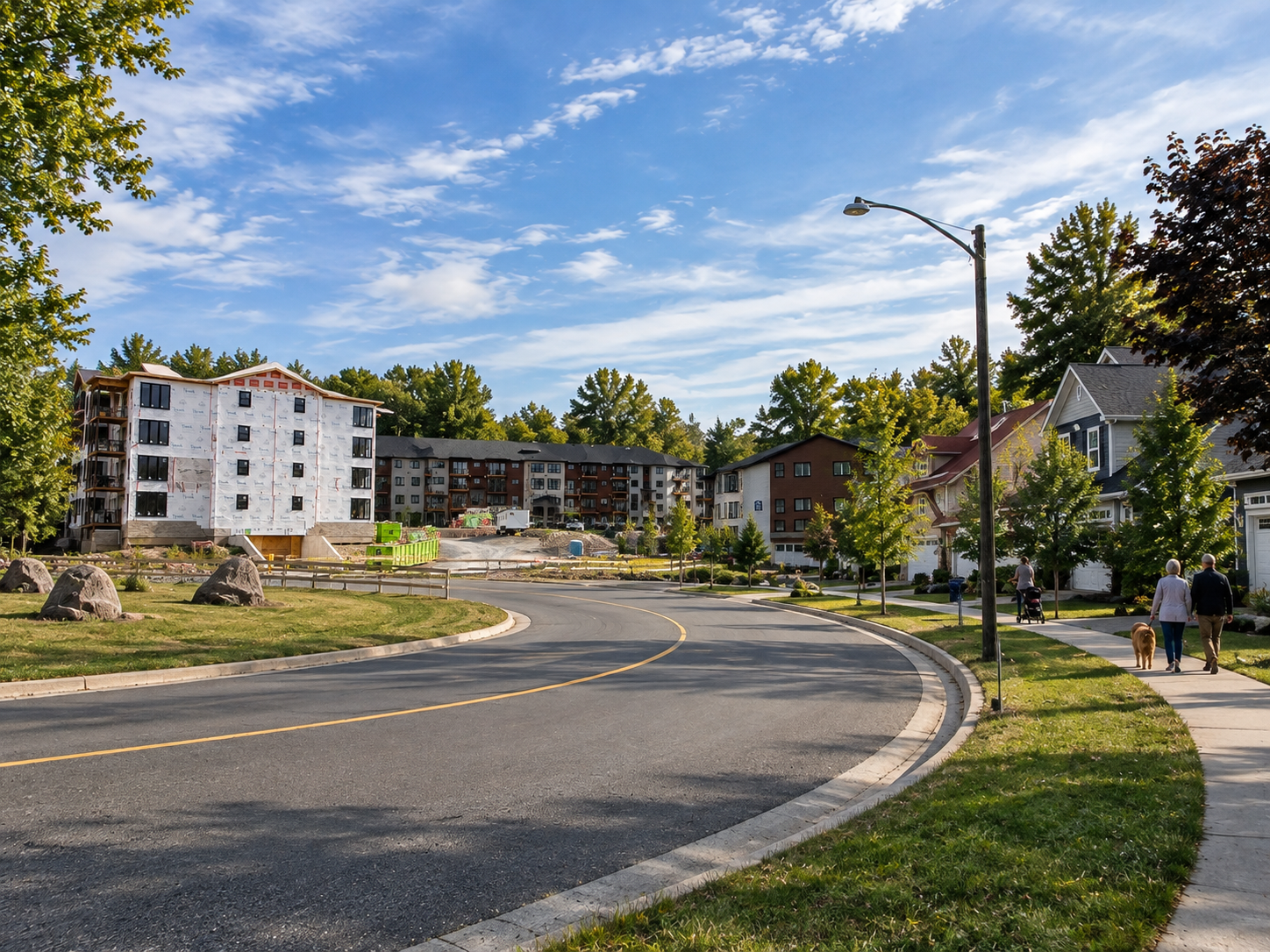
Look around the city and the direction is fairly clear.More apartments. More townhouses. More infill. More mixed-use development. More homes concentrated in places where infrastructure and services already exist.
That isn't accidental.
Fredericton's Municipal Plan specifically directs significant residential growth toward the Urban Core, mixed-use nodes and new neighbourhoods, with some additional infill elsewhere inside the growth boundary.
And development is following that map.
During the first six months of 2026, 81% of newly permitted housing units were located within designated growth areas.
There are practical reasons for this.
A city that spreads outward indefinitely needs more roads, pipes, utilities and other infrastructure. Compact neighbourhoods can put more residents closer to existing services, businesses, trails, transit and employment.
But density itself isn't really the issue.
The quality of that density is.
🏘️ What Are We Trying to Preserve?
Ask people what gives Fredericton its character and you'll probably hear some familiar answers.The river.
The trails.
The mature trees.
Downtown.
Historic homes.
Older neighbourhoods where houses don't all look the same.
Places such as Waterloo Row, Sunshine Gardens and the Town Plat.
And established postwar neighbourhoods such as Skyline Acres, Southwood Park and Fulton Heights, where larger lots, mature trees and quieter residential streets create an entirely different character.
None of that means Fredericton should be frozen in time.
It does mean character should be treated as infrastructure rather than decoration.
Once a mature tree canopy disappears, it takes decades to replace.
Once an interesting streetscape becomes a collection of large blank façades and parking areas, rebuilding pedestrian character isn't simple.
And once housing diversity disappears from a neighbourhood, restoring it can be difficult.
Growth isn't automatically the enemy of character.
Poorly designed growth can be.
🌳 More Homes Doesn't Have to Mean Less Fredericton
This is where the conversation becomes more useful than a simple development versus preservation argument.Fredericton needs considerably more housing.
The city's 2025 Housing Needs Assessment projected a need for more than 19,500 additional homes over the following two decades.
So saying don't build isn't much of a housing strategy.
The better question is how do we build?
That could mean mid-rise buildings along appropriate corridors rather than inserting the largest possible buildings onto every available parcel.
It could mean duplexes, townhouses, garden suites and smaller apartment buildings creating "gentle density" inside established neighbourhoods — something the City's housing strategy already supports.
It could mean protecting mature trees wherever practical.
It could mean requiring buildings to relate to sidewalks and streets rather than turning inward toward parking lots.
And it could mean creating neighbourhoods where housing, parks, schools, trails and everyday services are planned together.
In other words:
Density doesn't have to look like one thing.
🧭 The Southeast Neighbourhood May Be the Real Test
One of the most interesting experiments in Fredericton's next chapter may happen around Doak Road.The planned Southeast New Neighbourhood covers roughly 148.5 hectares and is expected to eventually accommodate 5,000 to 7,000 residents.
The plan isn't simply to build houses.
It calls for different housing types and price points, affordable ownership and rental opportunities on City-owned lands, potential space for a school, active transportation, transit connections, public spaces and preservation of natural features. It also explicitly proposes a compact development pattern.
And governments are now putting infrastructure behind it: more than $23 million combined in federal, provincial and municipal funding was announced this Summer for water, wastewater and stormwater infrastructure supporting the new neighbourhood.
That makes Southeast worth watching.
Because if Fredericton can create thousands of homes while also creating a neighbourhood people actually enjoy living in, density becomes much easier to defend.
If we simply produce units, roads and parking?
That's a very different legacy.
⚖️ Maybe "Growth vs. Character" Is the Wrong Question
Fredericton's own Municipal Plan describes the desired city as progressive and modern while retaining its distinctive charm and character.Those goals don't have to contradict one another.
The real choices are more specific:
Where should taller buildings go?
Where should lower-scale neighbourhood character be protected?
How much mature tree canopy are we willing to lose?
Can new developments create walkable neighbourhoods rather than simply housing subdivisions?
Can we add density without making every part of Fredericton look increasingly interchangeable with every other growing Canadian city?
And perhaps most importantly:
What parts of Fredericton would we regret losing 20 years from now?
Those are harder questions than whether we're for or against growth.
They're also the ones worth asking.
The numbers make that difficult to dispute.
But growth is not just a mathematical exercise in units per hectare.
We're building the streets, neighbourhoods and public spaces that people will inherit decades from now.
The goal shouldn't be to make Fredericton look exactly as it did twenty years ago.
It should be to make sure that twenty years from now, it still feels unmistakably like Fredericton.
💬 What do you think? Where should Fredericton embrace more density — and what parts of the city's character should we be especially careful to protect?
And perhaps most importantly:
What parts of Fredericton would we regret losing 20 years from now?
Those are harder questions than whether we're for or against growth.
They're also the ones worth asking.
❤️ The Fredericton Conversation
Fredericton needs homes. It needs infrastructure. It needs room for new residents, families and businesses.The numbers make that difficult to dispute.
But growth is not just a mathematical exercise in units per hectare.
We're building the streets, neighbourhoods and public spaces that people will inherit decades from now.
The goal shouldn't be to make Fredericton look exactly as it did twenty years ago.
It should be to make sure that twenty years from now, it still feels unmistakably like Fredericton.
💬 What do you think? Where should Fredericton embrace more density — and what parts of the city's character should we be especially careful to protect?