🏡 Skyline Acres Fredericton: Why Established Neighbourhoods Are Having Another Moment
🍁The Rob Brown Realty JournalWhy one of Fredericton's great 1960s neighbourhood experiments may be having another moment
There was a time when Skyline Acres was the new neighbourhood.
The houses were new. The trees were small. Streets such as Liverpool, Canterbury, Bristol, Coventry and Southampton represented a different kind of Fredericton — one expanding beyond the older downtown grid and building neighbourhoods around the automobile, the backyard and the postwar family.
Today, nobody would call Skyline Acres new.
And that may be precisely why it's becoming interesting again.
Because after decades of building outward, Fredericton is confronting a surprisingly modern question:
What if some of the things buyers want next are already sitting inside the neighbourhoods we built 60 years ago?
City property records still reference subdivision plans for Skyline Acres dating to 1968, while another City subdivision plan for Liverpool Street and Canterbury Drive dates to January 1969.
Most of the neighbourhood was developed through the 1960s and 1970s.
Look at Skyline Acres with that history in mind and its character makes more sense.
This wasn't a collection of houses slowly appearing along an old country road.
It was a subdivision designed for a particular version of everyday life.
Detached homes.
Driveways.
Usable yards.
Residential streets separated from heavy commercial activity.
Schools and recreation embedded within the broader neighbourhood.
And houses that, compared with many new builds today, were often relatively modest in footprint.
The interesting part is what happened next.
Skyline Acres grew up.
Literally.
Those young trees became mature canopies. Gardens filled in. Houses were renovated. Families came and went. Basement rec rooms became apartments, offices and bedrooms.
A subdivision eventually became a neighbourhood.
That's not quite the same thing.
New construction. Modern insulation. Contemporary layouts. Heat pumps. Current electrical systems. New streets and infrastructure.
But established neighbourhoods possess something developers can't include on an upgrade sheet:
time.
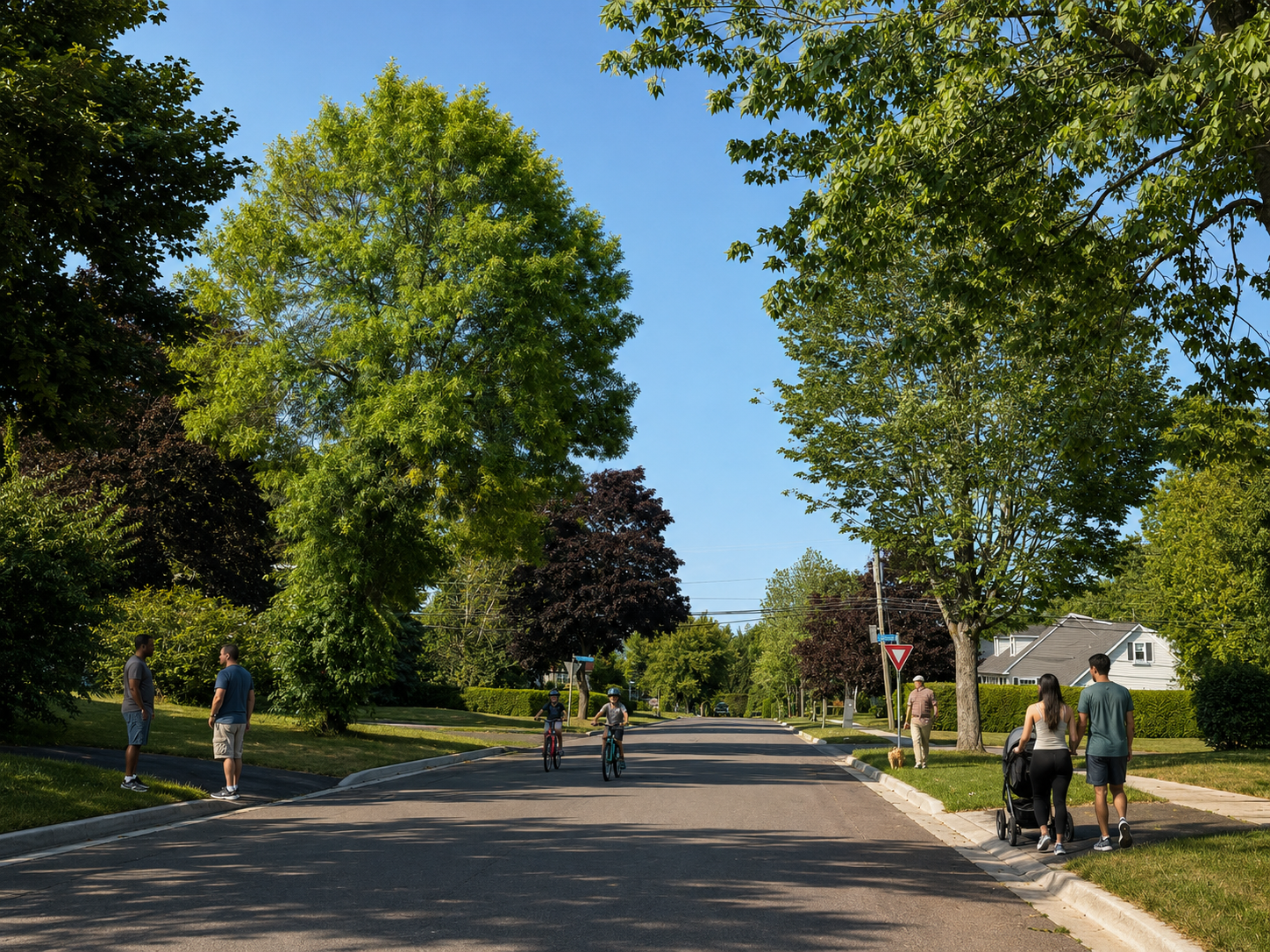
A mature maple shading a front yard isn't landscaping that can simply be ordered for closing day.
Neither is the feeling created when dozens of those trees occupy the same neighbourhood.
Nor can a developer instantly manufacture decades of gardens, established streetscapes, familiar walking routes and the subtle connections residents create after living beside one another for years.
That's part of the reason older neighbourhoods can look completely different at 50 than they did at five.
Skyline Acres' houses aged.
But so did everything around them.
And some of that aging actually increased the neighbourhood's appeal.
That sounds bureaucratic.
It isn't.
The designation speaks directly to the debate Fredericton is having about growth.
City planning policy allows modest intensification around established neighbourhoods, particularly near major roads, while calling for new development to respect existing neighbourhood scale and character.
At the same time, something very old-fashioned is being reinforced inside Skyline Acres itself:
the neighbourhood school.
Recent City planning documents concerning school development in Skyline Acres describe neighbourhood schools as critically important to creating complete communities. The City's reasoning is strikingly current: put schools near the population they serve, reduce bussing, encourage active transportation and allow schools to function as community focal points.
But think about that for a moment.
We're describing this as a modern planning goal.
Skyline Acres was already largely organized around that idea generations ago.
Skyline Acres isn't downtown.
You're probably not walking out your front door and choosing among six cafés, a grocery store and three restaurants.
But Skyline Acres occupies an interesting middle ground.
It's suburban without being particularly remote.
UNB and STU are nearby. The southside commercial district isn't far away. Downtown is accessible. Major employment areas are relatively close. Schools, parks and recreational spaces are woven through the area.
And increasingly, the neighbourhood isn't isolated from Fredericton's newer transportation thinking either.
When City planners evaluated higher-density development near Forest Hill Road, they specifically cited proximity to transit and the walking trail, as well as UNB, STU and downtown.
So a neighbourhood conceived during the automobile age is gradually being connected to a more multi-modal Fredericton.
That's an interesting evolution.
The street pattern didn't have to disappear for the way people use the neighbourhood to change.
A typical Skyline Acres bungalow or split-entry may be 50 or 60 years old.
That sounds like a disadvantage until you start looking at what people have done with them.
Walls have come down.
Kitchens have opened up.
Heat pumps have been installed.
Windows and roofs have been replaced.
Basements have become family rooms, home offices, bedrooms and secondary living spaces.
Some homes now contain basement apartments or potential mortgage-helper configurations; secondary suites are common enough in the broader Skyline Acres/Southwood Park area to be specifically noted in local real-estate descriptions.
That adaptability matters in 2026.
A house designed for a 1968 family might now accommodate an aging parent, an adult child, a tenant, someone working from home — or simply a family wanting more flexible space.
The architecture stayed relatively simple. The way we use it didn't.
A lot of it.
The City's 2025 Housing Needs Assessment calls for more than 19,500 additional housing units over the next two decades, according to the City, while the planned Southeast New Neighbourhood could eventually accommodate 5,000 to 7,000 residents.
The City's adopted plan for that new neighbourhood calls for something revealing: an affordable, walkable and inclusive complete community, with compact development, multiple ways to get around and connections to employment.
In other words, Fredericton is trying to figure out how to build the next generation of neighbourhoods well.
And that's where places like Skyline Acres become useful.
Not because we should recreate a 1960s subdivision in 2026.
We shouldn't.
But because established neighbourhoods show us what can't always be measured on the day construction finishes.
What happens after 20 years?
Where do the trees grow?
Do children have somewhere to play?
Can the housing adapt?
Does the school remain part of neighbourhood life?
Can people stay after their children leave home?
Can a new generation afford to move in?
Does the neighbourhood become more useful with age — or less?
Those might be better measures of successful development than how impressive the model home looked during opening weekend.
Neighbourhoods built heavily during one period eventually experience generational turnover.
The young families who bought homes decades ago become empty nesters and retirees. Some remain. Others downsize.
Their houses return to the market.
Then something interesting happens.
A home that raised one generation gets renovated by another.
The avocado appliances disappeared long ago. The basement panelling may be next.
But the yard, street and neighbourhood remain.
That cycle can gradually refresh an established area without bulldozing what made it work in the first place.
It's neighbourhood recycling — on a house-by-house scale.
Older homes can bring older sewer lines, electrical systems, insulation, foundations, windows and decades of renovations of varying quality.
Some buyers would rather pay for new construction and know exactly what they're getting.
And Skyline Acres' car-oriented origins don't magically disappear because cycling and walking have become more important.
That's why this isn't an argument that established neighbourhoods are inherently superior.
It's something more interesting:
Maybe age itself has become an amenity.
Not the age of the furnace.
The age of the neighbourhood.
There is value in seeing how a place actually works after decades of real life have tested it.
Skyline Acres offers a chance to look backward before we build forward.
Some ideas haven't aged particularly well.
Others — neighbourhood schools, useful green space, adaptable houses, reasonable yards and streets that eventually disappear beneath mature trees — suddenly look remarkably current.
So perhaps the question isn't:
Why are established neighbourhoods popular again?
Maybe it's:
What did neighbourhoods like Skyline Acres get right that we should make sure we don't forget?
And we'd genuinely like to hear from the people who know it best.
If you grew up in Skyline Acres — or live there today — what has changed most? And what hasn't changed at all?
A real neighbourhood takes considerably longer.
If you're trying to decide between the possibilities of a new development and the character of an established Fredericton neighbourhood, understanding what you're actually buying around the house can matter every bit as much as what's inside it.
There was a time when Skyline Acres was the new neighbourhood.
The houses were new. The trees were small. Streets such as Liverpool, Canterbury, Bristol, Coventry and Southampton represented a different kind of Fredericton — one expanding beyond the older downtown grid and building neighbourhoods around the automobile, the backyard and the postwar family.
Today, nobody would call Skyline Acres new.
And that may be precisely why it's becoming interesting again.
Because after decades of building outward, Fredericton is confronting a surprisingly modern question:
What if some of the things buyers want next are already sitting inside the neighbourhoods we built 60 years ago?
📐 Skyline Was Planned — Not Just Built
Here's a detail that helps explain the neighbourhood.City property records still reference subdivision plans for Skyline Acres dating to 1968, while another City subdivision plan for Liverpool Street and Canterbury Drive dates to January 1969.
Most of the neighbourhood was developed through the 1960s and 1970s.
Look at Skyline Acres with that history in mind and its character makes more sense.
This wasn't a collection of houses slowly appearing along an old country road.
It was a subdivision designed for a particular version of everyday life.
Detached homes.
Driveways.
Usable yards.
Residential streets separated from heavy commercial activity.
Schools and recreation embedded within the broader neighbourhood.
And houses that, compared with many new builds today, were often relatively modest in footprint.
The interesting part is what happened next.
Skyline Acres grew up.
Literally.
Those young trees became mature canopies. Gardens filled in. Houses were renovated. Families came and went. Basement rec rooms became apartments, offices and bedrooms.
A subdivision eventually became a neighbourhood.
That's not quite the same thing.
🌳 You Can't Install a 50-Year-Old Tree
New neighbourhoods have obvious advantages.New construction. Modern insulation. Contemporary layouts. Heat pumps. Current electrical systems. New streets and infrastructure.
But established neighbourhoods possess something developers can't include on an upgrade sheet:
time.
A mature maple shading a front yard isn't landscaping that can simply be ordered for closing day.
Neither is the feeling created when dozens of those trees occupy the same neighbourhood.
Nor can a developer instantly manufacture decades of gardens, established streetscapes, familiar walking routes and the subtle connections residents create after living beside one another for years.
That's part of the reason older neighbourhoods can look completely different at 50 than they did at five.
Skyline Acres' houses aged.
But so did everything around them.
And some of that aging actually increased the neighbourhood's appeal.
🏫 Here's Where Skyline Acres Gets Especially Interesting
Fredericton's planning documents now classify Skyline Acres as an Established Neighbourhood.That sounds bureaucratic.
It isn't.
The designation speaks directly to the debate Fredericton is having about growth.
City planning policy allows modest intensification around established neighbourhoods, particularly near major roads, while calling for new development to respect existing neighbourhood scale and character.
At the same time, something very old-fashioned is being reinforced inside Skyline Acres itself:
the neighbourhood school.
Recent City planning documents concerning school development in Skyline Acres describe neighbourhood schools as critically important to creating complete communities. The City's reasoning is strikingly current: put schools near the population they serve, reduce bussing, encourage active transportation and allow schools to function as community focal points.
But think about that for a moment.
We're describing this as a modern planning goal.
Skyline Acres was already largely organized around that idea generations ago.
🚸 Maybe the Old Subdivision Got Something Right
One criticism of postwar subdivisions is completely fair: many were designed around cars.Skyline Acres isn't downtown.
You're probably not walking out your front door and choosing among six cafés, a grocery store and three restaurants.
But Skyline Acres occupies an interesting middle ground.
It's suburban without being particularly remote.
UNB and STU are nearby. The southside commercial district isn't far away. Downtown is accessible. Major employment areas are relatively close. Schools, parks and recreational spaces are woven through the area.
And increasingly, the neighbourhood isn't isolated from Fredericton's newer transportation thinking either.
When City planners evaluated higher-density development near Forest Hill Road, they specifically cited proximity to transit and the walking trail, as well as UNB, STU and downtown.
So a neighbourhood conceived during the automobile age is gradually being connected to a more multi-modal Fredericton.
That's an interesting evolution.
The street pattern didn't have to disappear for the way people use the neighbourhood to change.
🔨 The Houses Are Entering Their Second — or Third — Lives
This may be the biggest reason established neighbourhoods are worth watching.A typical Skyline Acres bungalow or split-entry may be 50 or 60 years old.
That sounds like a disadvantage until you start looking at what people have done with them.
Walls have come down.
Kitchens have opened up.
Heat pumps have been installed.
Windows and roofs have been replaced.
Basements have become family rooms, home offices, bedrooms and secondary living spaces.
Some homes now contain basement apartments or potential mortgage-helper configurations; secondary suites are common enough in the broader Skyline Acres/Southwood Park area to be specifically noted in local real-estate descriptions.
That adaptability matters in 2026.
A house designed for a 1968 family might now accommodate an aging parent, an adult child, a tenant, someone working from home — or simply a family wanting more flexible space.
The architecture stayed relatively simple. The way we use it didn't.
💰 Then There's the New-Construction Question
Fredericton needs housing.A lot of it.
The City's 2025 Housing Needs Assessment calls for more than 19,500 additional housing units over the next two decades, according to the City, while the planned Southeast New Neighbourhood could eventually accommodate 5,000 to 7,000 residents.
The City's adopted plan for that new neighbourhood calls for something revealing: an affordable, walkable and inclusive complete community, with compact development, multiple ways to get around and connections to employment.
In other words, Fredericton is trying to figure out how to build the next generation of neighbourhoods well.
And that's where places like Skyline Acres become useful.
Not because we should recreate a 1960s subdivision in 2026.
We shouldn't.
But because established neighbourhoods show us what can't always be measured on the day construction finishes.
What happens after 20 years?
Where do the trees grow?
Do children have somewhere to play?
Can the housing adapt?
Does the school remain part of neighbourhood life?
Can people stay after their children leave home?
Can a new generation afford to move in?
Does the neighbourhood become more useful with age — or less?
Those might be better measures of successful development than how impressive the model home looked during opening weekend.
🔄 The Quiet Generational Turnover
There's another reason Skyline Acres' moment may only be beginning.Neighbourhoods built heavily during one period eventually experience generational turnover.
The young families who bought homes decades ago become empty nesters and retirees. Some remain. Others downsize.
Their houses return to the market.
Then something interesting happens.
A home that raised one generation gets renovated by another.
The avocado appliances disappeared long ago. The basement panelling may be next.
But the yard, street and neighbourhood remain.
That cycle can gradually refresh an established area without bulldozing what made it work in the first place.
It's neighbourhood recycling — on a house-by-house scale.
🤔 But Established Doesn't Automatically Mean Better
There are trade-offs.Older homes can bring older sewer lines, electrical systems, insulation, foundations, windows and decades of renovations of varying quality.
Some buyers would rather pay for new construction and know exactly what they're getting.
And Skyline Acres' car-oriented origins don't magically disappear because cycling and walking have become more important.
That's why this isn't an argument that established neighbourhoods are inherently superior.
It's something more interesting:
Maybe age itself has become an amenity.
Not the age of the furnace.
The age of the neighbourhood.
There is value in seeing how a place actually works after decades of real life have tested it.
❤️ The Fredericton Conversation
Fredericton is about to build neighbourhoods that people may still be living in around 2080.Skyline Acres offers a chance to look backward before we build forward.
Some ideas haven't aged particularly well.
Others — neighbourhood schools, useful green space, adaptable houses, reasonable yards and streets that eventually disappear beneath mature trees — suddenly look remarkably current.
So perhaps the question isn't:
Why are established neighbourhoods popular again?
Maybe it's:
What did neighbourhoods like Skyline Acres get right that we should make sure we don't forget?
And we'd genuinely like to hear from the people who know it best.
If you grew up in Skyline Acres — or live there today — what has changed most? And what hasn't changed at all?
🌳 Some Neighbourhoods Need Time...
A new house can be finished in months.A real neighbourhood takes considerably longer.
If you're trying to decide between the possibilities of a new development and the character of an established Fredericton neighbourhood, understanding what you're actually buying around the house can matter every bit as much as what's inside it.