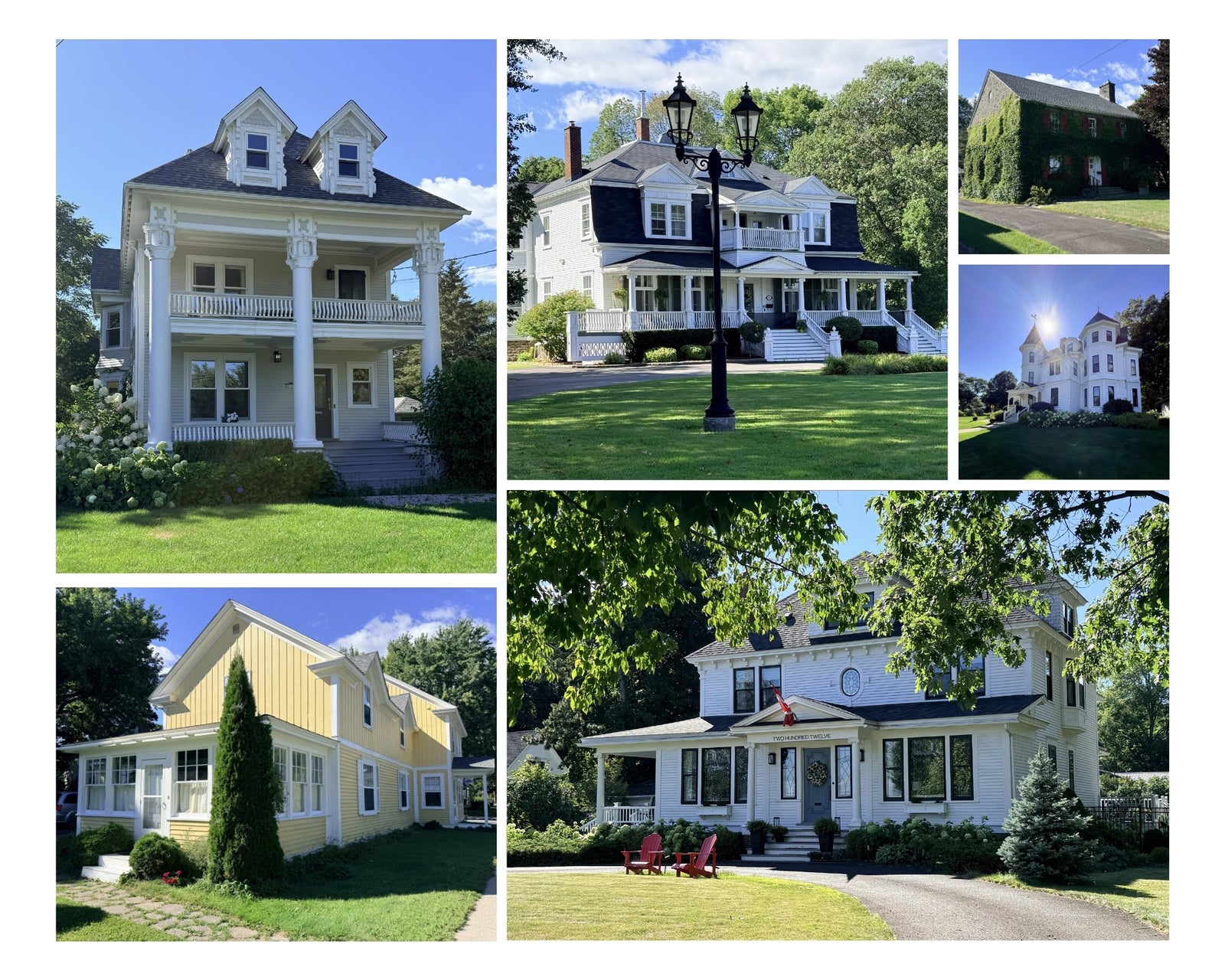
🏛️ Waterloo Row: The Houses That Watched Fredericton Grow
🍁The Rob Brown Realty JournalFrom Loyalist inns and a homemade radio station to a magazine-inspired “House of the Year,” one Fredericton street has been quietly collecting the city's stories for more than two centuries.
Drive, walk or cycle along Waterloo Row and it's easy to understand why it remains one of Fredericton's most recognizable residential streets.
The river is beside you. Mature trees frame the road. Large old houses sit back from the street, some grand and some surprisingly understated.
But here's what is easy to miss:
Waterloo Row isn't simply a street with beautiful old houses. It's almost a timeline of Fredericton itself.
Behind those doors are stories involving Loyalist settlers, taverns, Confederation, a pioneering radio station, a future U.S. president, one of Canada's best-known painters — and even a house copied from Good Housekeeping magazine.
Here are a few worth knowing.
🍺 Before the Mansions, There Were Inns
Waterloo Row's story begins much earlier than many of the stately homes we associate with it today.At 12–14 Waterloo Row, Loyalists Duncan and John McLeod constructed what became McLeod's Inn around 1785–86, opening an inn on the site in 1791. Its distinctive gambrel roof wasn't simply decorative: the design efficiently created a third floor, valuable space for a busy waterfront inn. Around 1880, the building was converted into two residences and today contains apartments.
Nearby, the site of today's 58 Waterloo Row was once home to the Golden Ball Inn, an early Loyalist-era tavern, inn and mercantile establishment.
The Golden Ball wasn't merely somewhere to sleep. It was part store, part tavern and part community gathering place. When it later became known as Avery's Tavern, the local Masonic lodge met there — and in 1819, proprietor Ebenezer Avery even brought a travelling wax-figure exhibition to the property.
Think about that the next time you pass by.
Long before entertainment arrived on televisions and phones, Waterloo Row was apparently a pretty good place to catch a travelling show.
📻 Fredericton Radio Started in a Living Room
Here's a Waterloo Row story even longtime Fredericton residents may not know.At 212 Waterloo Row, J. Stewart Neill began experimenting with radio broadcasting from his family home in the early 1920s.
His broadcasts initially involved playing music from a gramophone into a microphone and adding his own commentary.
The remarkable part?
When Neill began experimenting with broadcasting in 1922, the City says there were only five Fredericton households with radio receivers. By January 1923 he was broadcasting with a 10-watt transmitter, and what began as a hobby developed into CFNB, identified by the City as the first radio station in the Maritimes.
There was one practical complication.
The Neill family had to live quietly while Dad was on the air.
According to the City's heritage history, family members learned to communicate through their own form of sign language and walked on tiptoe while broadcasts were underway. CFNB eventually outgrew the house and moved to York Street in 1927.
A piece of Maritime broadcasting history began not in a purpose-built studio, but in a Waterloo Row parlour.
🛗 The 1905 House With an Elevator
Then there's 82 Waterloo Row.Businessman W.G. Clark commissioned prominent Fredericton builder Moses Mitchell to construct the Queen Anne Revival home, completed in 1905.
Clark later served as Fredericton's mayor and as Lieutenant Governor of New Brunswick. His daughter, historian Esther Clark Wright, grew up there.
But the detail that really stands out is inside the house.
When it was built, 82 Waterloo Row included the modern conveniences expected of an impressive new residence — plus something decidedly unusual for a Fredericton home in 1905:
an elevator running from the cellar to the attic.
More than 120 years later, an elevator is still considered an unusual feature in a Fredericton single-family home.
Imagine what the neighbours thought in 1905.
🛶 The House Connected to a Fredericton Icon
At 132 Waterloo Row, another chapter of the city's commercial history appears.The striking Queen Anne Revival house was completed in 1902 for Harry G. Chestnut, manager of the Chestnut Canoe Company.
The Chestnut family's Fredericton business story had begun decades earlier in hardware, but canoe manufacturing would make the name famous. The family secured a Canadian patent for canvas canoes in 1905, and the Chestnut Canoe Company was incorporated in 1907.
The connection goes even deeper.
Architect William E. Minue designed the Waterloo Row residence — and was later hired to design factory buildings and a warehouse for the Chestnut Canoe Company.
So one house quietly links Waterloo Row to one of Fredericton's most recognizable manufacturing stories.
📰 Fredericton's Version of a Magazine Dream Home
Perhaps the most wonderfully relatable story sits at 126 Waterloo Row.In 1937, William J. West saw Good Housekeeping magazine's “House of the Year.”
Apparently, he liked it.
A lot.
West obtained the plans and built his own version on Waterloo Row in 1938.
The design closely followed the magazine house, but West made one important New Brunswick substitution: instead of the brick used on the published home, his was clad in stone quarried from Royal Road on Fredericton's north side.
In other words, nearly 90 years before Pinterest inspiration boards, someone in Fredericton effectively saw a dream house in a magazine and said:
“Build me that.”
The house later became significant for another reason.
West's daughter Mary Pratt grew up there and became one of Canada's celebrated visual artists. The City notes that a number of Pratt's works relate directly to the Waterloo Row home.
🇨🇦 A Father of Confederation — and a Future U.S. President
Farther along Waterloo Row stands Somerville House at 238 Waterloo Row, whose history reads almost like someone tried to fit too much Canadian history into one address.The property was purchased in 1815 by John Murray Bliss.
By 1845 it had become the home of Charles Fisher, a Father of Confederation and New Brunswick's first elected premier under responsible government. After an 1886 fire destroyed the earlier house, Fisher's widow rebuilt it in the grand form seen today.
Then came another famous owner:
Lord Beaverbrook purchased Somerville House in 1948 as his Fredericton residence and later donated it to UNB.
And here's the detail worth saving for Fredericton trivia night:
During UNB's 1957 Fall Convocation, Somerville House hosted an honorary doctorate recipient from Massachusetts.
His name was Senator John F. Kennedy.
Three years later, Kennedy was elected President of the United States.
🗺️ Even the Land Beneath the Houses Has Stories
Some Waterloo Row history predates the houses altogether.The land at 102 Waterloo Row, for example, was originally granted to Benedict Arnold. The house standing there dates to around 1790, with Fredericton Heritage Trust noting that part of the structure may even be pre-Loyalist.
Farther along, large sections of land south of what became Lansdowne Street formed Rose Hall, an estate acquired in 1791 by Loyalist Colonel Jacob Ellegood and named after his former plantation in Virginia. The estate remained intact until the 1880s, when the property began to be subdivided.
That helps explain something about Waterloo Row today.
The street wasn't created all at once.
Its built landscape accumulated gradually as large estates were divided, older buildings disappeared, new houses replaced them and Fredericton expanded around them.
🌳 That's What Makes Waterloo Row Different
There are older buildings elsewhere in Fredericton.There are grander houses.
And there are streets with their own remarkable histories.
But Waterloo Row offers something unusual: layers of Fredericton history sitting almost side by side.
An 18th-century inn.
A Victorian-era estate.
Turn-of-the-century Queen Anne houses.
A 1905 home with an elevator.
A 1930s magazine-inspired dream house.
A living room where radio broadcasting began.
Homes connected to politicians, industrialists, artists, university presidents and people whose names eventually appeared in history books.
Meanwhile, outside those houses, Fredericton kept changing.
Cars replaced horses. Radio arrived. The city expanded. UNB grew. The riverfront evolved. Trails appeared. Neighbourhoods pushed farther outward.
And Waterloo Row remained.
Maybe that's why walking it feels different once you know what's behind the doors.
You're not simply looking at old houses.
You're looking at houses that watched Fredericton become Fredericton.
❤️ The Fredericton Conversation
Here's a question worth asking:Which Fredericton street should we explore next?
George Street? Charlotte Street? Church Street? University Avenue? An older Northside neighbourhood?
And if you know a Waterloo Row story that isn't in the history books, we'd especially like to hear it.
Because some of the best local history isn't written on a plaque.
It's still being passed from neighbour to neighbour.
🏡 Bringing It Home...
Knowing a neighbourhood means understanding more than property lines and sale prices. It means knowing why a street looks the way it does, how it changed — and what makes people care about preserving its character.That's part of what makes living in Fredericton interesting.