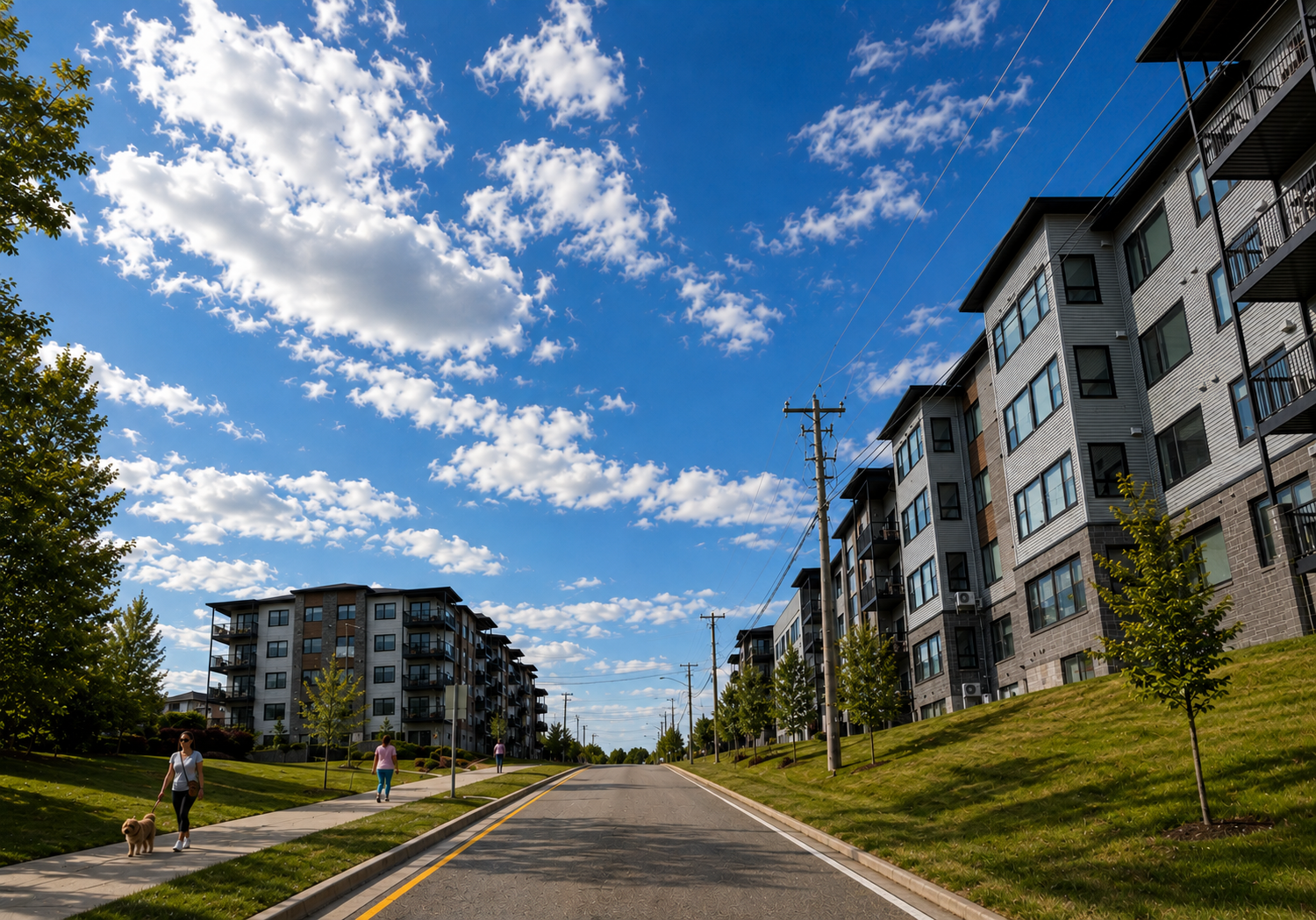
Does Fredericton Need More High-Density Housing? What Halifax Can Teach Us About Growth, Supply and Affordability
🍁 The Rob Brown Realty Journal🔥 Monday | The Fredericton Conversation
How High Should We Grow?
Fredericton is growing up — perhaps literally.
Apartment buildings are appearing where there were once smaller buildings or open land. Townhouses and multi-unit developments are becoming a larger part of the housing conversation. And with each proposal comes a familiar debate:
How much density is right for Fredericton?
For some residents, more apartments and taller buildings represent exactly what a growing city needs. For others, they raise legitimate questions about traffic, infrastructure, neighbourhood character, parking, schools, green space and whether Fredericton risks losing some of what makes it feel like Fredericton.
But there is another question worth asking:
What happens if we don't build them?
🏘️ Fredericton's Housing Math Is Changing
This isn't simply a conversation about development preferences anymore.Fredericton's 2025 Housing Needs Assessment estimated that the city would need 19,680 additional homes by 2044, including approximately 6,010 affordable units. The city's population was about 77,500 in 2024 and was projected to grow another 41% over the following two decades.
That's a lot of households to accommodate.
And increasingly, the answer isn't another subdivision of detached homes.
In fact, Fredericton may already be showing us where things are headed.
Of the 1,564 new housing units permitted in 2025, the city says development was overwhelmingly multi-residential. By the middle of 2026, 91% of newly permitted residential units were townhouses and apartments.
So perhaps the question isn't whether density is coming.
It's what kind of density we want.
🏙️ Halifax Offers an Interesting Lesson — But Not a Perfect One
It's tempting to look east to Halifax.For years, Halifax has added apartments, redeveloped underused properties and increasingly concentrated housing within its urban area. Rental apartment starts and completions have grown by roughly 7% annually over the past decade, and more than 10,000 rental apartments were under construction in June 2025 alone.
That long pipeline of construction is now having an effect.
CMHC reported Halifax's purpose-built rental vacancy rate reached 2.7% in 2025, as strong additions to supply helped loosen what had been an exceptionally tight market.
And that is where Halifax becomes particularly interesting for Fredericton.
Buildings that were once new construction eventually become yesterday's apartments. Newer buildings enter the market. Residents move between them. More choices emerge.
Economists sometimes describe part of this process as filtering: housing doesn't necessarily begin as affordable, but over time an expanding supply can create more options throughout the market.
But there's an important caveat.
Halifax has not solved affordability.
Its average two-bedroom purpose-built rent reached $1,826 in 2025, up 6.7%, even while vacancy increased. CMHC expects rents to continue rising.
So the Halifax lesson isn't:
Build apartments today and inexpensive apartments magically appear tomorrow.
It's more useful than that.
Build enough housing over a long enough period and you give the market room to breathe.
🏗️ Does the Formula Work?
Partly.More supply can create competition, increase vacancy and give renters more choices. Fredericton may already be seeing an early version of that effect.
After years of extremely tight conditions, the city's vacancy rate increased from 0.9% in 2024 to 2.5% in 2025, following record housing construction.
That's significant.
But density alone doesn't guarantee affordability.
A city could theoretically build hundreds of expensive apartments and still leave lower-income households struggling. Fredericton's own Housing Needs Assessment acknowledges that private development tends to prioritize market-rate housing during shortages and that relatively little new non-market housing has been created locally in recent years.
That means a successful housing strategy probably needs both sides of the equation:
🏢 More market housing and apartments
🏘️ Townhouses, duplexes and "missing middle" homes
🏡 Continued opportunities for detached housing
❤️ Purpose-built affordable and non-market housing
🚶 Density located where services and infrastructure can support it
The answer doesn't have to be high-rises everywhere.
🌳 And That's Where Fredericton Gets to Make Its Own Choice
Fredericton isn't Halifax.Nor should it try to become Halifax.
Our scale is different. Our neighbourhoods are different. Our street network is different. And mature trees, trails, historic streetscapes, river views and established neighbourhoods are part of the city's identity.
Density done poorly can absolutely diminish those things.
But density done thoughtfully can also help protect them.
If more people can live within existing serviced areas, near employment, transit, trails and amenities, the city may be able to accommodate population growth without pushing every new household farther outward.
Fredericton's own housing strategy already talks about gentle density and directing growth toward areas with planned infrastructure, parks, transit and schools.
That's a considerably more nuanced conversation than simply asking whether we want more apartment buildings.
🤔 The Bigger Question: What Should Fredericton Look Like in 2040?
Imagine another 14 years of growth.Do we want more people living downtown?
Should larger apartment buildings cluster along major corridors?
Could four-, six- and eight-storey buildings become ordinary parts of some neighbourhoods?
Should established residential streets accommodate duplexes, garden suites and small multi-unit buildings while retaining their overall character?
And perhaps most importantly:
Can we build enough housing for the Fredericton of tomorrow without sacrificing the things people love about the Fredericton of today?
That's the real density conversation.
Because refusing to change doesn't necessarily preserve affordability or character. Sometimes it simply means fewer people can afford to participate in the community we're trying to protect.
❤️ The Fredericton Conversation
Halifax suggests that sustained housing construction can eventually create breathing room in a tight market.It also demonstrates that supply alone isn't a complete affordability strategy.
Fredericton therefore has an opportunity to learn from cities that grew before us rather than simply copying them.
Build more? Almost certainly.
Build higher in appropriate places? Probably.
Build everywhere without considering infrastructure, neighbourhood character and quality of life? That's a very different proposition.
The challenge is finding the balance.
So, Fredericton — how high should we grow?
Would you welcome more high-density housing if it meant greater housing choice and potentially better affordability over time? Or is there a point where density begins changing too much of what makes Fredericton appealing?
We'd genuinely like to hear where you would draw the line.
And tomorrow, we'll take this conversation from the city's future back to today's market — and look at what the final days of summer may be telling buyers and sellers heading into September.