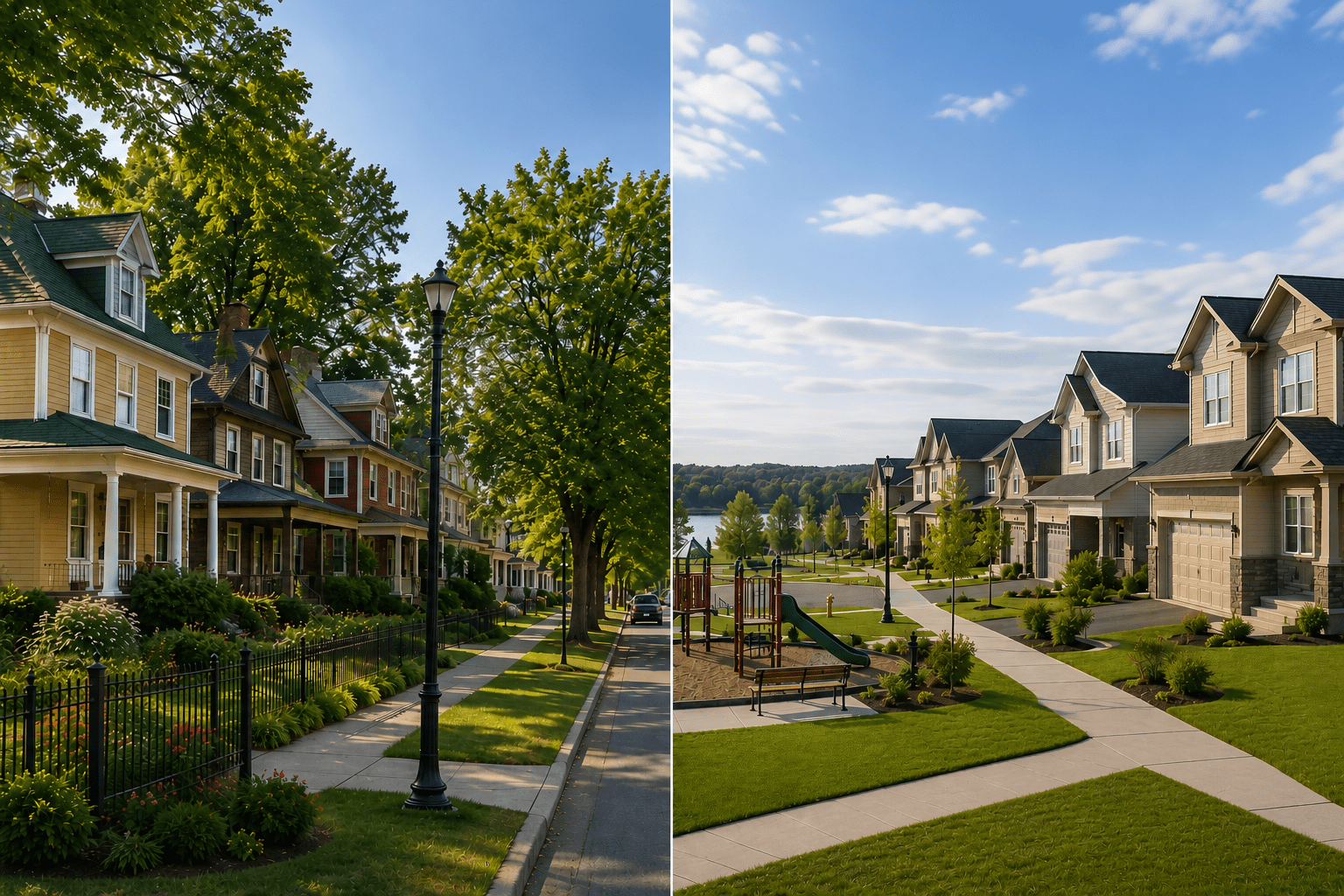
🏡 The New Neighbourhood Debate: Character vs. Convenience in a Growing City
There’s a conversation happening in cities everywhere — at coffee shops, community meetings, and around family dinner tables.
Would you rather live in an older neighbourhood full of charm and personality… or in a brand-new development designed for modern convenience?
As cities continue to grow, this debate is becoming more common — and more personal. Some people dream of tree-lined streets and century-old homes with stories built into the walls. Others want energy-efficient layouts, attached garages, and everything they need within five minutes.
The truth? Both sides make compelling points. 👇
🌳 The Appeal of Older Neighbourhoods: History, Character & Community
Older neighbourhoods often feel like they’ve had time to become themselves.
The mature trees stretch over sidewalks. The homes have architectural details you rarely see anymore. The streets aren’t perfectly symmetrical — and somehow that adds to the charm.
For many homeowners, older communities offer something that’s hard to manufacture: personality.
Why people love established areas:
✔️ Larger lots and mature landscaping
✔️ Unique home designs and architecture
✔️ Walkable streets with local businesses
✔️ Strong sense of community history
✔️ Central locations closer to downtown cores
There’s also an emotional element. Older neighbourhoods often feel lived-in and connected. Kids walk to school. Neighbours know each other. Local cafés remember your order. ☕🏘️
Of course, charm sometimes comes with trade-offs.
Older homes can mean:
🔧 More maintenance
💡 Less energy efficiency
🚗 Limited parking or garage space
📐 Smaller layouts or outdated floor plans
For some buyers, those quirks are worth it. For others, practicality wins.
🏗️ The Rise of New Developments: Built for Modern Living
New neighbourhoods are booming — and it’s easy to understand why.
Today’s developments are often designed around convenience and lifestyle. Open-concept kitchens, smart-home technology, attached garages, efficient heating systems, and nearby amenities all appeal to busy modern families.
Why buyers are drawn to newer communities:
✔️ Move-in-ready homes
✔️ Modern layouts and finishes
✔️ Lower maintenance costs
✔️ Energy-efficient construction
✔️ New schools, parks, and recreational spaces
There’s also predictability in a newer build. Buyers know what to expect. Everything is fresh, updated, and designed for how people live today.
And for growing cities, these developments help meet increasing housing demand while creating entirely new communities from the ground up. 🏘️✨
Still, critics argue that some newer areas can feel a little too similar — rows of homes with less individuality and fewer mature natural features.
That’s where the debate really begins.
⚖️ Character vs. Convenience — Or Is It Really That Simple?
What makes this discussion interesting is that there’s no universal right answer.
For one person, a creaky hardwood floor and historic façade feel priceless. For another, a brand-new furnace and an ensuite bathroom matter more.
Lifestyle plays a huge role.
Older neighbourhoods may suit:
🏡 Buyers who value charm and uniqueness
🚶 People who prefer walkability and central living
🌳 Those who appreciate established greenery and community feel
New developments may suit:
👨👩👧 Growing families wanting functionality
🛠️ Buyers looking for lower maintenance
📍 People prioritizing modern amenities and efficiency
Interestingly, many cities are now trying to blend both worlds — designing new communities with more green space, walkability, and mixed-use planning while revitalizing older areas with updated infrastructure and modern housing options.
The line between “old” and “new” is starting to blur.
🌆 What Growing Cities Are Teaching Us
As urban areas expand, people are becoming more intentional about how they want to live — not just where.
The neighbourhood debate is really about priorities:
- Do you value character or convenience?
- Space or proximity?
- Tradition or modern efficiency?
- Quiet streets or evolving communities?
And perhaps the biggest realization of all?
A great neighbourhood isn’t defined solely by its age. It’s defined by how well it supports the people living there. ❤️
Whether it’s a historic street lined with maples or a modern subdivision filled with young families, every neighbourhood eventually develops its own identity over time.
🏠 Final Thoughts
The “older vs. newer” debate will likely continue as cities grow and evolve — and that’s not a bad thing.
These conversations reflect something positive: people care deeply about the communities they call home.
At the end of the day, the best neighbourhood is the one that fits your lifestyle, your priorities, and your vision for the future.
Because while homes matter, it’s the feeling of belonging that truly turns a neighbourhood into a community. 🌟
📣 Call to Action
Thinking about making a move or exploring different neighbourhoods? Take time to look beyond the listing itself. Visit the parks, walk the streets, grab coffee nearby, and imagine your daily life there.
Sometimes the right neighbourhood chooses you just as much as you choose it. 🏡✨